Marvel's Wolverine Has the Claws and the Rage, but Not the Range
Verdict: 7.0/10. Marvel's Wolverine is Insomniac's most violent game and its most confined, a sharp berserker brawler hurt by a repetitive, linear scope.
Aymen Sakouhi·Writer · Games Hobbyist//5 min read
© Sony Interactive Entertainment. Media via IGDB.
The pitch
OverviewMarvel's Wolverine arrives with a strange kind of pressure on it. It is the first game Insomniac has made about a character who settles arguments with his hands, after a run of Spider-Man titles that turned swinging across a city into one of the most joyful traversal systems in the medium. Trading web-lines and rooftops for a man who walks into a room and cuts it apart was always going to produce a narrower game. The question was whether the studio could make narrow feel deliberate rather than small.
Developed by Insomniac Games and published by Sony Interactive Entertainment, Marvel's Wolverine launched exclusively on PlayStation 5 on September 15, 2026. It is a single-player action-adventure built inside the same continuity as Insomniac's Spider-Man games, though it tells a self-contained story of its own. You play Logan, you use the adamantium claws, and you cut through foes and encounters pulled from X-Men mythology in tight, close-quarters fighting rather than the open-city sandbox the studio is known for.
Its reception tells the honest story of the gap between expectation and result. The game settled around a 77 on aggregate, which is a respectable number in a vacuum and, at the same time, the lowest score a PlayStation Studios game has carried this generation. Several major outlets landed around a 6 out of 10, with IGN noting that the combat wears thin well before the end, GameSpot calling it extremely violent but highly repetitive, and Eurogamer framing it as an underwhelming, old-school romp whose best quality is its characterization of Logan. This is not a disaster. It is a very good studio turning in its weakest game in years, and understanding why is the whole review.
There is a real game here with real strengths, chiefly a combat system built on fury and a central relationship the writers clearly cared about. What holds it back is a scope that confines rather than focuses, and a loop that shows you most of its ideas early and then asks you to repeat them.
How it plays
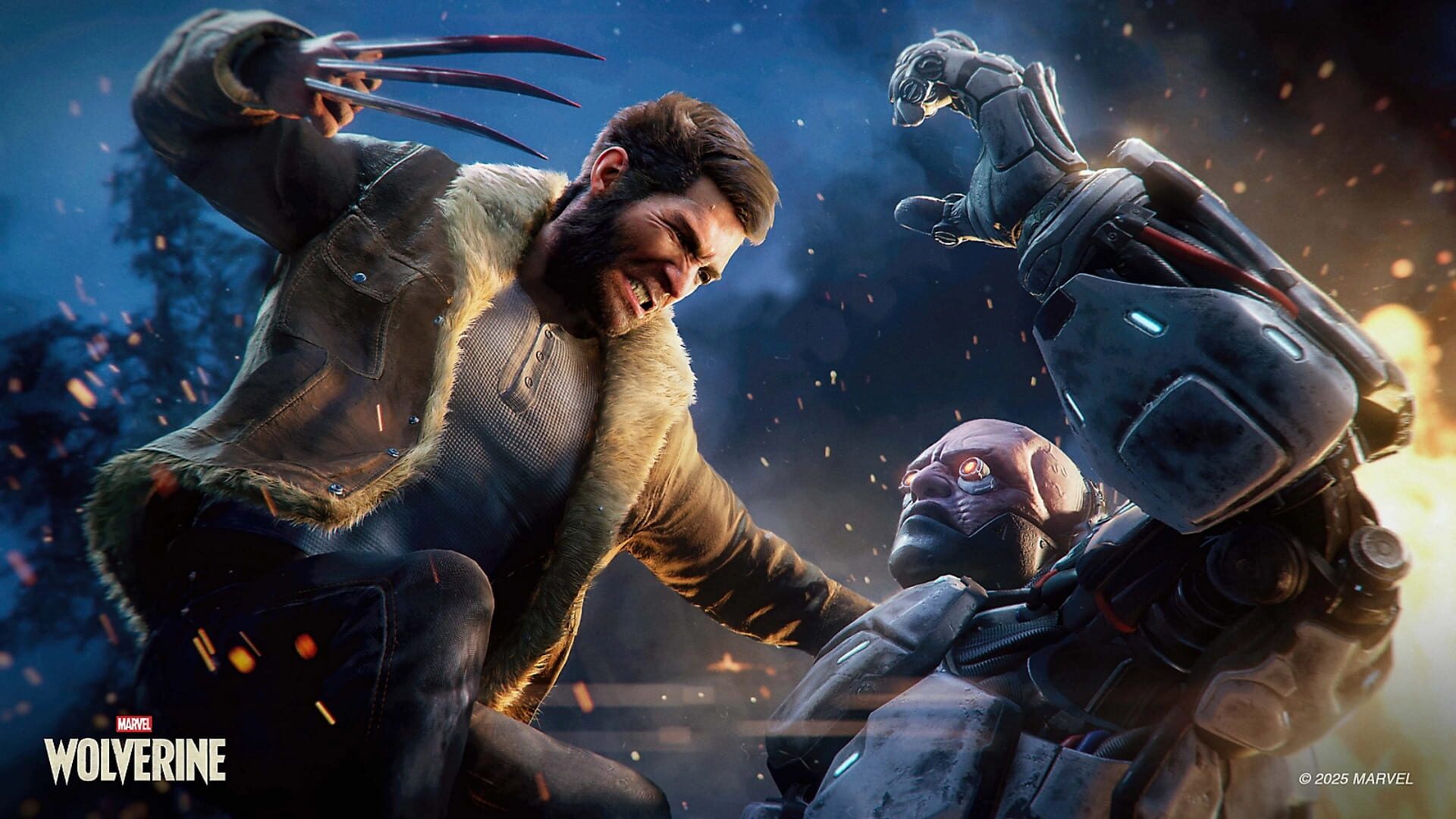
PlayCombat is the center of Wolverine, as it should be, and at its best it delivers the fantasy with real weight. The foundation is familiar to anyone who has played a modern action game: light attacks, heavy attacks, a timing-based parry, and dodges that open enemies up. What distinguishes it is the rage mechanic. As you fight, Logan builds toward a berserk state that lets you chain executions together, tearing through enemies in brutal, uninterrupted succession and leaving the kind of carnage the character has always implied but games have rarely been allowed to show. When it clicks, it feels authentically savage in a way few licensed brawlers manage.
The problem is that the system reaches its ceiling early. The core verbs do not expand enough over the length of the game, and once you have internalized the parry windows and the rhythm of building and spending rage, encounters start to blur. Enemy variety does not push back hard enough to force you to rethink the approach, so the loop that feels ferocious in the first hours settles into something closer to routine by the midgame. The violence is still satisfying on a visceral level; it is the strategic texture around it that thins out.
Structurally, this is a far tighter and more linear game than Spider-Man, and that choice is a double-edged blade. The focus suits the character: Logan is not a man who glides over a city, and keeping him grounded in confined, deliberately staged spaces is a defensible design instinct. But the linearity does not buy back enough in return. Spider-Man used its open world to vary the texture of play constantly, and without that variety Wolverine leans almost entirely on its combat to carry the hours, which is exactly the system that wears thin. The restricted environments can feel less like a focused design and more like a smaller one.
Pacing is where the two halves collide. The story sequences and set pieces give the game its strongest moments, and the quieter character beats are genuinely effective, but between them the connective tissue is often another arena of the same enemies and the same escalating-rage dance. Quality-of-life is solid and the game is readable and responsive moment to moment, so the friction is rarely mechanical. It is structural. You are rarely frustrated by how Wolverine plays; you are more often simply ahead of it, waiting for the next narrative beat to pull you forward.
There is content here, and the combat can be genuinely thrilling in bursts, but the overall shape is of a game that establishes its best ideas quickly and then runs on them longer than they can comfortably sustain. It is a tightly made action game that mistakes confinement for intensity a little too often.
Art & atmosphere
CraftWhere Wolverine rarely wavers is in the sheer brutality of its presentation. This is the most violent game Insomniac has made, and it commits to that fully. Executions are staged with a wince-inducing specificity, the claws catch and tear rather than simply connect, and the berserk state turns the screen into a frenzy that sells Logan's loss of control better than any cutscene could. The animation work on the combat is the game's craft highlight, giving each kill a physical, unglamorous weight that matches the character's reputation.
The art direction is confident and grounded, favoring a grittier, more grounded palette than the bright, swinging color of the Spider-Man games. It suits a story about a blunt instrument of a man, though the more confined spaces mean the game rarely gets to deliver the wide, breathtaking vistas that are a Sony first-party calling card. This is a game of rooms and corridors and close, dangerous spaces, and it is lit and textured to make those spaces feel oppressive rather than grand.
The real surprise is how much the writing and performance elevate the character work. The relationship between Logan and Jean Grey is the element critics singled out most consistently as a bright spot, and the game is at its most alive when it slows down to sit with that dynamic. The voice work carries the weariness and the barely-contained anger that define Logan, and the quieter scenes have a texture the combat loop never quite matches. It is telling that a game about tearing enemies apart is at its best when two people are simply talking.
A brutal, well-acted action game with a thrilling berserk combat core, held back from more by a repetitive loop and a confining linear scope that make it Insomniac's weakest game in years.
Pros & cons
The ledgerIn its favour
- A genuinely savage berserk-and-execution combat system that nails the Wolverine fantasy
- The most committed, physically brutal violence Insomniac has ever staged
- Strong character writing, especially the Logan and Jean Grey relationship
- Grounded, oppressive art direction that suits the character
- Responsive, readable moment-to-moment combat with solid quality-of-life
- Standalone story that does not require having played the Spider-Man games
Against it
- The combat system reaches its ceiling early and grows repetitive
- The tight, linear scope confines more than it focuses
- Thin enemy variety stops encounters from evolving across the runtime
- Without an open world, the combat has to carry too much alone
- A clear step below Insomniac's Spider-Man games in ambition and variety
- Connective sections too often repeat the same arenas and beats
Screens
Official media© Sony Interactive Entertainment. Media via IGDB.
Verdict
The callMarvel's Wolverine is a good game made by a studio we have learned to expect great ones from, and the distance between those two things is the honest story of it. The combat can be viscerally thrilling, the rage mechanic delivers the fantasy of an unleashed Logan better than any previous attempt, and the character writing around Jean Grey gives the game an emotional core that genuinely lands. On its best nights, it is exactly the brutal, focused action game the premise promised.
The trouble is that it shows you most of its hand early. The combat ceiling arrives before the halfway point, the linear design confines rather than concentrates, and the lack of variety that an open world used to provide leaves the back half leaning on a loop that has already started to tire. It is less that Wolverine does anything badly and more that it does a narrow set of things, repeatedly, for a little too long.
At 7.0, this is a solid, worthwhile PlayStation 5 exclusive that will satisfy anyone who wants to feel like Wolverine for a dozen hours, and its lowest-of-the-generation first-party score says more about the absurd standard Insomniac set than about any real failure. Go in wanting a sharp, brutal, character-driven brawler and you will get one. Go in expecting the next leap forward for the studio, and you will feel the claws catch on the same wall the critics did.
Sources
Original review by Aymen Sakouhi from the licensed facts above. Score: 7.0/10.