Lethal Company Turns a Corporate Quota Into the Best Panic in Co-op Gaming
Lethal Company review: Zeekerss's co-op scavenger horror runs on proximity chat, ticking quotas, and monsters that punish curiosity.
Aymen Sakouhi·Writer · Games Hobbyist//5 min read
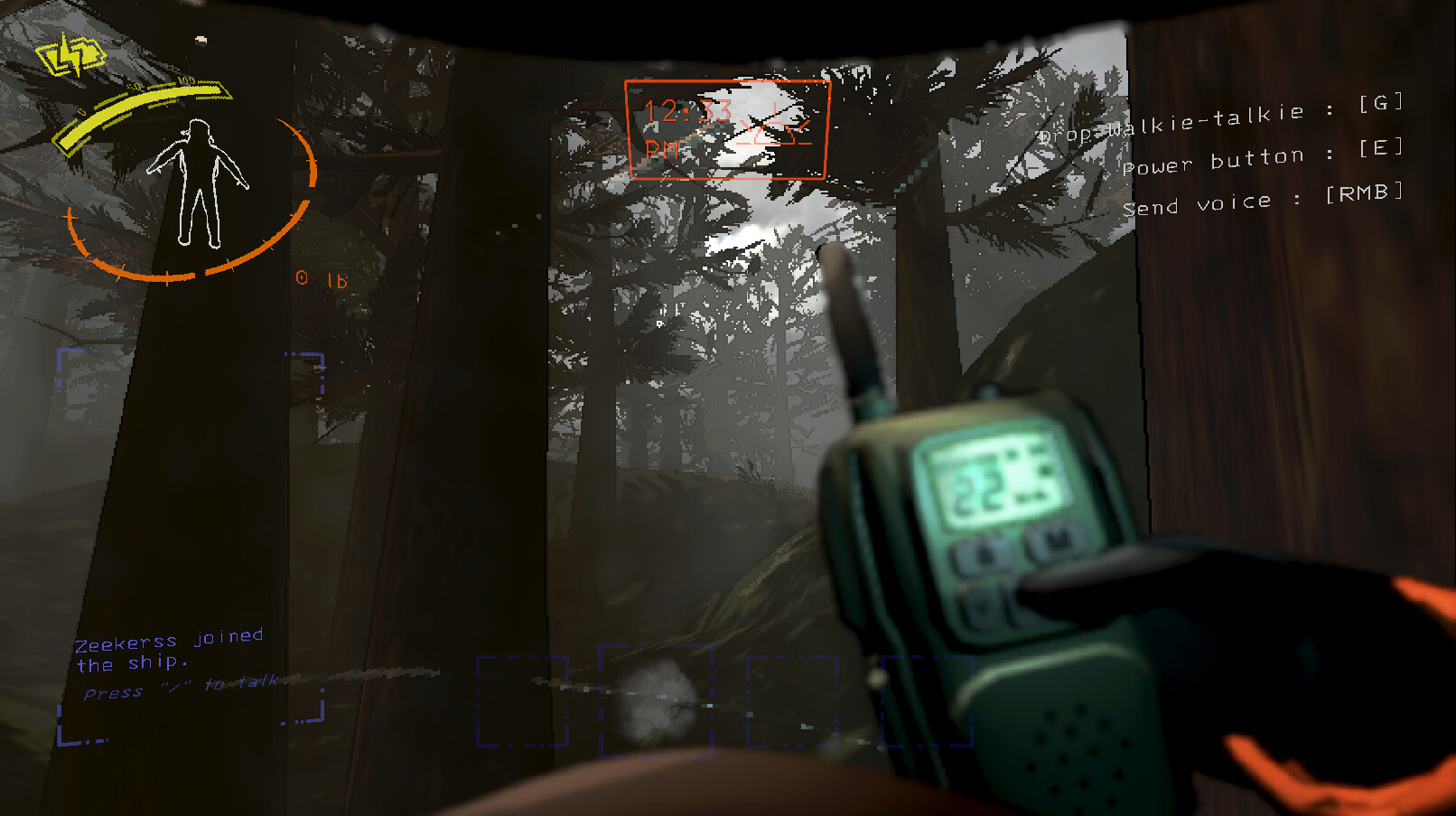
© Zeekerss. Official media via Steam.
The pitch
OverviewHorror games have spent decades trying to manufacture the feeling Lethal Company gets for free: the moment a familiar voice goes thin with panic and you genuinely cannot tell whether the threat is real or an idiot friend having a laugh. Zeekerss builds an entire haunted house on that uncertainty, then charges you rent for the privilege. You play a disposable contractor for an unnamed Company, dropped onto dead industrial moons with a profit target to hit and a ship that will not wait for stragglers.
Strip the fear away and what remains is a scavenging game with a spreadsheet at its heart. You comb derelict facilities for scrap, weigh each object's value against how much it slows you down, and haul it to the airlock before the clock runs out and the crew is left in the dark. Sell enough to satisfy the Company's rising quota and you live to clock in again; fall short and you are jettisoned into space, politely. The loop is small enough to explain in a breath and deep enough to eat entire evenings.
What the game reaches for lands somewhere between Phasmophobia's investigative dread and the slapstick of four coworkers who cannot be trusted with a flashlight. It belongs to the recent wave of cheap, mic-forward co-op horror, but it separates itself by keeping the monsters legible and letting the humans be the wild variable. The scares are engineered with real care; the comedy is entirely your own fault.
That it shipped as a one-person Early Access project, then detonated across streaming and sold millions on word of mouth, is exactly the kind of story the industry keeps insisting cannot happen anymore. It is rough at the edges and thin in a few places, as every Early Access darling is, but the central idea is so sturdy that the roughness reads as texture rather than neglect.
How it plays
PlayEvery expedition runs on the same rhythm and rarely feels mechanical, because the danger is procedurally arranged and the people beside you are not. From the ship's terminal you pick a moon, each one priced by risk: the free starter worlds are calm and stingy, while the pricey outer moons bury enormous payouts under foul weather, longer nights, and a nastier roster of things that want you dead. Time and conditions matter as much as the map, since daylight drains toward a deadlier night and a flooded or eclipsed moon can turn a routine payday into a sprint for the exit. You step into the fog, find the facility entrance, and start filling four inventory slots with whatever the scanner flags as worth money.
Loot, crucially, is not free to carry. A car battery or a heavy sculpture eats both hands and drops a jog to a labored trudge, which is invariably the instant something decides to hunt you. Overload the ship and the Company docks your pay; leave good scrap behind and you miss quota. Each run becomes a running negotiation between greed and self-preservation, conducted while the onboard clock marches toward the moment the autopilot leaves and strands anyone still inside.
The monsters do the heavy lifting, and nearly every one runs on a rule you can learn and abuse, which quietly makes the bestiary the real progression system. The Bracken drags you off if you ignore it but backs away the instant you meet its stare; the Coilhead only advances when no one is looking at it, so a single doorway becomes a lethal game of statues; the Jester cranks its music box for an agonizing stretch before it stops being funny and starts sprinting. Death here is usually tuition rather than a swindle, and a wiped crew tends to know precisely which rule it broke.
Back at the Company's grim little dispatch window you sell the haul, watch the quota ratchet upward, and spend the profit on gear from a deadpan catalog: brighter flashlights, walkie-talkies, shovels for the bold, stun grenades, a jetpack that kills roughly as often as it saves. There is no permanent upgrade tree and no leveling of any kind; your only progression is knowledge and equipment, and one bad night can wipe out your savings and your best tools in a single panicked decision. That fragility is the entire point, and it keeps the stakes honest in a way most loot loops never bother to.
Proximity voice is the engine that makes all of it sing. Radios hiss and cut out as you descend, whoever volunteered to babysit the ship reads monster blips off a laggy radar, and coordination frays exactly when you can least afford it. Solo, this is a taut and genuinely lonely scavenge with nobody around to hear you die. With a full crew it becomes improv theater about four temps sprinting past one another toward the exit, and the game is delighted to let a well-timed betrayal be the funniest thing that happens all week.
The friction is real and worth naming plainly. The game explains almost nothing, so newcomers burn their first shifts fumbling controls and dying to rules they had no way to know. Once the bestiary holds no more surprises, the two interior tilesets start visibly recycling their corridors, and the novelty leans hard on fresh players and a sprawling mod scene to keep topping itself up. Later updates have folded in new moons, tools, and enemies, but this remains a compact game that trusts your group to supply most of its replay value.
Art & atmosphere
CraftLethal Company treats its own cheapness as a special effect. Everything is assembled from deliberately crude, low-polygon shapes and smeared under a grainy dither that evokes a scratched PS1 disc, and the murk does genuine work: ten feet of fog hides whatever the flashlight cannot reach and lets your imagination conjure a far worse monster than any budget could afford. The moons are wet concrete, rusted catwalks, and blue-grey industrial rot, while the ship glows a warm, stupid yellow, ringed with jaunty terminal chirps that make stepping back outside feel like a genuinely poor life choice.
Sound, though, is the true architecture of the horror. The game hoards silence and then punctures it: footsteps that may or may not be your own, the metallic screech of a Coilhead lurching a step closer, the distant thud of something large rearranging the floor above you, radio chatter dissolving into static as the facility swallows your signal. Every safe quiet is a held breath the game is waiting to spend.
Then proximity chat layers real human voices over that soundscape until the mood is half authored and half whatever your friends are shrieking. A whispered warning, a cackle, a scream cut short by a snapped neck: the sound design builds the stage, and the crew supplies a performance no script could write. It is the rare game where the audio mix and your own social circle are quietly collaborating on the same jump scare.
A sharp, endlessly quotable co-op horror let down only by Early Access thinness and its total reliance on assembling the right group.
Pros & cons
The ledgerIn its favour
- Proximity chat that turns every crew into a doomed workplace sitcom
- Monsters built around learnable rules that reward knowledge over twitch reflexes
- A tight risk-reward quota loop where greed and survival are always at war
- Absurd value: tiny download, low system demands, near-endless replay with mods
- Sound design that weaponizes silence and makes the ship the only safe place
- A generous, easily modded foundation with a thriving community behind it
Against it
- Early Access content runs thin once you have the bestiary memorized
- Barely any solo appeal; it needs a talkative group to come alive
- Only two interior tilesets, so facility layouts begin repeating quickly
- Almost no onboarding leaves new contractors dying to unexplained rules
- Knowledge-only progression can feel flat in the stretches between updates
Screens
Official media© Zeekerss. Official media via Steam.
The player verdict
Real reviews · Steam- Recommended
“PROS - Hilarious and memorable co-op experiences. - Diverse maps with unique environments. - Strong atmosphere that balances horror and comedy. - Emergent gameplay creates endless funny stories. CONS - Gameplay becomes repetitive over…”
27 found helpfulvia Steam - Recommended
“A bird molested me, i fell down off an old bridge, then when i finally got to my ship as the only survivor i got eaten alive by a mutated lion. 10/10 would play agin”
13 found helpfulvia Steam - Not recommended
“The game itself is good, however the sheer amount of adult-only lobby makes it basically impossible for any younger people to play without being alone.”
7 found helpfulvia Steam - Recommended
“I found Lethal Compnay to be a fun and intense game, mainly because it requires teamwork. Each match brings different challenges, which makes the experience more interesting.”
6 found helpfulvia Steam
Verdict
The callLethal Company is that unusual viral sensation that actually earned the stampede. It costs less than a round of drinks, runs on hardware you already own, and reliably manufactures the sort of story you are still retelling weeks later, most of them beginning with the words so then he left me. The value proposition borders on the absurd.
It is also, unmistakably, an Early Access game, and pretending otherwise would be a disservice. The loop thins once the monsters stop surprising you, the interiors repeat, and without a lively group willing to talk, panic, and betray, the whole thing quietly deflates into a lonely spreadsheet. This is a game that hands you the kindling and assumes you brought your own friends to set it alight.
Bring them, and almost nothing near this price wrings so much fear and laughter from so little. Treat it as a night out with a healthy tolerance for treachery rather than a solo campaign, and it hands you stories you could not buy for ten times the money.
Sources
Original review by Aymen Sakouhi from the licensed facts above. Score: 8.5/10.