Baldur's Gate 3: The CRPG That Quietly Raised the Ceiling for Everyone Else
Our Baldur's Gate 3 review: Larian's D&D epic sets a new standard for reactivity and turn-based tactics, Act 3 rough edges and all.
Aymen Sakouhi·Writer · Games Hobbyist//6 min read
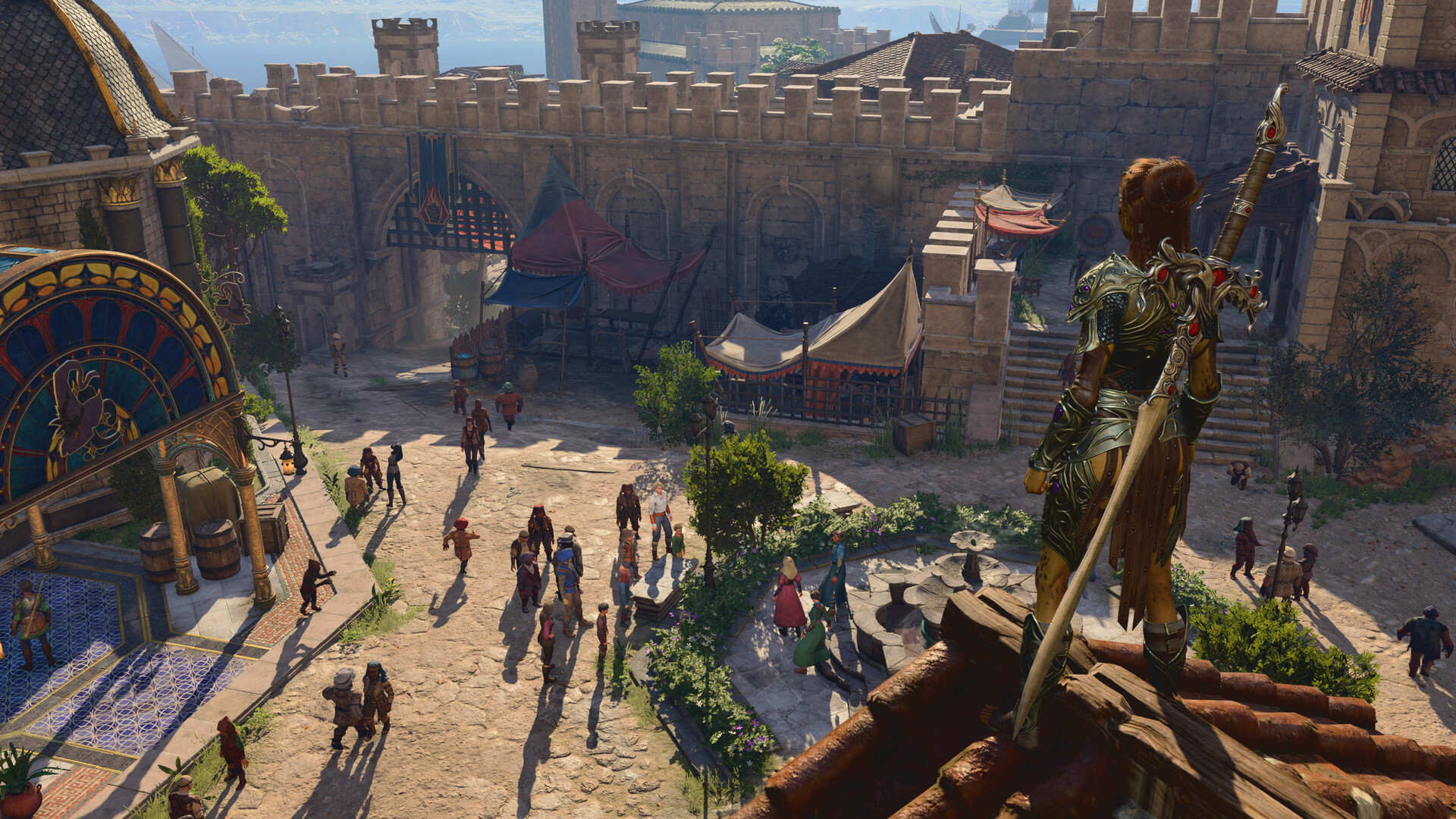
© Larian Studios. Official media via Steam.
The pitch
OverviewMost role-playing games promise that your choices matter, then quietly pray you never stress-test the claim. Baldur's Gate 3 hands you a rope, gestures at the nearest cliff, and grins while you improvise. Talk a knife-wielding zealot down, shove him off a ledge mid-sentence, polymorph him into a sheep, or just walk away and let the whole scene curdle without you, and the game has a prepared, voiced, consequence-bearing answer for every one of those, plus a dozen more you have not thought of yet.
This is Larian Studios adapting Dungeons & Dragons fifth edition into a sprawling, party-based campaign about the worst week of your character's life. An illithid parasite is lodged behind your eye, ceremorphosis is the ticking clock, and the strange, prickly company you assemble while hunting a cure becomes the actual heart of the thing. It is the fullest realization yet of the studio's Divinity template, scaled up with a licensed rulebook and a budget that announces itself in every reactive line.
The pitch is a tabletop session run by a dungeon master with infinite patience and no off day, one who anticipated your dumbest plan and prepared for it anyway. That is a preposterous thing to promise in a fixed, pre-authored video game, where every branch costs real money and most studios ration reactivity like wartime sugar. The genuinely astonishing part is how close Larian comes to actually delivering it.
Isometric CRPGs spent two decades as a beloved niche, kept alive by Kickstarter and the faithful. Baldur's Gate 3 dragged the whole subgenre into the mainstream, sold it to people who had never rolled a twenty-sided die, and quietly reset expectations for what a big-budget RPG is allowed to remember about you. Its peers are now measured against a bar it simply picked up and moved.
How it plays
PlayCombat is turn-based and unusually faithful to fifth edition's action economy: one action, one bonus action, your movement, and a reaction held in reserve, with the dice math laid bare so you can watch a natural one ruin your entire afternoon. Advantage and disadvantage do real work, positioning matters constantly, and the rules are legible enough that a tabletop veteran feels instantly at home while a newcomer can pick up the grammar over a handful of fights. On top of that faithful skeleton, Larian piles its signature environmental chaos. You can shove enemies off cliffs and bridges, grease a floor and set it alight, drop a chandelier, lob a bottle of alchemist's fire, or claim the high ground for its accuracy bonus. Encounters become physics puzzles as much as arithmetic, and the game almost always rewards the player willing to read the room rather than the health bars, which is either liberating or slightly ridiculous depending on how solemn you like your fantasy.
Outside of fights the campaign is a dense lattice of dialogue, skill checks, and consequence. Nearly every conversation can be rerouted by your class, race, background, a past decision, an overheard secret, or one lucky persuasion roll, and the branches genuinely fork rather than politely funnel back to the same node. Companions clock your conduct and remember it, approval shifting in ways that ripple across dozens of hours and occasionally end a relationship, or a life, you had assumed was perfectly safe.
Those companions are the reason the whole edifice holds. Astarion, Shadowheart, Karlach, Lae'zel and the rest are written and performed with a specificity most games simply cannot afford: full performance-capture faces doing real acting, voice work that almost never dips below excellent across an absurd volume of recorded lines. Romances land as character work rather than vending-machine rewards, and the party banter alone is reason enough to keep dragging everyone along behind you.
Character building is generous, with respecs cheap enough to actively encourage experimentation, multiclassing available for the incurably fiddly, and difficulty options that span from a forgiving Explorer mode to the single-save, one-shot brutality of Honour mode and its custom boss mechanics. It also supports full four-player online and split-screen co-op, where the drop-in freedom of everyone talking to different NPCs at once is both a small marvel and a reliable recipe for cheerful narrative anarchy.
The campaign runs across three acts and comfortably north of seventy-five hours, and it is front-loaded with its very best work: Act 1's Druid Grove and goblin camp is a masterclass in a compact map that branches in every direction at once, rewarding the same obstacle with a dozen equally valid solutions. Long rests double as the pacing metronome, the camp scenes doling out companion confessions, fevered prophetic dreams, and the occasional midnight ambush between the fighting, so the story keeps breathing even through the lulls. The ending, when it finally arrives, fans out into a genuinely wide spread of outcomes with a proper reflective epilogue that reads your choices back to you one last time. It is a great deal of game, and it very nearly all earns its keep.
The seams show, and they show late. Act 3 is the most ambitious stretch and the most strained, its dense city choking framerates even on strong hardware, a couple of companion arcs resolving more abruptly than the setup earned, and quest threads that clearly wanted one more editing pass. The same density that thrills veterans can bury a first-timer under systems the tutorial gestures vaguely toward and never really explains, and the inventory, shared across a full party of scavengers, quietly becomes its own low-grade chore by the back half.
Art & atmosphere
CraftLarian dresses Faerun in warm, painterly light and then keeps sliding body horror into the frame: a tadpole squirming behind an eye, the wet organic architecture of a nautiloid, ceremorphosis rendered in loving and genuinely stomach-turning detail. The tonal range is enormous and mostly under control, from gilded upper-city interiors to the bioluminescent hush of the Underdark, a burning creche, a circus of the damned, all rendered with a density of hand-placed clutter that makes each space feel inhabited rather than merely dressed.
Borislav Slavov's score is the connective tissue, sliding from solo-cello melancholy to full choir as the scene demands, and the game is confident enough to hand its main theme to a lute-strumming bard in a tavern and then let a companion sing it back to you later, unaccompanied, as a quiet gut-punch. The reactive voice barks give even minor encounters texture, and the character faces, driven by strong capture, do more emotional lifting than most prestige television manages with a bigger crew and a smaller cast.
For all the gore sliding through the frame, the abiding impression the game leaves is warmth. The lighting flatters faces, the campfire glows invitingly, and even the ugliest dungeon is lit with enough care that you want to linger a moment longer. It is a grim, often horrifying story told through a surprisingly inviting frame, and the contrast is entirely deliberate.
A landmark CRPG whose reactivity and tactical depth are essentially peerless, docked only slightly for Act 3's performance dips and rushed edges.
Pros & cons
The ledgerIn its favour
- Staggering reactivity, it remembers choices most RPGs would silently throw away
- Turn-based combat rewards positioning, verticality, and improvised environmental chaos
- Companion writing and performance-capture acting carry real dramatic weight
- Difficulty options span forgiving Explorer to the punishing single-save Honour mode
- Full four-player online and split-screen co-op, drop-in and gleefully chaotic
- Cheap respecs and multiclassing make experimenting with builds genuinely inviting
Against it
- Act 3 sags under performance dips and unfinished-feeling quest threads
- The sheer volume of interlocking systems overwhelms first-time D&D players
- A few late companion arcs resolve more abruptly than they earn
- Party-wide inventory management becomes a persistent low-grade chore
Screens
Official media© Larian Studios. Official media via Steam.
The player verdict
Real reviews · Steam- Recommended
“---{ Graphics }--- ☐ You forget what reality is ☐ Beautiful ☑ Good ☐ Decent ☐ Bad ☐ Don‘t look too long at it ☐ MS-DOS ---{ Gameplay }--- ☑ Very good ☐ Good ☐ It's just gameplay ☐ Mehh ☐ Watch paint dry instead ☐ Just don't ---{ Audio }---…”
246 found helpfulvia Steam - Recommended
“Great game. I can definitely see why it's getting so much praise. I'm only at the beginning of Act 2, and I can already tell this game has a huge amount of replayability. The combat can be pretty frustrating until you reach level 5, even…”
49 found helpfulvia Steam - Not recommended
“It's been 2 years and nobody cares about my opinion, but this is the most overrated game in history. It's fine. It's not a bad game, but I'd recommend Divinity Original Sin 2 instead to anyone who want a good gaming experience. The only…”
37 found helpfulvia Steam - Recommended
“I'm 3 years late to playing this game, and after finally diving in... I get it. I completely understand why this game won so many awards and why people still talk about it. I went in expecting a good RPG, but I wasn't expecting to get so…”
34 found helpfulvia Steam
Verdict
The callBaldur's Gate 3 is the kind of release that reframes what its entire genre is allowed to attempt. Its reactivity is not a marketing line but a lived, constant quality you keep bumping into, the game remembering a body you hid or a bargain you welched on forty hours earlier, and its combat is deep enough to reward hundreds of hours without ever curdling into homework. Even its flaws are the flaws of a team reaching too far rather than one playing it safe.
A rocky, stuttering third act and a genuinely steep on-ramp keep it a hair short of flawless, and it would be dishonest to pretend the learning curve does not lose some people in the opening hours. But this is still the most complete and most humane role-playing game in years, and the closest a fixed piece of software has yet come to feeling like a living campaign that is paying attention to you.
If you have ever wanted to know what a great tabletop night feels like without wrangling five friends and a free weekend, start here. If you are a CRPG lifer, this is your subgenre's biggest and most confident moment by a wide margin. And if turn-based combat has always looked like homework to you, this is the game most likely to quietly change your mind.
Sources
Original review by Aymen Sakouhi from the licensed facts above. Score: 9.5/10.