Cyberpunk 2077: Night City Finally Lives Up to Its Own Skyline
Our Cyberpunk 2077 review after the 2.0 rebuild and Phantom Liberty: a sharper RPG in a stunning city, still carrying a few old scars.
Aymen Sakouhi·Writer · Games Hobbyist//6 min read
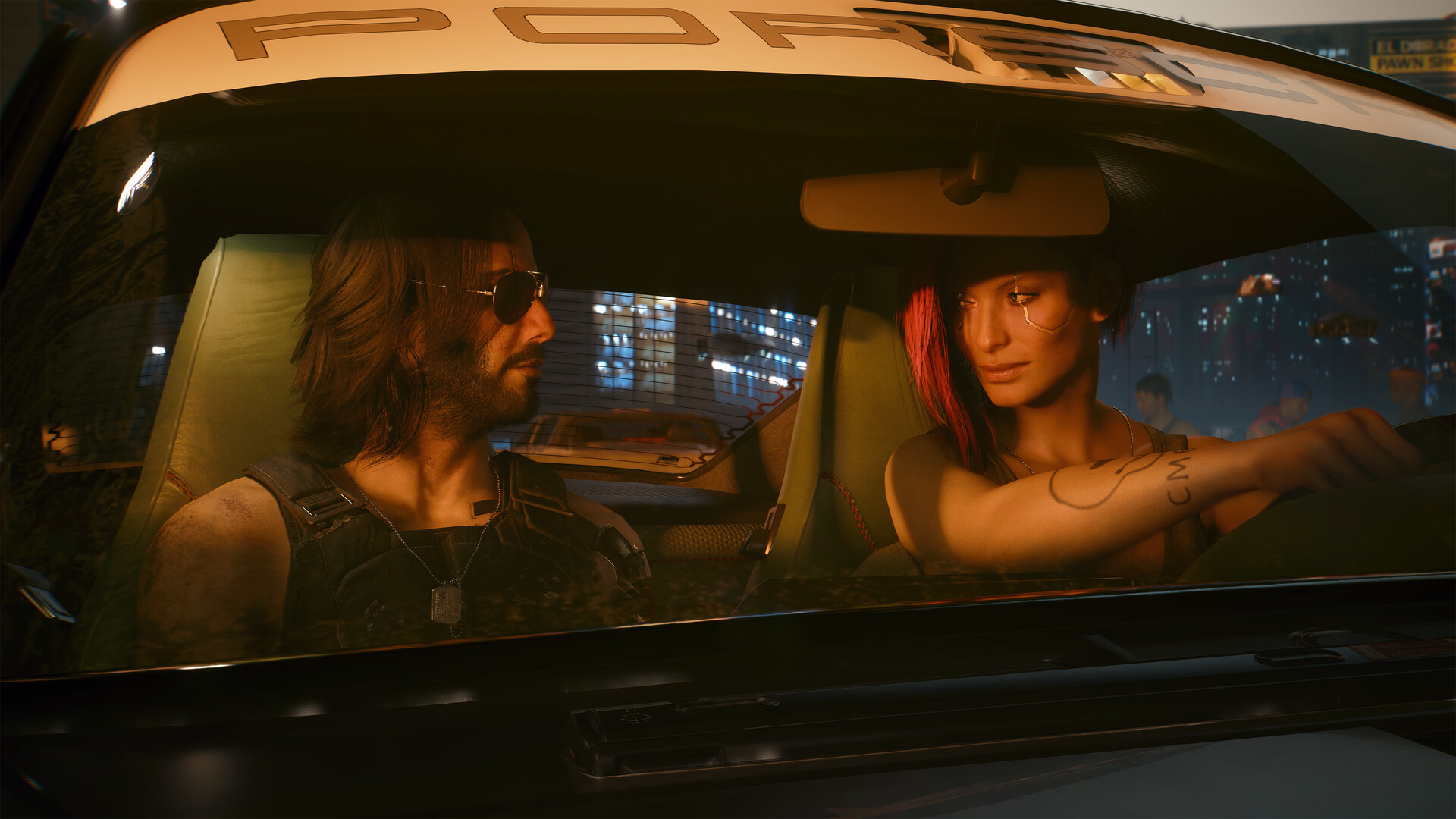
© CD PROJEKT RED. Official media via Steam.
The pitch
OverviewFew games have staged a comeback this stubborn, or this thoroughly deserved. Cyberpunk 2077 arrived in 2020 as an industry punchline: crash-prone, feature-light against years of grand promises, and so broken on last-generation consoles that Sony pulled it from the store and offered refunds. It is genuinely hard to overstate how bad that launch was, or how completely the game has since been torn down and rebuilt in public.
Strip away the saga and the thing itself is a first-person action-RPG about V, a mercenary clawing up the food chain of Night City, a neon megalopolis where everyone is chromed, broke, and one bad gig from the morgue. A heist goes catastrophically wrong, a dead rockstar's digital ghost takes up residence in your skull, and the clock on your own borrowed life starts ticking down. The fantasy was always the fiction of a lived-in future you could disappear into.
What the game was reaching for, and initially fumbled badly, was the marriage of that immersive-sim ambition to a Witcher-scale narrative RPG. The 2.0 overhaul and the Phantom Liberty expansion are where CD PROJEKT RED finally supplied the mechanical spine to carry the fiction, so reviewing it now means reviewing the game the studio clearly always meant to ship, rather than the wreckage that actually shipped first.
It sits in an odd and instructive spot: living proof that a studio can spend years and a fortune patching its way from outright disaster to something genuinely very good, without ever fully sanding off the scar tissue. This is a redemption arc that actually lands, which is not at all the same as pretending the fall never happened.
How it plays
PlayThe 2.0 rework tore out the original's flimsy progression and rebuilt it from the studs. Skill trees now feed distinct, legible fantasies: a netrunner daisy-chaining quickhacks through a room until the guards cook themselves from the inside, a Sandevistan build slowing time to a crawl and carving through a gang mid-blink, a shotgun-and-cyberware bruiser who strolls through gunfire because his skin is worth more than his rifle. For the first time in this game's life, a build feels like a decision rather than a formality. Cyberware is the centerpiece of that change, now governed by an armor-and-capacity budget that forces genuine trade-offs instead of letting you bolt on everything at once. The old skill-tree bloat is gone, individual perks hit harder, and the vendor and crafting economy has been tuned so that loot finally feels like it carries weight. Mechanically, it is a different and far better game than the one that came in the box.
Moment to moment the gunplay is punchy, the hacking is tactile, and the reworked police now actually escalate against you, calling in tougher units and eventually the MaxTac flyers, rather than teleporting into existence behind you as they once notoriously did. Driving has real heft, the arsenal is varied and characterful, and the systems finally cohere into the power fantasy the marketing was selling half a decade too early.
But the real draw is the writing around the edges. The gigs and side jobs, Judy's grief in the wetsuit, Panam's found-family arc out in the Badlands, the quiet one-off contracts fixers phone in, consistently outclass the main campaign for mood and character. And Phantom Liberty's Dogtown spy-thriller, with a genuinely branching finale and a career-best turn from its cast, is the studio operating at the absolute peak of its considerable powers.
The RPG scaffolding around all this is thinner than the studio's own Witcher work but has real teeth in places. Three lifepaths, Nomad, Streetkid, and Corpo, flavor the opening and salt later conversations with origin-specific dialogue, though their influence quietly fades once the main story converges. Skill checks gate whole approaches behind your build, letting a high-Body or high-Intelligence V bypass fights entirely, the branching endings genuinely diverge in tone and body count, and Phantom Liberty layers in a Relic skill tree and a spy-craft campaign whose central, irreversible choice is one of the sharpest the studio has ever written.
The 2.0 update also finally made the moment-to-moment world worth moving through. Car chases and drive-by combat now actually exist, vehicular missile launchers and door-mounted guns turn a getaway into a legitimate set piece, and the once-pointless act of buying a car suddenly has a reason behind it. It is a mountain of quality-of-life improvements piled onto a game that shipped without the basics, and the cumulative effect is a first-person RPG that at long last feels genuinely finished. There is a great deal to do, even if not all of it is worth doing. The critical path runs a brisk twenty-odd hours, but the gigs, NCPD scanner hustles, cyberpsycho hunts, and courier races can stretch a completionist run well past a hundred, and the best of that side content is precisely where the writing lives. The worst of it is the usual open-world confetti, clear a camp, grab the loot, repeat until the map is clean, and the game is at least honest enough that you can simply ignore the parts that bore you.
It is not spotless, and it would be revisionist to pretend otherwise. Even now, this deep into the patch cycle, the game glitches and occasionally crashes more than something this old and this fussed-over has any real excuse to. The crowd and traffic AI stays paper-thin the instant you stop to actually look at it, pedestrians folding into the same handful of panic animations. And the open-world activity list, that scatter of icons across the map, starts repeating itself once the city's first-night novelty burns off. Night City is a spectacular stage; it is still a slightly hollow simulation the moment you tap on the scenery.
Art & atmosphere
CraftNight City is the real protagonist, and it is a triumph of maximalist art direction, a vertical sprawl where corporate brutalism, screaming holo-ads, and chrome-and-neon excess pile up until the skyline reads as deliberate sensory overload. CDPR invented in-world design movements, Entropism, Kitsch, Neomilitarism, to organize the chaos, and the coherence genuinely shows: Japantown's paper-lantern glow, the corpo towers' cold geometry, the Badlands bleaching everything to dust the moment you leave the grid behind.
The soundtrack pulls its weight and then some, from Refused's snarling SAMURAI tracks standing in for Johnny Silverhand's band to the synthwave and breakbeat leaking out of every passing car radio, each station a fully committed mood of its own. The voice performances anchor the whole thing, Keanu Reeves' Johnny needling you from inside your own head, the cast giving V real presence, and rain-slick streets throw the neon back at you in smeared reflections. The ray-traced lighting, when it behaves, turns genuinely painterly.
What lingers is the mood more than any single system: loud, lonely, and lit like a permanent three in the morning. Night City impresses hardest not when you are shooting your way through it but when you stop the bike on an overpass, let a sad song finish, and just look at the enormous, indifferent thing.
A rebuilt, richly atmospheric RPG in a landmark city, still held back by lingering jank and a metropolis that dazzles more than it truly simulates.
Pros & cons
The ledgerIn its favour
- The 2.0 skill and cyberware overhaul finally makes builds feel deliberate
- Side jobs and gigs outclass the main story for character and atmosphere
- Night City remains one of the most convincing urban spaces in games
- Phantom Liberty's branching spy-thriller is CDPR at its sharpest
- A soundtrack and radio roster that nail the mood from every passing car
Against it
- Still crashes and glitches more than a game this old and patched should
- Crowd and traffic AI stays paper-thin the moment you inspect it
- Open-world activity icons grow repetitive once the novelty fades
- The scars of a catastrophic launch still color the whole package
Screens
Official media© CD PROJEKT RED. Official media via Steam.
The player verdict
Real reviews · Steam- Recommended
“Well, after 86 hours I finally 100%’d the game - all side quests, fixer gigs, DLC, main story, everything you can possibly do in one playthrough without save scumming. So, is Cyberpunk 2077 worth the money right now? Yeah, it is. What it…”
174 found helpfulvia Steam - Recommended
“In the last few days before Cyberpunk's day one release, I told a buddy of mine how excited I was and that I was going to buy it day one. He warned me up and down and I listened to him. And good thing I did. 5 years later, when I upgraded…”
114 found helpfulvia Steam - Recommended
“No words can describe how much I love this game. Peak story, unforgettable characters, and Night City is bursting with detail and life. Driving through Night City with the radio on is just so peak. Hope you're doing well on the moon So Mi…”
56 found helpfulvia Steam - Recommended
“I'm more of a medieval fantasy fan over sci-fi and I love the Witcher universe, but Cyberpunk did a great job of getting me invested in this world. Great gameplay, story and my favourite open world city, the dlc is just as good if not…”
36 found helpfulvia Steam
Verdict
The callJudged on what it is now rather than the disaster it launched as, Cyberpunk 2077 is a strong, distinctive RPG wrapped around one of the best-realized cities the medium has ever produced. The rebuilt systems finally give its stories a body to inhabit, and Phantom Liberty is reason enough to return even if you bounced off the thing hard, years ago.
The lingering technical rough patches and the thinness beneath the spectacle keep it out of the very top tier, and honesty demands acknowledging that the road here was ugly and largely self-inflicted. A game should not need three years of triage to become itself. But this one did, and against long odds it got there.
Come for the story-driven RPG and the best-dressed dystopia in games; stay for the side characters, who are quietly the main event. Just do not expect the streets underneath all that neon to survive close inspection, and you will have a very good time in a city that, at long last, actually works.
Sources
Original review by Aymen Sakouhi from the licensed facts above. Score: 8.3/10.