VHOLUME is the Mirror's Edge successor movement fans have been waiting for
Verdict: 8.2/10. A melancholic first-person parkour game with sublime movement and a bleak, bureaucratic soul. The Mirror's Edge heir we needed.
Aymen Sakouhi·Writer · Games Hobbyist//5 min read
© IronEqual. Official media via Steam.
The pitch
OverviewFor over a decade, a very specific kind of player has been waiting for a proper heir to Mirror's Edge: someone to pick up the idea of first-person parkour, of a city you read with your body rather than your gun, and actually run with it. VHOLUME is that game. It is a small, focused, melancholic parkour adventure from a tiny team, and it captures the exact feeling its inspiration was famous for, the pure, weightless joy of flowing through a space at speed, with a confidence that belies its budget.
Developed by Nathan Grange, Leonard Lemaitre, and Niels Tiercelin and published by IronEqual, it sets you in a dystopian brutalist megalopolis, the derelict capital of a place called Afro-Eurasia, run by a faceless, all-controlling Ministry. You play Robert, and your quest is almost aggressively mundane: your family's ration tickets have been revoked, and you have to get them back. That is the whole engine of the story, a bureaucratic errand turned into an odyssey, and it is a perfect fit for the mood the game is chasing.
The reception has been immediate and warm, landing at overwhelmingly positive on Steam, and it is easy to see why. This is a game with a clear, singular vision: gorgeous, oppressive architecture to traverse, movement that feels sensational the moment you understand it, and a quiet, sad little story about being ground down by a system that does not care. It is not a huge game, and it does not pretend to be. It is a precise one, and precision is exactly what this genre demands.
If you have spent years replaying Mirror's Edge and wishing someone would build on it, stop reading and go play this. For everyone else, the case is almost as easy: VHOLUME is one of the most satisfying pure-movement games in a long time, wrapped in an atmosphere with real soul.
How it plays
PlayEverything in VHOLUME serves the movement, and the movement is superb. You jump, run, climb, and slide through the city with a freedom that feels immediately good and gets better the more you learn. The core loop is the classic parkour flow state: reading the environment ahead, chaining together a route, and stringing momentum from one obstacle to the next without ever touching the brakes. When it clicks, and it clicks quickly, you feel less like you are playing a game and more like you are performing one.
What elevates it above a simple traversal toy is the depth underneath the flow. The environments are built to be broken. Mastery-driven players can exploit momentum, discover shortcuts, and pick apart the labyrinthine level design to find faster, cleaner lines, and the game openly rewards this by having you chase target times. That is the crucial hook: VHOLUME is as much a speedrunning playground as it is an adventure, and the layouts have the kind of deliberate, replayable geometry that keeps you coming back to shave off seconds.
The game supports both solo play and a light multiplayer layer, where you can run alongside friends and see other players' ghosts, watching how someone else solved a section you have been struggling with. It is a smart, low-pressure way to fold competition and inspiration into a fundamentally single-player experience, and it feeds directly back into the mastery loop. Steam Workshop support at launch extends that further, opening the door to community-made levels and a long tail of new routes to conquer.
Structurally, this is a focused game rather than a sprawling one. The main journey is not enormous, and the emphasis is firmly on the quality and replayability of its movement rather than on hours of content or systemic breadth. For the target player, that is a feature, not a flaw: a tight, replayable, mechanically rich experience beats a padded one every time. But anyone expecting a large, content-heavy adventure should calibrate accordingly.
Being the work of a small team, it is not entirely without rough edges, and first-person platforming is an unforgiving genre where the occasional finicky ledge or read can break a run. But the fundamentals here are so strong, and the movement so carefully tuned, that the friction rarely undermines the pleasure. This is a game that understands, deeply, what makes running feel good.
Art & atmosphere
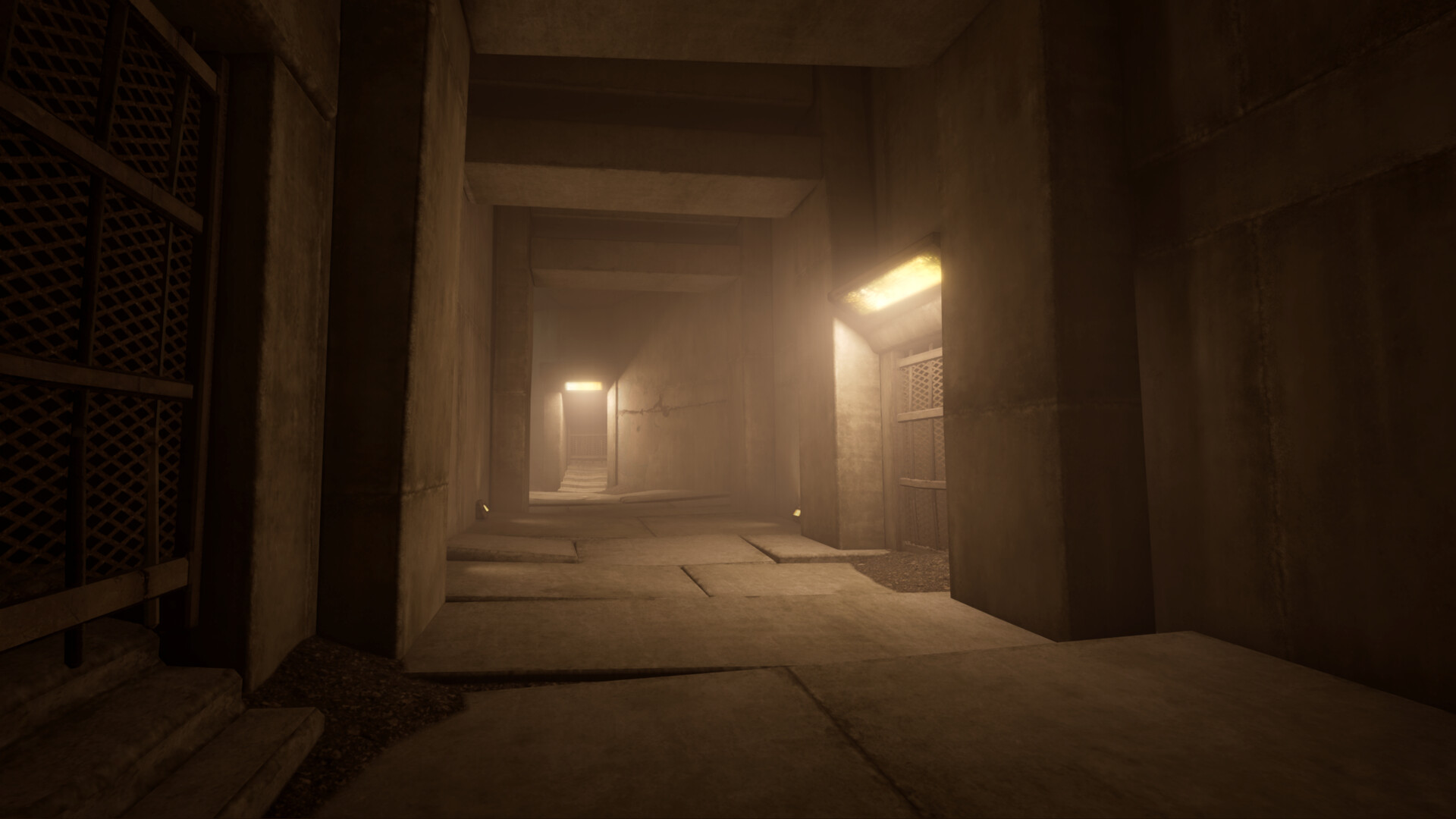
CraftVHOLUME's aesthetic is one of its biggest strengths and a huge part of why it lands emotionally. The city is a study in brutalism, all raw concrete, imposing geometry, and desolate scale, and it is beautiful in the specific, melancholy way that only decayed grandeur can be. Where Mirror's Edge was clean, white, and sun-bleached, VHOLUME is grayer, sadder, and heavier, and that shift in mood gives it an identity of its own rather than making it a mere imitation.
The art direction and the theme are inseparable. This is a world built to make you feel small, a monument to an indifferent bureaucracy, and every oppressive tower and empty plaza reinforces the story of one person trying to reclaim something trivial from a machine that has forgotten he exists. The environmental storytelling does a lot of quiet work, and the desolation never feels like empty space; it feels like a place that has given up.
Crucially, the visual clarity serves the gameplay as much as the mood. Good parkour games live or die on readability, on your ability to instantly understand what you can grab, climb, and vault, and VHOLUME's stark, high-contrast world makes routes legible even at speed. The presentation is atmospheric and stylish, but never at the expense of function. It is a genuinely impressive piece of art direction from a small team, and it turns a technical parkour game into something that lingers.
A focused first-person parkour game that nails the sublime Mirror's Edge movement feel, with deep, exploit-friendly level design, target times, ghosts, and Workshop support for a long tail, plus a striking melancholic brutalist world. Held back only by short length and minor small-team roughness. Overwhelmingly Positive on Steam. An 8.2 reflects a confident, essential entry for movement fans that over-delivers on its singular vision.
Pros & cons
The ledgerIn its favour
- Sublime first-person movement, the true Mirror's Edge successor
- Deep, replayable, exploit-friendly level design built for mastery and speedrunning
- Striking, melancholic brutalist art direction with real atmosphere
- Target times, ghosts, and Steam Workshop give it a long tail
- A focused, singular vision executed with confidence and polish
- A quietly affecting story of one person versus an indifferent system
Against it
- Short and focused; not a large, content-heavy adventure
- Occasional finicky ledges and reads, as first-person platforming tends to have
- Small-team roughness in places
- The mastery-and-times focus will not hook players who just want a casual stroll
Screens
Official media© IronEqual. Official media via Steam.
The player verdict
Real reviews · Steam- Recommended
“Easy to get into, incredibly satisfying to master. Some of the best movement in any game ive ever played, it scratches a very specific itch in my brain, congrats to the devs on making an incredible game. ̶s̶i̶d̶e̶ ̶n̶o̶t̶e̶:̶ ̶a̶…”
114 found helpfulvia Steam - Recommended
“An out of body experience. It's crazy how the devs make consistently good games all the time. Just one more run.”
89 found helpfulvia Steam - Recommended
“An absolute gem! After spending 5 hours just on the demo, I was already completely sold: - Incredible game feel, satisfying moves - Stunning atmosphere (both music and environment) - Replayable (and addictive!!) - Multiplayer (easy to…”
20 found helpfulvia Steam - Recommended
“Meditative, beautiful, well machined. Not so much Mirror's Edge as it is influenced by more recent FPS character controllers, a focus on slide hopping and wallrunning over technical button-combo climbing. An immersive, contemplative…”
16 found helpfulvia Steam
Verdict
The callVHOLUME is a small triumph. It sets out to do one very hard thing, capture the sublime feeling of Mirror's Edge-style first-person parkour, and it succeeds so completely that it instantly becomes the reference point for the genre's revival. The movement is a joy, the level design is deep enough to reward hundreds of runs, and the bleak brutalist world gives it a soul that far outstrips its modest scale. Overwhelmingly positive reviews are the right response to a game this assured.
Its limits are the honest limits of a focused indie. This is not a long or content-stuffed game, it carries a little small-team roughness, and its emphasis on mastery and target times means it is aimed squarely at players who want to get good rather than those who just want a gentle wander. If you need dozens of hours of structured content, this is not built for that.
But judged as what it is, a precise, replayable, gorgeous movement game with a melancholy heart, VHOLUME is an easy and enthusiastic recommendation. For anyone who has spent years missing Mirror's Edge, it is essential. For everyone else, it is one of the most purely satisfying things you can do with a keyboard and mouse right now. Go run.
Sources
Original review by Aymen Sakouhi from the licensed facts above. Score: 8.2/10.