Hades: The Roguelike That Turned Dying Into Storytelling
Our Hades review: Supergiant welds roguelike combat to story so death itself drives the plot. Sharp, generous, faintly repetitive.
Aymen Sakouhi·Writer · Games Hobbyist//5 min read
© Supergiant Games. Official media via Steam.
The pitch
OverviewIn most roguelikes, death is a reset button, an interruption you tolerate purely for the sake of the next attempt. Hades looks at that convention and does something quietly radical with it: when Zagreus, the perpetually exasperated prince of the Underworld, dies, he is flushed straight back to his father's house, where the staff, the gods, and his own tangled family are all waiting with something new to say. Failure is not a wall here. It is a plot device, and very often a punchline.
Supergiant Games, the small studio behind Bastion, Transistor, and Pyre, built an isometric action roguelike about a son trying to escape the land of the dead over his father's furious objections. You fight your way up through the Underworld, die, get dragged home, trade barbs with a cast of gorgeous immortals, and go again, a little stronger and a little further into everyone's business each and every time.
The masterstroke, and the thing every roguelike since has quietly been trying to copy, is welding the run-based structure to the writing so tightly that the two become genuinely inseparable. Most games in the genre treat their story as wallpaper. Hades makes the loop itself the narrative engine, so you are not grinding toward the credits so much as living inside a story that only advances because you keep failing to finish it.
It emerged from a long, unusually public early-access period as the game that finally made the roguelike palatable to people who had always found the genre punishing and cold, and it managed that without dumbing down the combat by a single inch. That balance, deep enough for the hardcore, warm enough for everyone else, is precisely why it broke out the way it did.
How it plays
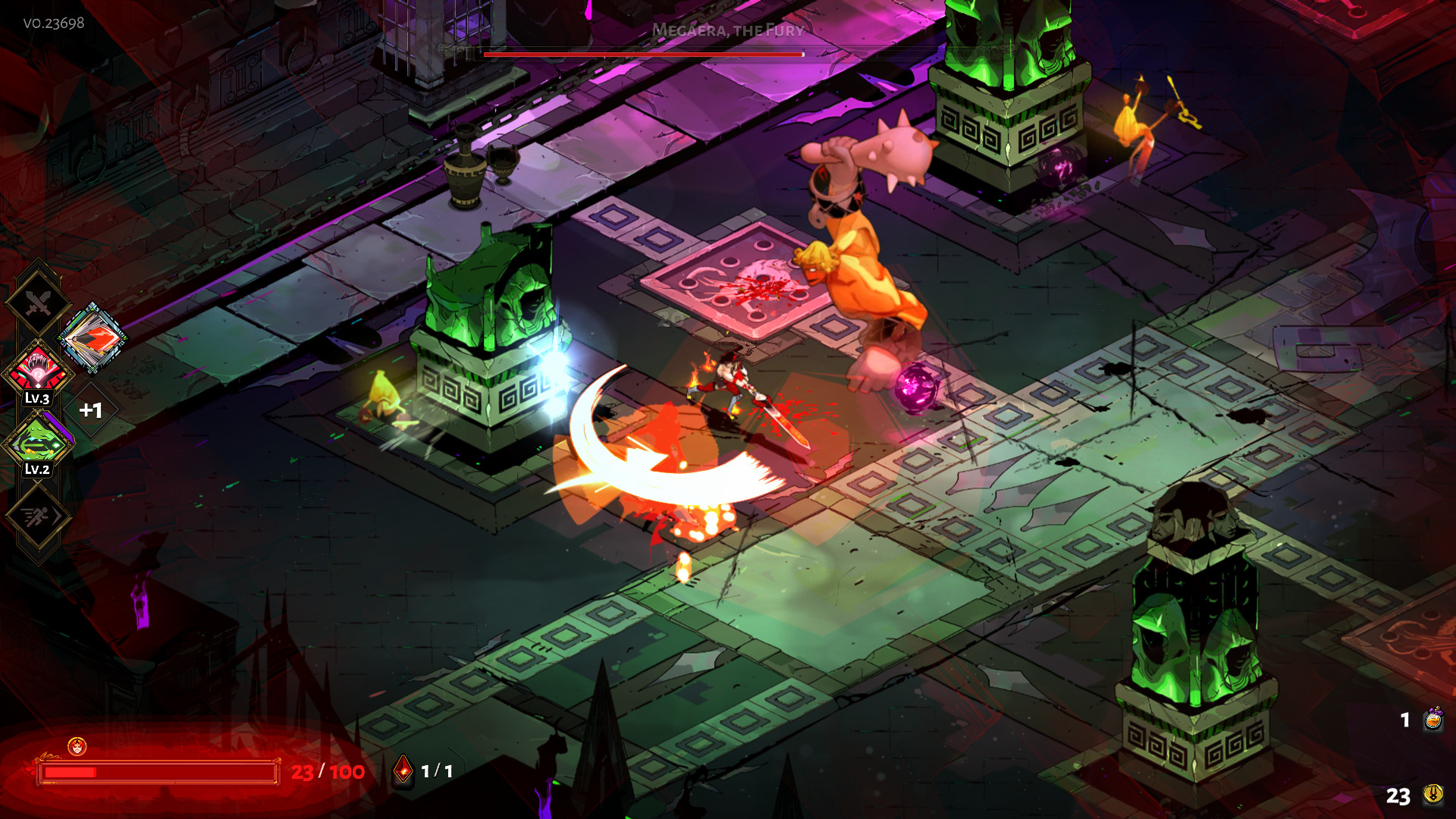
PlayEach escape attempt sends you up through four biomes of escalating enemy waves, and the combat is fast, readable, and relentlessly aggressive. You pick one of six Infernal Arms, a sword, spear, shield, bow, twin fists, or a rail cannon, and each weapon genuinely reshapes your whole approach rather than simply reskinning it. Dashing is your lifeline and your main defensive tool, positioning is everything in the crowded arenas, and the design constantly nudges you to lean in and attack rather than turtle in a corner.
The build variety comes from Boons, blessings the Olympian gods offer as you climb: Zeus chains lightning across a room, Aphrodite weakens everything she touches, Athena grants a deflect that turns projectiles back on their owners, Ares rains down blades of doom. The real depth lives in the interactions, Duo Boons and legendary combinations that turn a specific pairing of gods into a run-defining engine, so what first looks like a slot machine of blessings is actually a fast, improvisational puzzle you solve on the fly.
Between attempts, the Mirror of Night spends accumulated resources on permanent upgrades, so even a run that ends face-down in the second biome leaves you meaningfully stronger for the next one. Currencies feed weapon unlocks, cosmetic and story-gating gifts for the cast, and the House Contractor's steady renovations, so there is always a concrete next goal to chase. And the optional God Mode quietly stacks damage resistance each time you fall, an accessibility valve that lets a struggling player reach the story without ever softening the actual challenge for those who came for the wall.
The sheer volume of hand-written, context-aware dialogue is the quiet miracle underpinning all of it. Characters react to which weapon you carried, which god you favored, how exactly you died and to what, and whether you have been lavishing gifts on someone else, and there is enough material that it takes a genuinely long time to start hearing repeats. The voice performances, with Logan Cunningham alone voicing what feels like half the pantheon, are wall-to-wall excellent, and the story actually resolves and then keeps going, rewarding persistence with real payoff rather than a shrug and a stat bump.
The long game runs deeper than a first successful escape ever suggests. Keepsakes let you equip a character's gift for run-shaping bonuses, weapon Aspects unlock hidden alternate movesets that can rework a familiar armament from the ground up, and the Fated List of Minor Prophecies hands you a long, moreish checklist of goals to chase across dozens of hours. It is a purely single-player affair, with no co-op or competitive modes anywhere in sight, and it does not miss them for a single second. The House of Hades itself functions as a warm decompression chamber between the violence, a place to spend your spoils, redecorate the halls, feed a very good three-headed dog, and gently nudge along a dozen simmering romances and old family grudges. It gives every death somewhere meaningful to land instead of a bare retry screen, and it is quietly the single cleverest structural decision in the entire game.
The limits are inherent to the form, and worth stating plainly. You will run the same four regions every single time, and while the loadouts and Boons change wildly from attempt to attempt, the scenery does not, so a certain visual sameness is simply unavoidable. Reaching the true ending takes dozens of successful clears, not a handful, and the post-credits Heat system, which stacks difficulty modifiers for tougher runs and better rewards, eventually asks more raw grind of you than genuine reinvention. It is a tight, generous loop, but it is unmistakably still a loop.
Art & atmosphere
CraftSupergiant weaponizes character art like nobody else currently in the business. Jen Zee's portraits give every god and shade a magazine-cover glamour, bold ink lines, jewel color, poses that frankly flirt with the camera, and they are a large part of why a run's hundredth conversation still lands with a small jolt. The biomes are color-coded storytelling: Tartarus's bruised crimson stone, Asphodel's rivers of molten gold, Elysium's serene marble blue, and the clean, cold snow of a surface you keep almost, never quite, reaching.
Darren Korb scores it as underworld prog-rock, driving guitar wedded to Greek-tinged strings and bouzouki, then hands the show-stoppers to Ashley Barrett's vocals, with 'Good Riddance' quietly turning a save room into a lament you will be humming for weeks. The combat stays legible in the chaos because the effects read clean rather than muddy, every Boon and hazard color-keyed so you can parse a screen full of lightning and blood at a single glance, and the sound design punches with a satisfying, weighty crunch.
The whole production hangs together as one confident, unified aesthetic, a game that makes dying on repeat feel less like failure than like flipping through a gorgeous, talkative comic that happens to fight back. It is warm, funny, and stylish in a register the genre almost never allows itself.
A masterclass in fusing roguelike structure with story and character, held just short of the summit by the inherent repetition of its four-biome loop.
Pros & cons
The ledgerIn its favour
- Death feeds the narrative instead of merely interrupting it
- Six Infernal Arms and stackable Boons make every single run play differently
- Tight, readable combat that rewards dashing, positioning, and aggression
- God Mode and Mirror upgrades keep failure from ever feeling purely punitive
- An enormous volume of context-aware dialogue that resists repeating itself
- Jen Zee's art and Darren Korb's score give it a singular, confident style
Against it
- The core loop runs the same four biomes on every attempt
- Reaching the true ending demands dozens of successful clears
- Post-credits Heat modifiers lean more on grind than genuine variety
- The fixed scenery grows visually familiar long before you are done
Screens
Official media© Supergiant Games. Official media via Steam.
The player verdict
Real reviews · Steam- Recommended
“Hades is one of those games where losing doesn't feel like losing. Every run unlocks something new, every build feels different and before you know it you've been playing for hours. The combat is smooth, the soundtrack is fantastic and the…”
78 found helpfulvia Steam - Recommended
“I won't go into every detail, but I have to mention the amount of content packed into this game. It's honestly ridiculous how it refuses to become repetitive. Every run seems to bring new dialogue, new interactions, or some small surprise…”
17 found helpfulvia Steam - Recommended
“I went into this not really knowing what it was, just that it was very well rated, those ratings are well deserved this is a very fun game. Love the art style, love the voice acting, love the game play. Works fine on my Debian 12 install…”
10 found helpfulvia Steam - Recommended
“It’s been a while since I played it, but playing Hades 2 right now, I realized this deserved an overdue review! I really like mythology and therefore this game was already something to pique my interest and in the end the characters really…”
9 found helpfulvia Steam
Verdict
The callHades is the rare roguelike that people who actively dislike roguelikes should still play, precisely because it solves the form's oldest and most stubborn weakness. The endless repetition that usually grinds players down is here reframed as narrative momentum, so every death buys you a fresh conversation, a new wrinkle of characterization, or a concrete step closer to an ending you actually want to reach.
It is still, at bottom, a game built on running the same four rooms over and over, and the grind toward its deepest content and its hardest challenges is real and will not suit everyone who tries it. But the combat is sharp enough, the writing warm and funny enough, and the meta-progression generous enough that the loop almost never stops feeling like forward motion rather than a hamster wheel.
Come for a best-in-class action game with a low barrier to entry and a genuinely high ceiling; stay for a cast you will be honestly sad to leave behind. It is a near-perfect execution of a deceptively simple idea, and the clearest proof going that structure and story do not have to be strangers.
Sources
Original review by Aymen Sakouhi from the licensed facts above. Score: 9.2/10.