The Left Behind Has a Great Idea and a Launch That Cannot Hold It Up
Our The Left Behind review looks at a charming Dutch open-world zombie concept buried under crashes, janky movement, and rough performance at launch.
Aymen Sakouhi·Writer · Games Hobbyist//5 min read
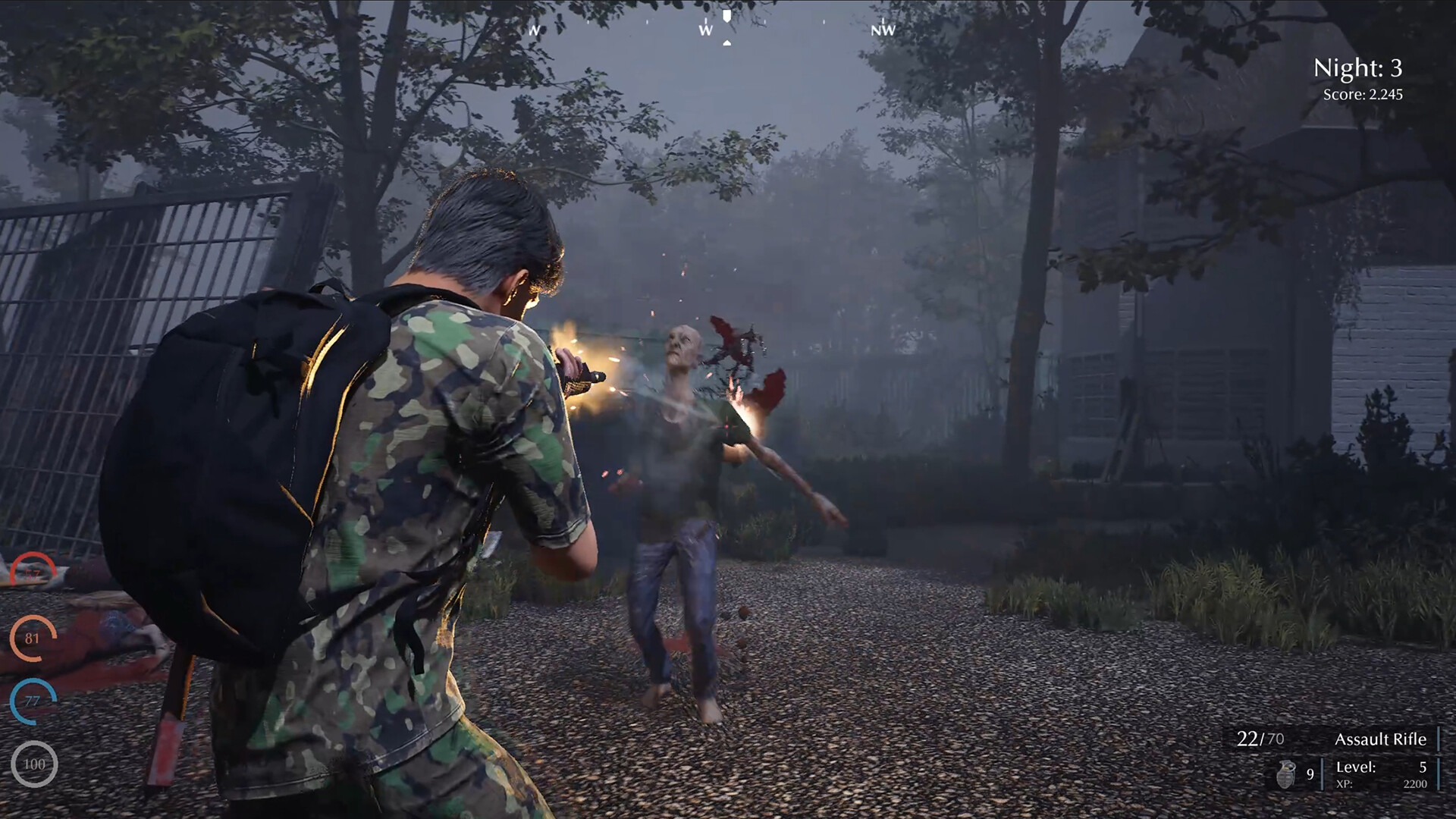
© Extrude. Official media via Steam.
The pitch
OverviewThere is a version of The Left Behind that is genuinely exciting, and you can see its outline through the cracks. Developed and published by Extrude, the small Dutch outfit behind it, this is a post-apocalyptic survival game with a hook most of its bigger rivals never bothered with: a handcrafted open world modeled on the actual Netherlands, where the promise is that every building, hundreds of them, can be entered and picked clean. It is DayZ energy by day and something closer to Dying Light after dark, and as a pitch it is easy to fall for.
The loop is built around the sun. During daylight you explore the Dutch countryside, scavenge for supplies, and manage the survival basics of hunger, thirst, and health. When night comes the tone flips: hordes of the undead converge, move faster, and press harder, and each night is meant to escalate the pressure until your run finally breaks. There are a few ways to engage with it, from a short story mode to open-ended survival and a wave-based horde mode, plus solo or co-op play for a small group of friends.
Here is the honest part. The Left Behind launched on July 27, 2026 on PC at under ten dollars, and it arrived to a Negative verdict on Steam, with only a small fraction of early players recommending it. The reasons are not mysterious or unfair: they are the loud, specific complaints of people who wanted the concept to work and could not get it to run. This review has to weigh the idea against the state it shipped in, and at launch, the state is the story.
That tension defines the whole thing. The ambition is real and the price is modest, which buys a lot of goodwill. But goodwill does not fix a crash, and a clever setting does not compensate for controls that fight you. What follows is a look at a promising survival game that, right now, is not ready to deliver on its own promise.
How it plays
PlayOn paper the design is smart and generous. The day-night cycle gives the survival loop a natural rhythm, turning safe scavenging runs into a race to fortify or flee before the horde arrives, and the escalating nightly difficulty is a clean way to keep runs tense without leaning on artificial timers. Managing hunger, thirst, and health is standard survival grammar, but the enterable-building conceit is the real draw: a town where any door might open into loot or an ambush is a genuinely appealing space to explore.
The mode variety is a point in its favor as well. A story mode offers a short, mystery-flavored throughline of a couple of hours, survival mode hands you the open world to endure at your own pace, and the wave-based horde mode is a straightforward pull for anyone who likes the arcade rush of holding a position against the dead. Co-op, both online and over LAN for a small group, is exactly the kind of feature that could turn a rough survival game into a memorable one with friends. The intentions here are consistently good.
The execution is where it comes apart. The most common complaint from early players is performance: the game runs poorly on a wide range of setups, with stutter and choppiness that undercut both the exploration and the panic of a night raid. Movement is described as boxy and awkward, characters have been caught T-posing, and the general physicality of walking, jumping, and fighting lacks the smoothness that a survival game leans on for immersion. When the fundamentals of moving through space feel off, everything built on top of them wobbles.
Worse are the stability problems. Players report hard crashes, including one only a few minutes into a session, compounded by a save situation that can leave you starting over with nothing to show for the time lost. In co-op, disconnections and dropping out of servers turn a session with friends into a series of reconnections. Combat, meanwhile, is repeatedly called janky, with enemies that behave unpredictably and hits that do not land with the weight the horde fantasy needs. These are not nitpicks about balance or content; they are the load-bearing systems failing under normal play.
It is worth saying plainly that this is a small-team, low-budget effort priced accordingly, and none of these problems are necessarily permanent. Survival games have a long history of shaky launches followed by real recovery. But a review has to describe the game as it is on the day it releases, and on that day, the systems that should carry The Left Behind are the ones giving out.
Art & atmosphere
CraftThe setting is the best thing here, and it is a legitimately fresh one. Post-apocalyptic games almost always default to generic American suburbs or crumbling cities, so a zombie survival game staged in a recognizably Dutch landscape of low houses, flat green country, and quiet villages has an immediate novelty. Players who know the region have noted the small thrill of seeing a familiar place reframed as an outbreak zone, and that specificity of place is a real, if underused, asset.
Unfortunately the presentation struggles to sell it. Built in a modern engine, the game reaches for a grounded, realistic look, but the rough edges show constantly: awkward animation, that boxy movement, and a general stiffness that can make the handcrafted world read as generic despite the care behind it. Some players go so far as to call it asset-flip territory, which is unkind to the genuine ambition on display but tells you how the roughness lands on first contact.
The atmosphere that a good survival game trades in, the dread of watching the light fade before a horde night, is present in concept but rarely earned in the moment, because the technical noise keeps pulling you out. It is hard to sink into a mood when the frame rate hitches or a zombie snaps into a broken pose. The bones of a distinct, memorable aesthetic are here in the Dutch setting; the execution has not yet caught up to the idea.
A fresh setting and a smart survival loop are buried under crashes, rough performance, and janky controls that make the game hard to recommend in its launch state.
Pros & cons
The ledgerIn its favour
- A genuinely fresh setting: a handcrafted, recognizably Dutch open world
- Hundreds of enterable buildings that make exploration and looting appealing
- A day-night loop that gives survival a natural, escalating rhythm
- Multiple modes: story, open survival, and a wave-based horde mode
- Solo and co-op play, online and over LAN, for a small group of friends
- A modest sub-ten-dollar price that lowers the stakes of trying it
Against it
- Poor performance across many setups, with persistent stutter and choppiness
- Boxy, awkward movement and animation, including reported T-posing
- Hard crashes and save issues that can wipe out a session's progress
- Co-op plagued by disconnections and dropping out of servers
- Janky combat with unpredictable enemies and weightless hits
Screens
Official media© Extrude. Official media via Steam.
The player verdict
Real reviews · Steam- Not recommended
“As a Dutch person and someone that lives near and been in this city its funny to see it as a zombie game but that's the only positive about the game. Its quite poorly optimized and runs quite bad. The moving is weird and when you jump and…”
51 found helpfulvia Steam - Not recommended
“yeah, i love a good zombie games like anyone else. but to me this looks like a store asset game, the player movment is boxy and at one point i t posed, NO save i repeat No save game crashed after 5 mins of playing and thats it start new,…”
30 found helpfulvia Steam - Not recommended
“dont bother holy demon. devs need to take this off the store and spend another 36 months building it. broken mechanics, very clunky, constantly dropping out of a server. just all around ♥♥♥♥♥♥”
25 found helpfulvia Steam - Not recommended
“I lost a friend because he made me play this game Poorly optimized, runs terribly. The zombies are bugged and combat is very janky. Hopefully it gets optimized soon but at this stage it isn't worth the money.”
24 found helpfulvia Steam
Verdict
The callThe Left Behind is a frustrating review to write because the disappointment is proportional to the promise. Extrude picked a setting nobody else was using, built a world where curiosity is rewarded with a lootable interior behind nearly every door, and wrapped it in a day-night survival loop that knows exactly how to build tension. As a concept, this is the good stuff, and at under ten dollars it is priced like an easy gamble.
But the gamble does not pay off at launch. Crashes, lost progress, boxy movement, unreliable co-op, and combat that never finds its footing are not the growing pains you shrug past; they are the experience most early players are actually having, and the Negative verdict on Steam reflects that honestly. A great idea trapped inside an unstable build is still, for now, an unstable build.
If you are the patient sort who likes backing a rough indie survival game early and does not mind treating a launch as an ongoing project, keep an eye on it, because a few solid patches could change this story entirely. For everyone else, the kindest advice is to wishlist it and wait. The Left Behind has the idea; it does not yet have the game to hold it up.
Sources
Original review by Aymen Sakouhi from the licensed facts above. Score: 3.8/10.