Don't Starve Together Is Cruel, and That's the Whole Idea
Our Don't Starve Together review digs into Klei's brutal co-op survival: its sanity system, character roles, and a punishing learning curve.
Aymen Sakouhi·Writer · Games Hobbyist//5 min read
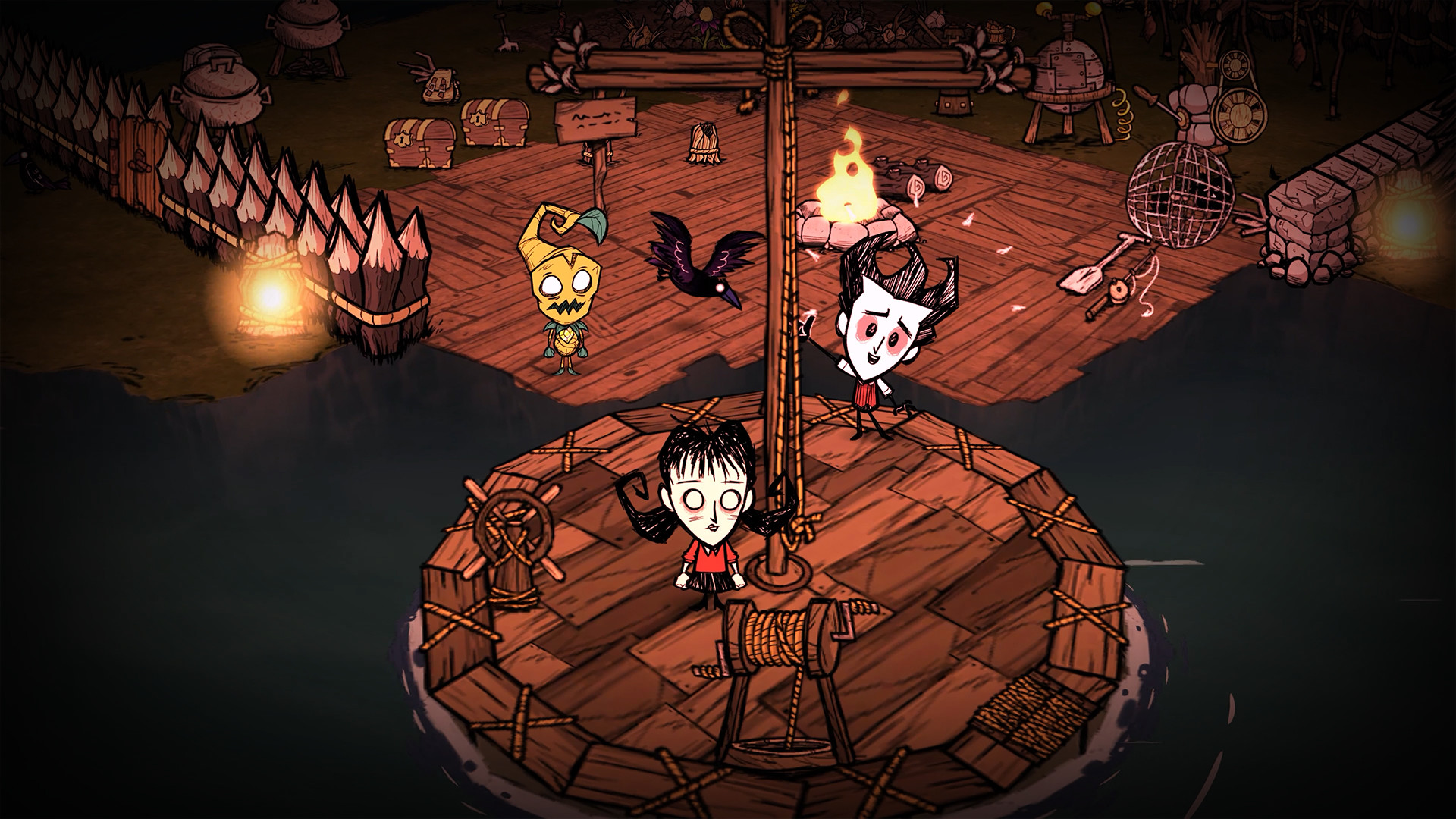
© Klei Entertainment. Official media via Steam.
The pitch
OverviewDon't Starve Together takes Klei's already merciless survival game and stirs in the one ingredient guaranteed to make everything harder and funnier at the same time: other people. It keeps the gothic, storybook-macabre art, the pitiless interlocking systems, and the flat refusal to hold your hand, then hands the whole grim experiment to a group and settles back to watch which of you starves first.
This is survival as a war of attrition against your own ignorance. The game tells you almost nothing up front; it fully expects you to die, learn one specific and usually cruel lesson from the corpse, and try again with fractionally less naivety. As a multiplayer proposition it becomes a game about pooled knowledge, divided labor, and the very particular comedy of watching a friend get ambushed by something enormous in the dark just outside the firelight.
What Klei is after here is a survival game with genuine teeth, one where safety is always provisional and every season is a deadline you are probably not ready for. It is uninterested in the tidy power-fantasy arc most of the genre trades in; the fantasy on offer instead is the slow, hard-won competence of a group that has finally, collectively, learned how not to die.
Built out of the single-player Don't Starve as a standalone co-op counterpart, it inherits that game's reputation for beautiful hostility and then complicates it with the logistics of keeping several people alive at once. It sits at the punishing end of the survival spectrum on purpose, closer to a roguelike endurance test than a cozy crafting hangout, and it makes no apology whatsoever for the company it keeps.
How it plays
PlayThe core is a triangle of meters, hunger, health, and sanity, and the world is forever chipping away at all three at once. Nightfall on its own can kill you outright if you have not secured a light source before the dark arrives, and low sanity conjures shadow creatures that literally attack your fraying mind. Everything runs as a race against the seasons, which escalate from a manageable summer into winters and worse that demand you have already built the infrastructure to weather them. There is no tutorial worth the name, and that opacity is not an oversight, it is the design.
In a group, the survival math changes shape entirely. Roles emerge on their own within the first hour: someone becomes the base-builder, someone the forager ranging out for supplies, someone the fighter who tanks the seasonal giants while the rest scatter. The roster of distinct characters, each carrying their own perks and pointed drawbacks, actively pushes a party toward specialization, and coordinating a functioning camp before the first winter lands is genuinely tense in a way single-player survival rarely manages.
The concrete systems reward that cooperation in genuinely satisfying ways. A crock pot converts raw ingredients into proper meals by recipe, so keeping a full camp fed becomes its own small logistics puzzle, and the roster ranges from Wilson, the default gentleman scientist, through a gleeful firestarter, a circus strongman, and a sleepless old librarian, each one bending the group's strategy around their particular quirks. Death is not necessarily the end of you, either: a fallen player lingers on as a ghost, revivable by teammates through a meat effigy or a telltale heart, which turns dying into a setback the group absorbs rather than a hard stop for everyone. Later, the caves and the ancient ruins buried beneath the surface open up a whole second frontier of threats and rewards for any party confident enough to climb down into the dark.
When it works, it is superb. Pulling off a smooth division of labor, watching a fire kept lit through a killing winter by a stockpile you all gathered together, surviving a boss because everyone held their assigned job, produces the specific kind of hard-earned, slightly disbelieving triumph that co-op games exist to manufacture. The wins feel earned precisely because the game spent so long trying to prevent them.
The friction is real, though, and it is not always the fun kind. The learning curve is less a curve than a sheer cliff face, and the game's habit of punishing knowledge you could not possibly have acquired yet, a hazard with no warning, a mechanic explained nowhere, can feel less like difficulty and more like an ambush from the design itself. There is a meaningful gap between a game that is fairly hard and one that simply withholds the information you needed, and Don't Starve Together spends real time on the wrong side of it.
It is also noticeably worse the fewer people you bring along. Solo, it is lonely and punishing in roughly equal measure, stripped of the group dynamics that are the entire pitch. Base-building leans more functional than expressive, and one bad early death, a careless night, a misjudged fight, can wipe out a long session's worth of progress for everyone sharing the world. It respects your time only after you have paid it a genuinely steep tuition up front.
Art & atmosphere
CraftKlei drew this world with a dip pen and a grudge. Everything in Don't Starve Together is scratchy monochrome ink, spidery trees, hunched puppet characters, a wobbling filigree border that makes the whole screen feel like a cursed pop-up book someone found in an attic. The obvious lineage is Tim Burton by way of Edward Gorey, but the execution is unmistakably Klei's own, gnarled and hand-cut and faintly gleeful about its own morbidity.
What is genuinely clever is how much of that art is also a mechanic. Night falls as literal, total black, so darkness is not a mood so much as an active threat, and low sanity smears the whole screen with a desaturated wobble as shadow shapes creep in at the corners of your vision. The presentation and the systems are the same thing wearing different hats; you can read your own peril in how the world is drawn at any given moment.
The audio pulls the same double duty. Characters speak in a comic gibberish, each voiced by a different instrument, so the cast has personality without a single word of real dialogue, while a nervy, ragtime-adjacent score picks steadily at your composure. As your sanity frays, the audio itself warps and sours, until the soundtrack becomes another gauge you are anxiously monitoring. It is whimsy and dread exhaled in the same breath, a storybook that very clearly wants you dead and is oddly charming about it.
A distinctive, deeply demanding co-op survival game whose steep and sometimes genuinely unfair barrier keeps it out of the top tier.
Pros & cons
The ledgerIn its favour
- Distinct, instantly recognizable gothic ink art direction
- Hunger, health, and sanity interlock into constant, meaningful pressure
- Character roles genuinely reward group specialization
- Tense, hard-earned victories at its co-op best
- Presentation and mechanics are cleverly one and the same
Against it
- A punishing, near-vertical learning curve
- Frequently punishes knowledge you could not yet have
- Lonely and grim, and much weaker, in solo play
- A single bad death can erase hours of shared progress
- Base-building is more functional than expressive
Screens
Official media© Klei Entertainment. Official media via Steam.
The player verdict
Real reviews · Steam- Recommended
“I bought this because everyone said it was a fun co-op survival game. Five hours later I'm starving, freezing, insane, and learning that a winter hat somehow requires more resources than building a house. Fine. I'll join a public server…”
457 found helpfulvia Steam - Recommended
“A try-to-survive-the-night, barely-make-it-through, die-by-morning, rinse-and-repeat survival simulator. Played with a bunch of friends, and the number of times we died and had to restart the run is beyond what words can describe. The…”
23 found helpfulvia Steam - Not recommended
“I grinded my solo world for hours, but once when I had to rollback, instead of clicking "rollback world" button, I miss-clicked the option below "regenerate world", and a few seconds later my entire world with 350 days was completely…”
13 found helpfulvia Steam - Recommended
“Just lost a 43 day world because i forgot to pause the game when i went to eat. I hate this game so much and can't wait to start another run.”
9 found helpfulvia Steam
Verdict
The callDon't Starve Together is excellent at exactly what it sets out to do, which is to make survival feel precarious and knowledge feel hard-won. Its atmosphere is genuinely singular, its systems interlock with real, deliberate cruelty, and in the right group it produces the sort of tense, funny, hard-earned victories that co-op games live and die on. There is nothing else quite like a good session of it.
But it is honestly difficult to recommend without a stack of caveats. The barrier to entry is high, the punishment is relentless and occasionally unfair, and players who would rather be welcomed than tested should probably look almost anywhere else first. For the stubborn, though, and for a committed group willing to fail together for a few sessions before it finally clicks, it is one of the most rewarding survival experiences going, and one of the very few that genuinely earns its cruelty.
Think of it less as a game you casually pick up and more as a hobby you commit to alongside the same few people, a shared language of near-misses, rationed food, and grim inside jokes accumulated across one long and deadly campaign. There are gentler survival games, and there are prettier ones, but very few that make simply reaching the next spring feel like a genuine achievement. Approached in that spirit, with patience and a regular group, its cruelty stops reading as an obstacle and starts to feel like the entire point of the exercise.
Sources
Original review by Aymen Sakouhi from the licensed facts above. Score: 7.6/10.