Forsaken Realms: Vahrin's Call Reaches for a Classic RPG and Trips Over Its Own Feet
Our Forsaken Realms: Vahrin's Call review weighs a dense fantasy world and classless build freedom against sluggish combat, stutters, and a repetitive quest loop.
Aymen Sakouhi·Writer · Games Hobbyist//5 min read
© Titan Roc. Official media via Steam.
The pitch
OverviewEvery so often a small studio swings for something far larger than its budget, and the interesting question is not whether it lands the whole thing but which parts survive the attempt. Forsaken Realms: Vahrin's Call is that kind of swing. Developed and published by Titan Roc, it is a narrative-driven fantasy action-RPG that drops you into the fading kingdom of Leyda as a mercenary drawn toward Vahrin, a war-torn city clinging to the edge of collapse. The pitch is old-fashioned in the best sense: a proper adventure with towns to walk, people to help, and a blade to earn your keep.
What makes it stand out on paper is how much it refuses to hold your hand into a class. Progression here is classless, built from the weapons, armor, abilities, and alchemy you choose to lean on, so the nimble archer and the axe-swinging bruiser are two ends of the same open system rather than menu choices made at the start. It is a design that trusts you to shape your own mercenary, and for players who like tinkering with a build over a long campaign, that trust is genuinely appealing.
The game launched on July 27, 2026 on PC at roughly twenty-seven euros, and it arrived to a Mixed verdict on Steam, with players landing a little under half positive out of the gate. That split is the honest headline. Nearly everyone agrees there is a real foundation here, a world worth walking through and a combat core with the right bones. Nearly everyone also agrees it stumbles, whether on performance, on the feel of a swing, or on quests that settle into a rhythm you can predict three chapters ahead.
The result is a game that is easy to root for and hard to unreservedly recommend. Vahrin's Call has taste and ambition well beyond what its resources should allow, and it keeps bumping into the ceiling of what those resources can actually deliver. Whether that trade works for you depends on how much rough you will tolerate in exchange for a world that clearly means it.
How it plays
PlayThe core loop is the familiar action-RPG contract: take a job, travel to where the trouble is, fight through it, come back changed by whatever gear and abilities you picked up along the way. Combat is real-time and weapon-driven, and the best thing about it is how freely it lets you move between tools. Swapping weapons mid-fight is quick and clean, the animations carry a sense of weight rather than floating through their frames, and there is a clear intent to make each armament feel like a different answer to the same problem rather than a reskin.
The classless build system is where the game is most itself. Instead of committing to a role, you assemble one out of what you equip and practice: a bow-and-alchemy skirmisher, a heavy-armor front-liner, or something messier in between. Adjustable difficulty and a save-anytime option soften the edges for players who want the adventure more than the challenge, and full controller support means it plays comfortably from the couch. For anyone who enjoys the slow accretion of a character across a campaign, the freedom on offer is the strongest reason to be here.
The trouble starts with how the moment-to-moment actually feels once the novelty settles. Where some players find the combat satisfying, others describe it as muddy or sluggish, lacking the crisp immediacy that a good action game lives or dies on, and both takes can be true depending on the encounter and the weapon. It is functional and readable, but it rarely snaps, and in a genre defined by the pleasure of a well-timed hit, that softness is felt.
Stealth is the clearest example of reach exceeding grasp. The systems are present but clunky, asking you to eyeball the geometry of a sneak attack without the prompts or feedback that would make it reliable, so what should be a tense alternative to open combat becomes a guessing game you often abandon. The quest design has a related problem of repetition: the main path leans hard on a receive-assignment, travel, defeat-the-target cadence that is comforting at first and predictable by the middle stretch, and the campaign does not do enough to vary the shape of what it asks.
Then there is performance, which for a meaningful slice of players is the first thing they notice and the last thing they forgive. Complaints of stutter, choppiness, and general roughness show up repeatedly, including loading hitches when moving out into the overworld, and on the wrong hardware they can sour an early impression before the game has had a chance to make its case. None of it is unfixable, and a patch cycle could move the needle a lot, but at launch the technical state is part of the experience and has to be weighed as such.
Art & atmosphere
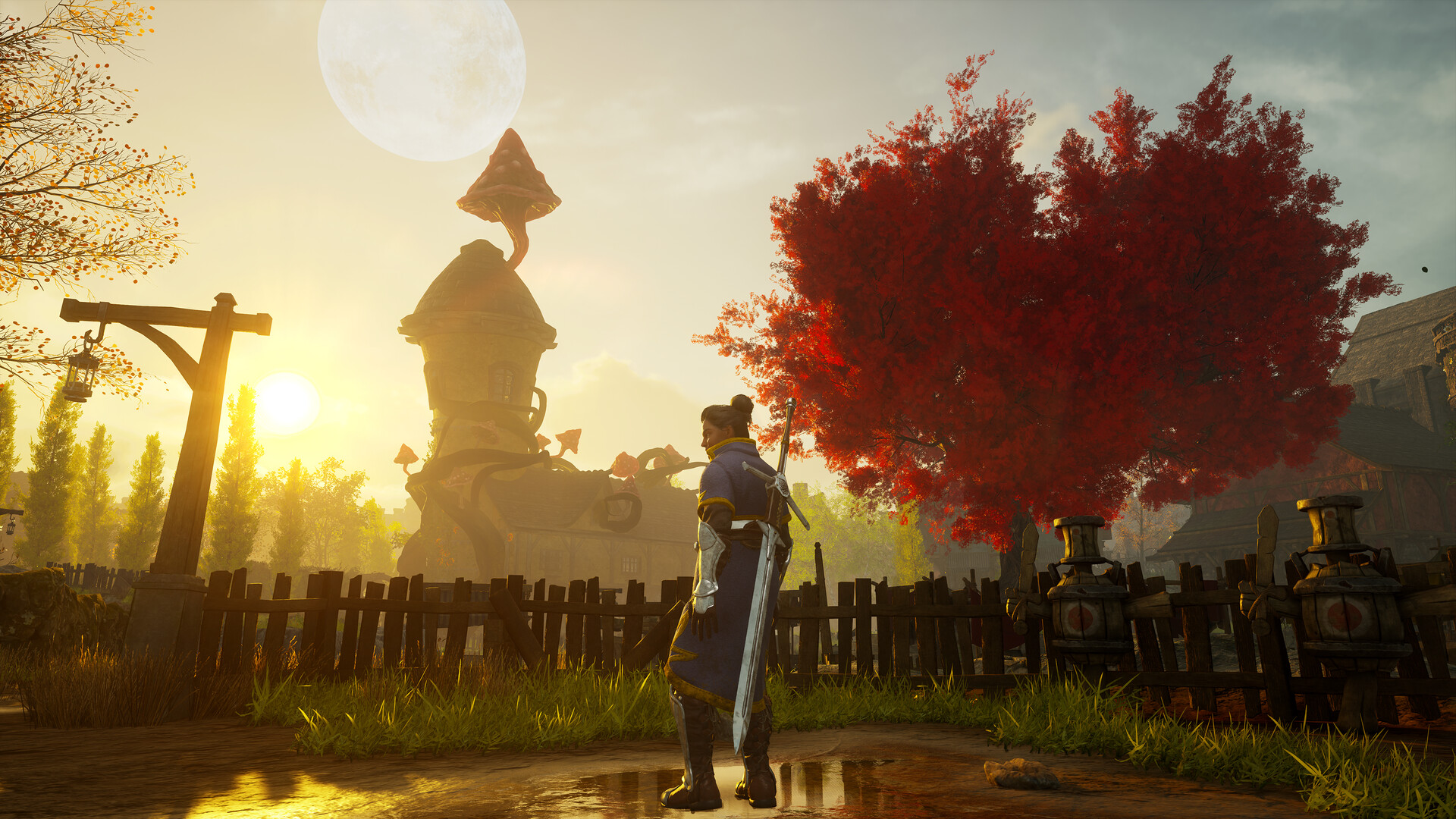
CraftVahrin's Call is at its most convincing as a place. Leyda's forests read as dense and genuinely endless, its towns feel lived-in rather than staged, and the sense of a world with history behind it is the single achievement that survives every other complaint intact. For a studio working without AAA resources, conjuring an environment this immersive is not a small thing, and it is why so many players who criticize the game still want it to succeed.
The visual choices are more of a gamble. The game reaches for a photorealistic look, and that ambition is exactly what exposes its rough edges: character models can blur or read as unfinished up close, and the seams of a small-budget production are more glaring in a realistic register than a stylized one would have been. A more painterly art direction might have hidden the limitations and sharpened the identity at the same time. As it stands, the world is more beautiful in the wide shot than in the close-up.
Sound is where the presentation quietly overdelivers. The orchestral score swings between magical wonder and grimmer, morbid moods with real confidence, and the voice cast turns in professional, believable performances rather than the flat line readings that so often sink indie RPGs. The one odd note is the silent protagonist, whose muteness sits awkwardly against a fully voiced supporting cast and thins out scenes that the writing clearly wants to land. It is a small dissonance, but a persistent one.
A genuinely immersive world and appealing build freedom are undercut by soft combat, technical roughness, and a predictable quest structure, landing it squarely in mixed territory.
Pros & cons
The ledgerIn its favour
- A dense, lived-in fantasy world that feels far larger than its budget suggests
- Classless progression that lets you build a mercenary freely from gear, abilities, and alchemy
- Quick, weighty weapon-swapping that gives combat a clear intent
- A strong orchestral score and a professional, believable voice cast
- Adjustable difficulty, save-anytime, and full controller support that welcome all comers
Against it
- Combat often reads as muddy or sluggish, missing the snap the genre needs
- Frequent performance complaints: stutter, choppiness, and overworld loading hitches
- Clunky stealth with no clear feedback for lining up a sneak attack
- A repetitive assignment-travel-kill quest loop that grows predictable
- Photorealistic visuals that magnify the rough edges of a small production
- A silent protagonist that clashes with the otherwise fully voiced cast
Screens
Official media© Titan Roc. Official media via Steam.
The player verdict
Real reviews · Steam- Not recommended
“I really wanted to like this game because there's a solid foundation here. The combat feels good. Swapping between weapons is seamless, the animations have weight, and it doesn't feel like every attack is copied and pasted. The world is…”
43 found helpfulvia Steam - Not recommended
“Installed, got through character creation screen. Walked 10 steps and was laggy clunky choppy every like 5 steps. Tried tons of setting swaps to make it more smooth. Still really choppy for me, disappointing because it looked like it would…”
37 found helpfulvia Steam - Recommended
“Fantastic open world soulslike! It's so good that it's straight up unbelievable that it's an indie game! Here's my breakdown: Plot: 3/10 Without spoiling too much, it's basically a quest to stop corruption from taking over the land of…”
32 found helpfulvia Steam - Recommended
“Vahrin's Call war für mich eine der positivsten Überraschungen seit Langem. Das Spiel setzt nicht auf riesige Open Worlds, künstlich aufgeblähte Spielzeit oder frustrierende Soulslike-Kämpfe. Stattdessen bekommt man ein klassisches…”
27 found helpfulvia Steam
Verdict
The callForsaken Realms: Vahrin's Call is the kind of indie RPG you end up defending even while listing its faults. Titan Roc has built a world with real texture, a progression system that respects your freedom, and an audio presentation that punches well above the game's weight. When it is working, walking Leyda's forests toward the next town with a build you cobbled together yourself, it delivers the unhurried adventure it set out to make.
The problem is how often it stops working. Combat that never quite sharpens, stealth that fights you as much as the enemies do, a quest loop that telegraphs itself, and performance that stutters on the wrong rig all pull against the world's pull. The Mixed launch verdict is not a mystery; it is the sound of players feeling both of those things at once and landing somewhere in the middle.
If you value atmosphere and build freedom over polish, and you can meet a rough launch with patience (or wait for the patches that a game like this usually gets), there is a rewarding, characterful adventure in here. If you need your action to feel crisp and your technical foundation to be solid on day one, this is one to watch rather than buy right now. It is a promising, flawed thing, and promising is not nothing.
Sources
Original review by Aymen Sakouhi from the licensed facts above. Score: 6.3/10.