Prince of Persia: The Lost Crown Is the Best Metroidvania Ubisoft Has Ever Published
Our Prince of Persia: The Lost Crown review: Ubisoft Montpellier's Mount Qaf is a fluid, brutal, beautifully designed metroidvania with elite combat.
Aymen Sakouhi·Writer · Games Hobbyist//4 min read
© Ubisoft. Official media via Steam.
The pitch
OverviewFor a series that spent the better part of two decades wandering, sand-swept reboots, a Sands of Time remake stuck in development limbo, long silences, Prince of Persia turning up as a razor-sharp 2D metroidvania is the last thing anyone reasonably expected. And yet here we are: The Lost Crown is not just a good Prince of Persia game, it is one of the finest metroidvanias of its generation, and comfortably the best thing Ubisoft Montpellier has shipped in years.
You do not even play the Prince this time. You are Sargon, the youngest of the Immortals, an elite band of warriors sent to Mount Qaf to rescue a kidnapped prince and rapidly finding that the mountain itself is a curse, a fortress where time folds back on itself, where past and present bleed together, and where nearly everyone you trusted has an agenda of their own. It is a smart framing, because it hands the designers an excuse to make the map a genuine puzzle box of layered timelines and shortcuts rather than a straight corridor.
What lands first, and hardest, is the sheer confidence of the thing. This is a game that knows exactly what it is from the opening minutes, moves with total assurance, and trusts you to keep up. Nothing about it feels tentative or committee-designed. It plays like the work of a team that loves the genre and has clearly studied its best, then set out to prove it could stand beside them.
How it plays
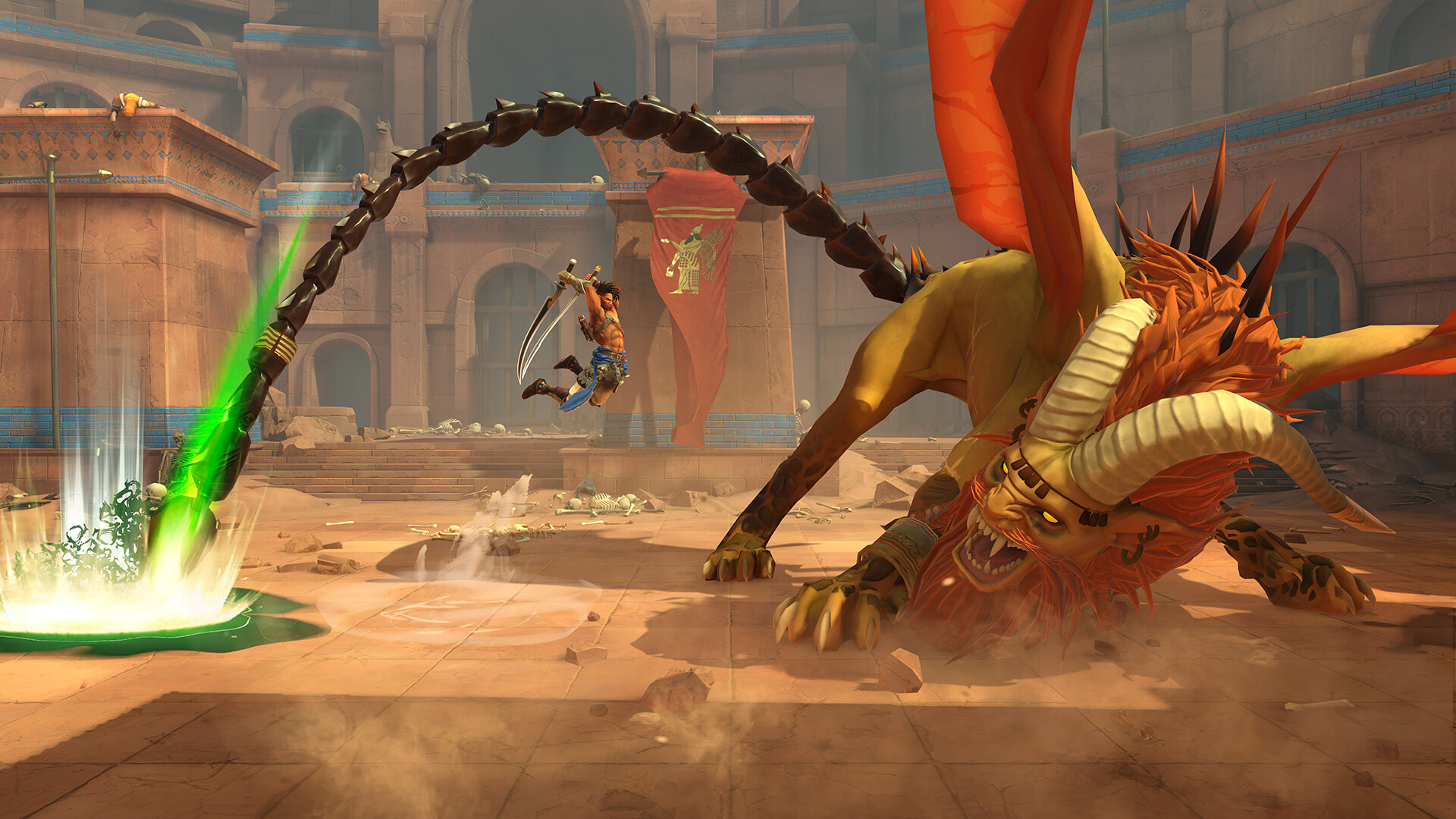
PlayThe foundation is movement, and the movement is superb. Sargon runs, vaults, wall-jumps and air-dashes with a weight and precision that recalls the platforming greats, and the combat is wired directly into that same vocabulary. You are constantly parrying, dodging through enemies to reposition, bouncing off heads, and juggling foes with a bow between sword combos. Yellow-flashing attacks can be parried for a satisfying stagger; red-flashing ones must be dodged. It is a rhythm you learn in your hands, and once it clicks the game becomes a kind of violent dance.
Progression follows the metroidvania template faithfully but with real craft. New Time Powers gate the map in clever ways, a mid-air dash, a shadow-clone that lets you teleport back to a marked position, abilities that manipulate the flow of time to reach places that were closed to you an hour ago. Backtracking never feels like a chore because traversal is such a pleasure and the shortcuts, once opened, are so satisfyingly tidy.
The genuinely clever addition is the Memory Shards system: at any point you can snap a screenshot of your surroundings and pin it to the map, so when you spot a locked door or an out-of-reach chest you can mark it and actually find your way back later without a wiki or a notebook. It is the kind of quality-of-life idea so obviously good that you wonder why the whole genre hasn't been doing it for years, and it single-handedly solves the biggest friction point in open-ended exploration.
Combat scales into a series of exceptional boss fights, elaborate, multi-phase duels that demand you actually understand your parry timing and your movement options, not just mash. Difficulty is broad and generous, with granular sliders for players who want a gentler ride and a punishing option for those who want Mount Qaf to hurt. The critical path is meaty, the optional content is dense, and almost none of it feels like padding. If there is a weak seam it is the story, which is serviceable rather than gripping, and voice performances that occasionally undersell some genuinely strong late-game turns.
Art & atmosphere
CraftThe Lost Crown's look drew the loudest complaints before launch, a brighter, more overtly stylised character design that some fans felt clashed with the moody Prince of Persia they carried in their heads. In motion, most of that argument evaporates. Sargon and his enemies animate with a fluidity that makes every dash and parry read cleanly, and the environments of Mount Qaf are the real star: a sunken city, a hall of frozen time, poison-choked depths and a soaring citadel, each with a distinct palette and a strong silhouette.
More importantly for a game this fast, the art always serves legibility. Attack tells are colour-coded and unmistakable, hazards read at a glance, and even the busiest boss arenas never lose you in visual noise, no small feat when the screen is full of projectiles and you are threading between them. Mengatsi Studio's Persian-mythology monster designs are a highlight, grotesque and memorable.
Mehdi Damou and Gareth Coker's soundtrack shifts between propulsive percussion for the fights and gorgeous, melancholy Persian-inflected melodies for the quieter halls, and it does an enormous amount to sell the mountain as an ancient, cursed place. It is a confident, cohesive presentation that only looks divisive in still screenshots.
A confident, superbly crafted metroidvania with elite combat and a genuinely clever map system, held just short of the top by a merely-adequate story.
Pros & cons
The ledgerIn its favour
- Elite combat built on precise parry-and-dodge timing
- Movement and platforming that feel wonderful in the hand
- The Memory Shards map-pinning system is a genre-fixing idea
- A dense, cleverly interconnected Mount Qaf to explore
- Excellent, multi-phase boss fights
- Generous, granular difficulty options
Against it
- The story is serviceable rather than memorable
- Some voice performances undersell key moments
- The stylised art direction won't win over every longtime fan
Screens
Official media© Ubisoft. Official media via Steam.
The player verdict
Real reviews · Steam- Not recommended
“Refunded. Everyone should avoid ubisoft products. The connect launcher AUTOMATICALLY associated this game with an old lost account due to linking issues. I pray they do not have the audacity to reply with "Sorry for that! Please get in…”
19 found helpfulvia Steam - Recommended
“A phenomenal metroidvania that unfortunately didn't allow its studio to remain active. This game is genuinely above what Ubisoft typically outputs, it has good platforming, good action, and the Simurgh powers allow for further creative…”
10 found helpfulvia Steam - Not recommended
“I will never buy an Ubisoft game again. It doesn't support Steam Cloud because they want you to use Ubisoft Connect to upload cloud saves manually, which makes playing between the Steam Deck and my PC a CHORE! Why don't you go Sargon deez…”
6 found helpfulvia Steam - Recommended
“This is one of the games that totally blew my expectations.. The game is absolute perfection & my first entry to the Metroidvania genre, haven't had this much fun playing a game in a good while.. I totally recommend this game even though…”
5 found helpfulvia Steam
Verdict
The callPrince of Persia: The Lost Crown is a small miracle: a dormant franchise revived not with a nostalgic remake but with a genuinely new idea, executed with the precision of a studio at the top of its craft. The combat is elite, the movement is a joy, and the Memory Shards system is the sort of quiet innovation the whole genre should be stealing. Its story never quite matches the mechanics, but that is a minor complaint against something this consistently excellent.
That it did not become the commercial hit it deserved to be, and that Ubisoft Montpellier's talented team was scattered not long after, is one of the more dispiriting footnotes in recent games. Do not let it become a game people only appreciate years too late. If you have any affection for metroidvanias, this belongs near the very top of your list.
Sources
Original review by Aymen Sakouhi from the licensed facts above. Score: 8.7/10.