Elden Ring: FromSoftware Opens the Door and Dares You to Walk Through It
Our Elden Ring review weighs FromSoftware's open-world gamble: punishing combat, real freedom, and the friction that comes with the scale.
Aymen Sakouhi·Writer · Games Hobbyist//6 min read
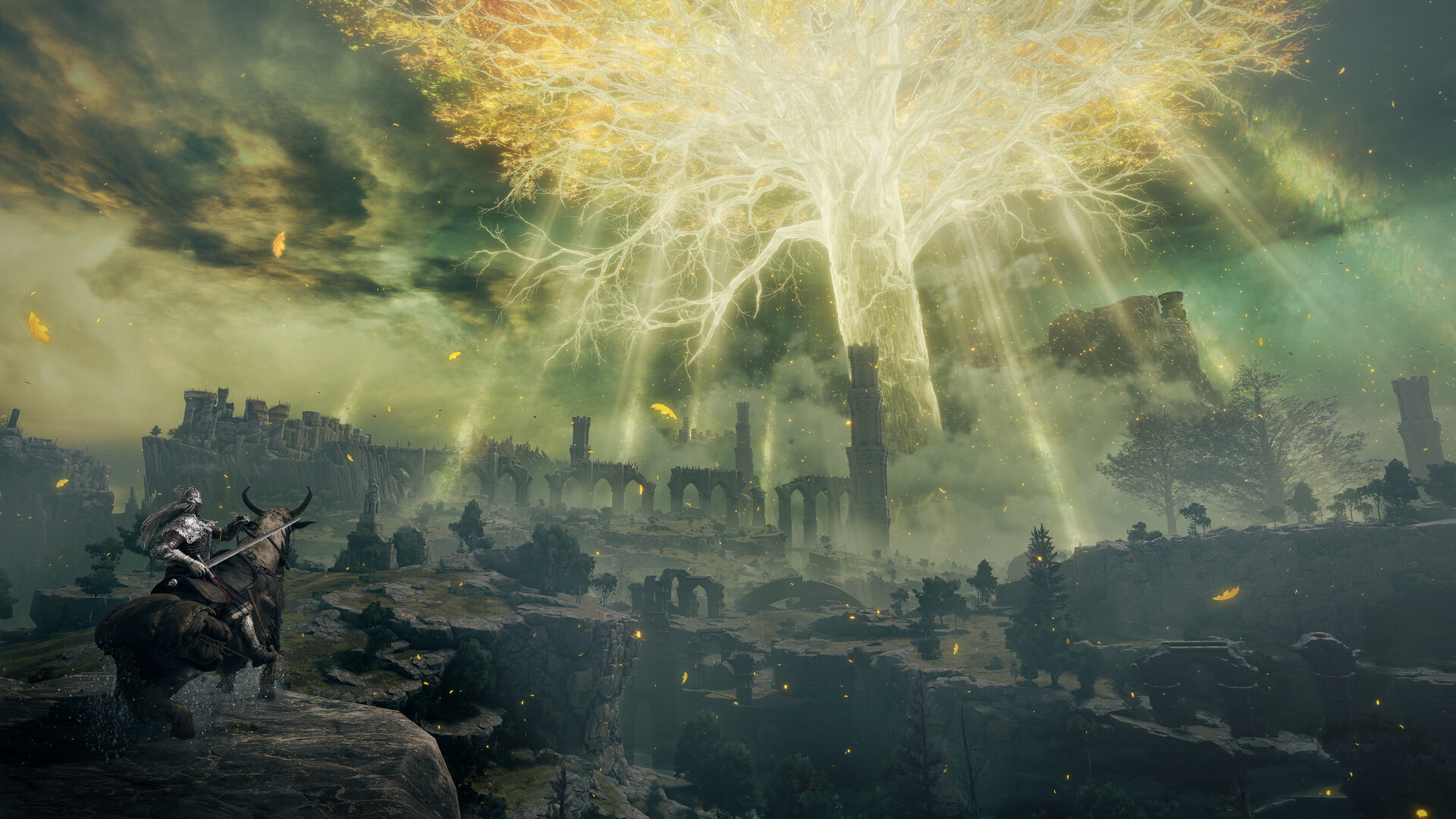
© FromSoftware, Inc.. Official media via Steam.
The pitch
OverviewThere is a moment, usually a couple of hours in, when Elden Ring stops holding your hand and simply lets go. You crest a rise, the fog thins, and the whole of Limgrave unrolls in front of you: a golden tree burning on the skyline, a ruined grace-site glinting below, a dragon asleep in a field it has clearly claimed. Nothing on screen tells you where to go. That mixture of exhilaration and low-grade dread is not a flaw in the design; it is the design, and FromSoftware trusts you to sit inside the discomfort until curiosity finally wins.
For over a decade the studio built its reputation inside tight, interlocking corridors, refining a single idea, the punishing action-RPG, until it gleamed. Elden Ring takes that machine and drops it into a continent. Director Hidetaka Miyazaki brought in novelist George R. R. Martin to seed the mythology, then buried most of that lore where only the stubborn will ever dig it out. The result is an action-RPG about a fallen demigod dynasty, a shattered ring of magic, and your own nameless Tarnished clawing toward a throne nobody sane should want.
The gamble becomes obvious the moment you understand what preceded it. Souls games earned their name on authorship, every enemy placement and sightline deliberate, every death a lesson the designer intended you to learn. Open worlds are, almost by definition, the enemy of that kind of control. Elden Ring is the studio trying to keep its hand-tooled precision while handing you a horse and a hundred square miles, betting that freedom will deepen the tension rather than dissolve it into filler.
Mostly, and somewhat astonishingly, the bet pays off. This is Dark Souls with the walls knocked out, the culmination of everything From has been circling since Demon's Souls, and its DNA is now smeared across half the industry's pitch decks. Whether it is the single best thing the studio has ever made is a bar-fight worth having. That it is the biggest, the most confident, and the most imitated is not really in question.
How it plays
PlayUnderneath the scale, the contract is unchanged. A stamina bar meters every swing, roll, and raised shield, enemies wind up attacks you are meant to read rather than out-twitch, and a mistimed dodge is punished with a severity that never really softens. Learning a fight here means learning a rhythm, dying to it a dozen times, and eventually internalizing a tell that was always there in plain sight. It is combat as language study, and it remains the most satisfying version of that idea anyone in games makes.
What is new is how much the design is now willing to hand you. Ashes of War let you bolt a weapon skill and a damage type onto almost anything, so a humble longsword can be rebuilt around a lunging thrust or a frost proc in seconds. Spirit Ashes summon a whole menagerie of allies, from a pack of wolves to a knight who can solo a boss on a good day, to split aggro and buy you room to breathe. Between sorceries, incantations, bleed and frostbite stacking, colossal two-handers, and dual-wield setups, two players can roll credits having barely touched the same half of the systems.
Structurally, this is where Elden Ring departs hardest from its ancestors. Sites of Grace replace bonfires and send a faint golden current toward the next major beat without ever ordering you there. Torrent, your double-jumping spectral mount, turns crossing the map into genuine exploration rather than a loading-screen commute, and turns several roaming boss fights into cavalry duels. The handcrafted legacy dungeons, Stormveil Castle, Raya Lucaria, Leyndell, are the studio at its outright peak: vertical, looping, riddled with shortcuts that click into place with an almost audible clunk.
Progression keeps its old shape and its old cruelty. Slain enemies drop runes that serve as both currency and experience, and dying twice before you reclaim your pile wipes the lot, a gambling mechanic dressed up as a leveling system. You pour runes into stats at any grace, upgrade weapons with smithing stones farmed from the world, and, once you find the right consumable, respec at the urging of a trapped moon-witch. Crafting and a cookbook economy sit on top, mostly optional, occasionally the difference between a wall and a walkover against a boss a single resist pot would have humbled.
There is still no difficulty slider, and From remains politely uninterested in adding one, but the open structure is itself the accessibility valve. Stuck on a wall, you can leave, level up, farm a better weapon, or call in a Spirit Ash or a flesh-and-blood player through co-op summoning. That same multiplayer layer invites PvP invasions and a deep, faintly obsessive duelling scene, though the netcode and the co-op restrictions feel a console generation behind. Newcomers have more footholds here than in any prior From game; veterans can strip every one of them away for the old, unfiltered pain.
The friction is real and worth naming out loud. For every bespoke legacy dungeon there are catacombs, caves, and hero's graves stamped from the same handful of tilesets, garrisoned by mini-bosses you will fight until you can do it half-asleep, and the back half of the map leans on repeated encounters, two dragons here, another tree-sentinel there, to pad an already enormous runtime. Late bosses escalate into long delayed swings and combo strings that read less like a duel and more like a memory test with a summon for a crutch. And the questlines are cryptic to the point of hostility: finish one blind, without a wiki or a friend who has, and you have not deduced it so much as won a small lottery.
Art & atmosphere
CraftFrom builds atmosphere by rationing it. The Lands Between trade the studio's usual dungeon murk for sourceless golden light, the Erdtree glowing on every horizon like a wound that refuses to scab, gorgeous and faintly sinister at once. Each region has a thesis: Caelid festers red and pustular under Scarlet Rot, Liurnia lies half-drowned beneath an endless grey mirror of water, the Mountaintops bleach to a funereal white. The enemy and boss design stays gleefully grotesque, grafted composites of limb and antler and wing, a saint rotted into a goddess, a bestiary that reads like a medieval marginal-artist's fever dream.
The sound design is a study in withheld information. For long stretches the overworld runs nearly scoreless, just wind combing the grass, the creak of your own armor, a bell tolling somewhere below the ridge, so that when a boss arena finally detonates into Latin choir and hammering timpani, the contrast lands like a slap. The composers, led by Yuka Kitamura and Tsukasa Saitoh, save their melodies for the moments that earn them, and the best of them, Godfrey's theme, Radagon's, the final phase you claw your way to, are engineered to make an ending feel like an event rather than a fade to black.
The whole thing coheres into a mood of magnificent decay, a world plainly past its golden age and picking at the scar. Beauty gets doled out so sparingly that you eventually stop trusting it, which is precisely the intended effect: when the light turns golden here, it usually means something enormous is about to try to kill you.
A genre-defining fusion of open-world freedom and hand-tooled combat whose only real flaws, recycled dungeons and wilfully cryptic quests, never come close to threatening the whole.
Pros & cons
The ledgerIn its favour
- Torrent and mounted combat turn traversal into genuine discovery, not a commute
- Legacy dungeons like Stormveil and Leyndell rank among From's finest level design
- Enormous build variety keeps sorcery, faith, bleed, and colossal weapons viable to the end
- Spirit Ashes and co-op give newcomers real footholds without gutting the challenge
- Ashes of War make experimenting with unfamiliar weapons cheap, fast, and genuinely fun
- The soundtrack's restraint makes every boss theme land like an event
Against it
- Catacombs, caves, and reused bosses pad the sprawling second half
- Late-game bosses lean on delayed swings and input-reading combo strings
- Questlines are cryptic to the point of effectively requiring a wiki
- Menus, co-op restrictions, and netcode feel a generation behind the rest
Screens
Official media© FromSoftware, Inc.. Official media via Steam.
The player verdict
Real reviews · Steam- Recommended
“Let me start off be saying this game is phenomenal. Elden Ring is nothing short of a masterpiece. From the moment you step into the lands between, the game captivates you with its vast, mysterious open world that rewards curiosity and…”
156 found helpfulvia Steam - Recommended
“This game did something VERY important for me, and it is that it brought me back from gaming burnout TWICE. The first time was when it came out, I just didn't want to play any games, everything felt bothersome, and then this game came out.…”
50 found helpfulvia Steam - Recommended
“Elden Ring is easily one of the most incredible and engaging games I've ever played. The open world is just so massive and beautiful that I often lost track of time completely. I love how the game gives you total freedom to explore…”
13 found helpfulvia Steam - Recommended
“the messages are like: "try fingers but hole", "Dog!?" instead of giving useful informations. 10/10 would recommend the game.”
11 found helpfulvia Steam
Verdict
The callElden Ring is the rare game where scale amplifies the vision instead of watering it down. The open world could have drowned From's precise, punishing combat in busywork, and in patches it does, but the core loop, spotting something strange on the far ridge and going to poke it with a sword, is magnetic enough that the repetition rarely stings for long. It is generous in a way the studio's earlier work never allowed itself to be, without ever once pretending to be gentle.
It asks for patience and a real streak of stubbornness, and it will not soften a single blow to meet you partway. There is no story recap, no quest marker, no apology for the twenty deaths a boss is going to cost you. What it offers in return is the most confidently designed world of its generation and a sense of discovery most games quietly gave up trying to manufacture years ago.
If you have bounced off From's work before, the summons and the open structure make this the most forgiving door into it, though forgiving is deeply relative. If you already speak the language fluently, this is its fullest expression yet. Either way it is a landmark, recycled crypts, cryptic riddles, and all.
Sources
Original review by Aymen Sakouhi from the licensed facts above. Score: 9.3/10.