Portal 2 Review: The Rare Sequel That Outgrows a Perfect Original
Portal 2 pairs razor-sharp puzzle design with some of the best writing in games, plus a brilliant co-op campaign. Our full review.
Aymen Sakouhi·Writer · Games Hobbyist//5 min read
© Valve. Official media via Steam.
The pitch
OverviewThe original Portal was a perfect miniature: three or four hours of physics-bending puzzles wrapped around one of the medium's great villains, released almost as a bonus and quietly becoming the thing everyone remembered. The obvious hazard of a full sequel was dilution. Stretch that elegance to five times the length and you usually get padding, filler chambers, and a good joke told one too many times. Portal 2 does the exact opposite. It expands in every direction at once, length, cast, mechanics, ambition, and somehow sheds none of the precision that made the first game so beloved.
What Valve actually built is a first-person puzzle game that treats its central trick, a gun that punches two linked holes in the world, as a springboard rather than a novelty. There is a lengthy solo campaign and an entirely separate two-player cooperative campaign, and both are structured like a school: introduce one idea in isolation, let you genuinely understand it, then start tying it into knots. It trusts you to keep pace, and it is extremely funny about the entire ordeal.
The game is equal parts brain-teaser and comedy, and it commits to both halves with unusual discipline. The puzzles are never softened to make room for the writing, and the writing never coasts on the strength of the puzzles. Each holds the other to a high standard across a running time long enough to expose any weakness in either, and neither one blinks.
Years after release it remains the high-water mark for its genre, and one of the very few games that can be correctly and routinely described as genuinely, out-loud funny. It is the unusual case of a sequel that makes its acclaimed predecessor look, in hindsight, a little like a proof of concept.
How it plays
PlayThe foundation is unchanged and still quietly ingenious. You carry a device that places two portals, one orange and one blue, on almost any flat white surface, and anything that passes through one emerges from the other with all of its momentum intact. Fall far enough and you exit the second portal at speed; that single rule of conserved motion is the entire physics lesson you need, and the campaign wrings a genuinely staggering amount of variety out of it.
Onto that base the game drips a steady supply of new toys. There are hard-light bridges you can route through your own portals, tractor beams that carry objects and you along a current, and three colored gels: one that makes surfaces bouncy, one that makes them frictionless and fast, and one that lets portals stick where they otherwise couldn't. Each is introduced gently, in a room built specifically to teach it, and then combined with everything you already know into puzzles that look flatly impossible right up until the instant the solution clicks into place.
That rhythm of bafflement and revelation is the real engine here, not the portals themselves. The puzzles almost never hinge on twitch execution or precise timing; they are about seeing the room correctly, about the moment a chamber stops being a wall and resolves into a diagram. The satisfaction is intellectual rather than mechanical, closer to a good crossword than a boss fight, and Valve paces it with real generosity, giving every new mechanic space to breathe before it starts complicating things.
The solo campaign is also far more of a journey than the first game's pure chamber-crawl. It breaks the testing up with real set pieces, escapes through the rusting guts of the facility, a mid-game reversal that reshuffles who you can trust, and a finale that pushes the portal gun somewhere gleefully absurd, all of which gives the eight-or-nine-hour run an actual shape and rising stakes rather than just a climbing difficulty curve.
The co-op campaign, meanwhile, is not an afterthought bolted onto the side but a separate, purpose-built triumph. Two players pilot the robots Atlas and P-body through chambers explicitly designed so that neither can solve them alone: you time paired portals, fling each other across gaps, and coordinate movements that a single brain simply cannot cover on its own. Valve hands you a small language of pings, gestures, and a shared countdown for the moments when voice chat isn't enough or isn't there, and cracking a chamber together lands differently, and frankly better, than solving one in solitude. It is one of the only co-op modes ever built where a strong player genuinely cannot just carry a weaker one.
Around all of this sits a remarkable amount of care. There are effectively no punishing fail states; die in a test and you respawn a breath later, so experimentation costs you nothing but a little pride. The pacing between chambers occasionally slows for walking and exposition, and because each puzzle generally has one intended solution there is less room for improvisation than a more open design would allow. But the game answers its own modest replay problem with built-in authoring tools and a workshop of community-made chambers that has kept the solo experience alive for well over a decade now.
Art & atmosphere
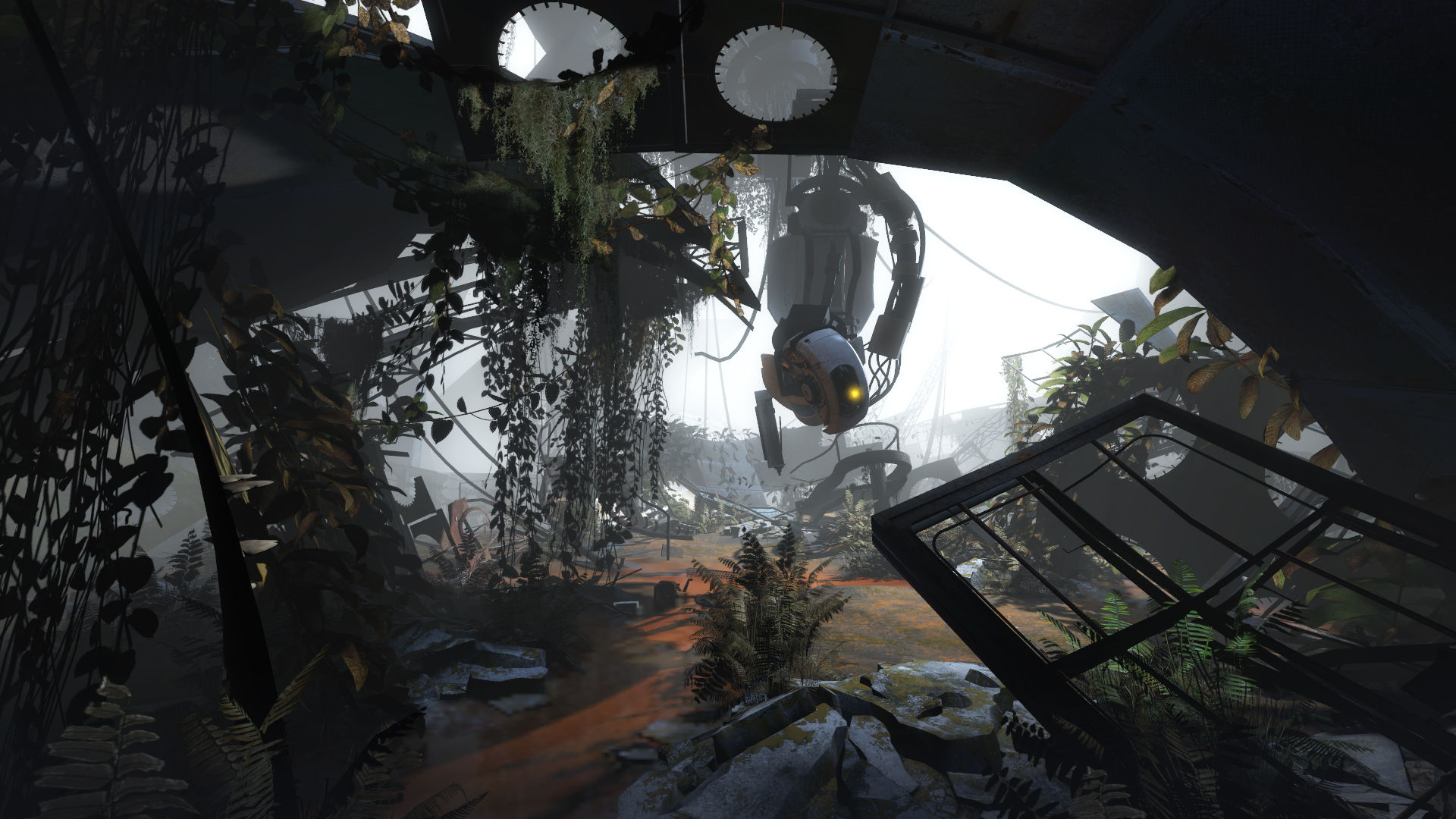
CraftAperture Science is one of gaming's great production designs, and Portal 2 serves you three distinct flavors of it. The modern test chambers are clean white panels, antiseptic light, and passive-aggressive signage, a corporate showroom that is slowly and visibly failing around you. Peel the walls back and you find the ruined machinery and creeping vegetation underneath, the whole facility revealed as a rotting body in a very nice suit. Then the game drops you into Old Aperture, a mid-century cathedral of enamel, rust, and nicotine-stained optimism that quietly reframes the entire history of the place. The turrets, the wobbling personality cores, and the ever-watching cameras give a lab full of right angles a startling amount of personality.
The writing and voice work are, plainly, some of the best in the medium. GLaDOS returns with her honeyed, homicidal contempt; Wheatley, voiced by Stephen Merchant, babbles his way from harmless comic relief into something far more complicated; and J.K. Simmons' Cave Johnson delivers a buried corporate backstory in dry, escalating monologues about lemons and combustible science. The comedy is character-driven and pitch-perfect, and it would comfortably carry the game even if the puzzles surrounding it were merely ordinary.
Mike Morasky's score seals it, a generative bed of synths and processed sound that assembles itself in real time as you solve, so the music swells at the precise moment your plan finally comes together. The soft, tactile fwoop of the portal gun, the clunk of a placed cube, the mechanical chirp of a turret catching sight of you: the sound design turns a sterile facility into a place that feels genuinely, eerily alive with the ghosts of its own corporate cheer. Very few games make emptiness this funny, or this quietly haunted.
A puzzle-design and comedy-writing masterclass, limited only by the single-path solutions and modest replayability that come with any authored, story-driven game.
Pros & cons
The ledgerIn its favour
- Puzzle design that teaches complex ideas without ever holding your hand
- Some of the sharpest comedy writing in the entire medium
- GLaDOS, Wheatley, and Cave Johnson are unforgettable creations
- A full co-op campaign built from scratch, not bolted on
- Has aged remarkably little in look, feel, and wit
- Built-in authoring tools give the solo game a long tail
Against it
- Largely single-path solutions leave little room for improvisation
- Story-driven design means fairly modest solo replay value
- Stretches of walking and exposition between puzzle rooms
- The best co-op experience really needs a committed partner
Screens
Official media© Valve. Official media via Steam.
The player verdict
Real reviews · Steam- Recommended
“this game is ABSOLUTE CINAMA voice acting perfect story amazing sound track comunity levels and a co- op mode it is awsome.”
29 found helpfulvia Steam - Recommended
“My playtime for this game says it all. Portal & Portal 2 are possibly some of the best puzzle games ever made.”
22 found helpfulvia Steam - Recommended
“playing with a friend is like sharing one braincells and trying to solve hunger in the world.”
21 found helpfulvia Steam - Recommended
“This game has always held a special place in my heart. In my opinion, it's one of the GOATs of the gaming industry, and I think everyone should play through it at least once.:p2aperture:”
11 found helpfulvia Steam
Verdict
The callPortal 2 is that genuinely rare thing, a sequel that reaches straight past its acclaimed predecessor and makes the original feel like a warm-up act. The writing alone, Wheatley's anxious spiraling, GLaDOS's poisonous patience, an entire company's history told in throwaway asides, would be more than enough to recommend it. That the puzzles turn out to be every bit as sharp as the jokes is almost unfair to everything else on the shelf.
Who is it for? Very nearly everyone. It asks for patience and a willingness to think rather than any particular reflexes, which makes it one of the easiest great games to put in front of people who do not usually play games at all. The only real hesitations are structural: it is a largely authored, single-path experience, so its solo replay value is genuinely modest, and the co-op campaign, its own separate masterpiece, is at its very best with a committed partner rather than a matchmade stranger.
Those are quibbles lodged against something close to a genre high-water mark. More than a decade on, Portal 2 has barely aged in look, feel, or wit, and it stands as both a masterclass in teaching through design and one of the funniest things the medium has ever produced. If you have somehow never played it, that is the rare backlog gap genuinely worth closing this week.
Sources
Original review by Aymen Sakouhi from the licensed facts above. Score: 9.4/10.