No Man's Sky Review: The Comeback That Rewrote Its Own Ending
No Man's Sky launched broken and spent years rebuilding into a vast, generous survival-exploration game. Where it stands now — our review.
Aymen Sakouhi·Writer · Games Hobbyist//5 min read
© Hello Games. Official media via Steam.
The pitch
OverviewFew games drag as much baggage behind them as No Man's Sky. Its 2016 launch has become shorthand for the gap between what a studio promises and what it ships: a universe sold as effectively infinite that arrived strangely hollow, missing features shown plainly in trailers, and a small team that retreated into near-silence while an enormous, betrayed audience did the shouting. To sit down with it now is to review two different games at once, the one that launched and the one Hello Games spent the better part of a decade quietly building on top of the wreckage.
The elevator pitch has never really changed. This is a survival and exploration game set across a procedurally generated galaxy so large that the marketing's favorite number, some eighteen quintillion planets, reads less as a boast than as an admission that no human being will ever see a meaningful fraction of it. You begin on one random rock and, in theory, point yourself at the center of the galaxy and go. What all those planets in between are actually worth doing is the question the launch version fumbled and the current version, mostly, answers.
Because of that history, the honest version of this review has to grade on motion rather than a single frozen snapshot. The No Man's Sky of 2016 would earn a very different number than the No Man's Sky you can download this afternoon, and pretending otherwise would flatter neither one. What follows is about where the game stands now, after dozens of substantial and completely free updates, rather than where it so infamously began.
And where it stands is genuinely good, with a few real and persistent caveats. The galaxy is finally worth living in. It is simply worth living in for a particular kind of player, and it is worth being honest up front about which one that is.
How it plays
PlayThe loop begins, as it always did, with a crashed ship on a hostile world. You scan the local flora and fauna for a trickle of currency, mine the resources locked into the landscape to repair your gear, and keep one eye on life-support gauges that drain against heat, cold, toxicity, and radiation. Those opening hours are a deliberately tight survival squeeze, and they remain the game at its most focused, before the sheer sprawl of interlocking systems opens up in front of you like a fan.
From there it expands outward almost alarmingly. You repair and fly the ship, warp to new systems, trade at space stations, raise a base that can grow into a sprawling compound, recruit a capital freighter and a fleet of frigates to send off on background expeditions, and chase steadily better technology across ever-stranger worlds. The moment-to-moment settles into a rhythm of scan, gather, craft, and refuel that will read as either meditative or tedious depending almost entirely on your patience for inventory management, of which there is a very great deal.
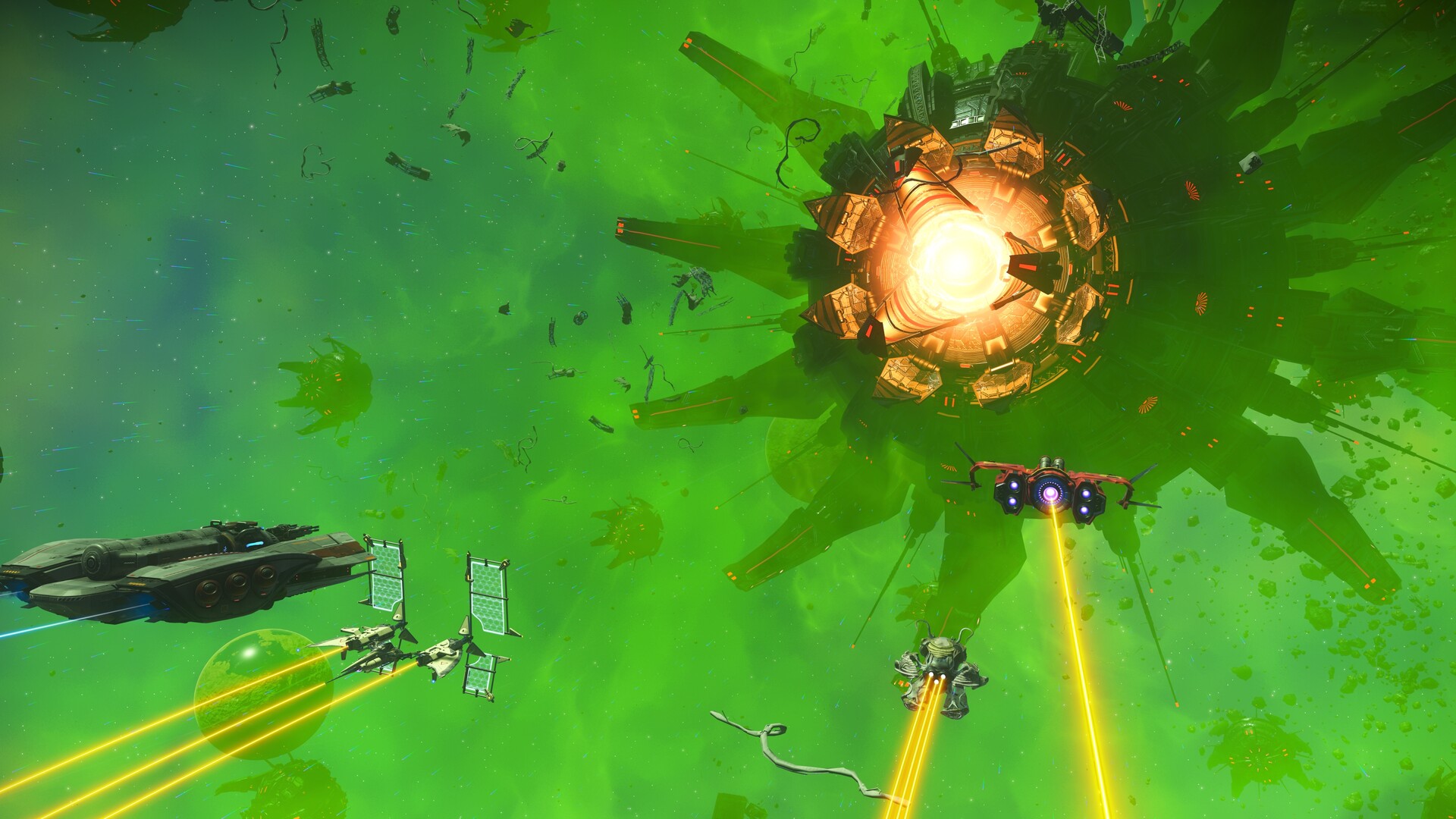
Years of free updates have layered in nearly all of the substance the launch version so conspicuously lacked. There is full drop-in multiplayer now, base building with real structural depth, planetary vehicles and even mechs, living freighter fleets, procedurally seeded settlements you can administer, recurring community Expeditions with their own unique rewards, and a genuine spine of story missions with actual characters and a surprisingly melancholy plot. The problem is no longer a drought of things to do; it is closer to an overwhelming flood, and the game is vastly better for the change.
The catch that no amount of patching has ever fully solved is procedural generation itself, which remains a double-edged sword. Individual planets can be breathtaking, a ringed gas giant hanging over a violet ocean beneath an impossible sky, and every so often the algorithm assembles something you genuinely stop to photograph. But the underlying templates repeat, and after a few dozen worlds the thrill of discovery quietly flattens into pattern recognition; you start to notice the seams, the reused rock formations and the reshuffled color palettes, and the infinite begins to feel stubbornly finite.
The friction runs deeper than mere repetition. Combat, both on foot and in your ship, stays resolutely shallow, a matter of holding a trigger on soft targets rather than anything you would honestly call a system. The interface, for all the passes it has received over the years, still buries basic actions under too many nested menus and a stubborn thicket of inventory slots, and managing your gear can feel like a second, far less enjoyable game running quietly alongside the first. These are old wounds that curing the content drought never quite reached.
What all of it adds up to is a sandbox that rewards players who arrive with their own goals and gently punishes those waiting to be handed one. Builders, explorers, traders, and screenshot tourists can lose whole months in here quite happily; anyone hoping for authored, directed momentum will feel the game politely shrug and hand them a scanner instead.
Art & atmosphere
CraftNo Man's Sky wears its influences openly on its jetpack. This is the airbrushed cover of a 1970s science-fiction paperback rendered playable, all Chris Foss starships in primary colors and Roger Dean skies with floating rocks and improbable arches. The palette is genuinely the whole appeal: procedural generation keeps throwing out color combinations no sober art director would ever sign off on, banded gas giants hung like hard candy over oceans that have no earthly business being that particular shade of purple, and every so often it lands on something authentically sublime.
Not all of it is dignified. The creature generator, splicing bodies together from a kit of interchangeable parts, produces as many hooting, waddling absurdities as it does convincing alien life, and you will meet plenty of animals that look like a committee assembled them in the dark. But the prevailing mood, lonely, vast, and faintly psychedelic, is pitched with real conviction, and the goofiness reads far more as charm than as failure once you stop expecting the game to keep a straight face.
Holding the entire drifting experience together is the soundtrack by 65daysofstatic, a swelling, generative bed of post-rock guitars and glitchy electronics that stretches and recombines as you fly. It means the long, quiet hauls between worlds always feel scored rather than silent, the music rising as you punch through an atmosphere and thinning out again over an empty plain. Paired with the ambient hum of your suit and the patient chirp of the scanner, it does an enormous amount of work to sell the fantasy of being very small and very alone in a very large and very colorful universe.
A vast, hugely improved sandbox whose relentless free updates cured the content drought but never the repetition and shallow combat still sitting underneath it.
Pros & cons
The ledgerIn its favour
- A staggering breadth of activities after years of free updates
- Base building and freighter fleets offer deep, long-term goals
- Full cross-platform multiplayer now comes as standard
- Frequent, unforced moments of real procedural beauty
- One of gaming's most complete post-launch turnarounds
- 65daysofstatic's adaptive score makes the drift feel scored
Against it
- Procedural templates dull the sense of discovery over time
- Combat stays shallow on foot and in ships alike
- A cluttered, menu-heavy interface and endless inventory slots
- The core resource loop can tip into outright grind
- Story is thin connective tissue rather than a genuine draw
Screens
Official media© Hello Games. Official media via Steam.
The player verdict
Real reviews · Steam- Recommended
“This game is not what I expected at all. I normally don't like games with no real ending. I prefer progression, a clear goal, and knowing that eventually I will reach a final point and move on. Endless games usually lose me because after…”
100 found helpfulvia Steam - Not recommended
“This game is a lot of kinda cool ideas all mashed together and left half-baked. The exploration is impressive in its breadth, but ultimately disappointing in depth. After a point, everything is pretty 'same old, same old'. The game is PvE,…”
57 found helpfulvia Steam - Recommended
“No Man's Sky is a game with one of the biggest redemption stories in video game history. When it launched in 2016, it was a massive disappointment. The game was far from what the developers promised, and it got heavily criticized. But…”
42 found helpfulvia Steam - Recommended
“this game here called No Man's Sky is one of my fav games i like related to exploration. what i like the most about this game is about how the universe in that game is insanely large. there are actually so many systems that i can explore.…”
39 found helpfulvia Steam
Verdict
The callNo Man's Sky is the games industry's most complete redemption story, and at this point it has unambiguously earned back the goodwill it once set on fire. What launched as a punchline has been rebuilt, patch by patch and year by year, into a generous and genuinely enormous sandbox, and Hello Games managed it without ever charging existing owners a single cent for the transformation. As a feat of studio perseverance, it has very few peers anywhere in the medium.
As a game to actually sit down and play, it is excellent for the right person and merely fine for everyone else, and it is worth knowing which one you are before you commit a weekend to it. If you are the sort of player who invents your own objectives, who finds real peace in laying out a tidy base or cataloguing a solar system or hunting the perfect screenshot, there are years of quiet obsession waiting in here. If you need tight combat, tautly authored storytelling, or handcrafted worlds that never repeat, the seams will show within an evening and the loop will start to feel like chores in a very pretty costume.
So the fair verdict is a warm and heavily qualified one. This is no longer a broken promise; it is a real, expansive, frequently beautiful place to get lost, one calm planet at a time. It never quite becomes the game that will grip everyone, but it finally and honestly delivers on a version of the dream it once only described from a stage.
Sources
Original review by Aymen Sakouhi from the licensed facts above. Score: 7.6/10.