Luna Abyss Review: A Bullet-Hell Descent Worth Taking
Luna Abyss review: Kwalee Labs' first-person bullet-hell platformer nails movement and atmosphere but leans on a thin enemy roster. Here's the verdict.
Aymen Sakouhi·Writer · Games Hobbyist//6 min read
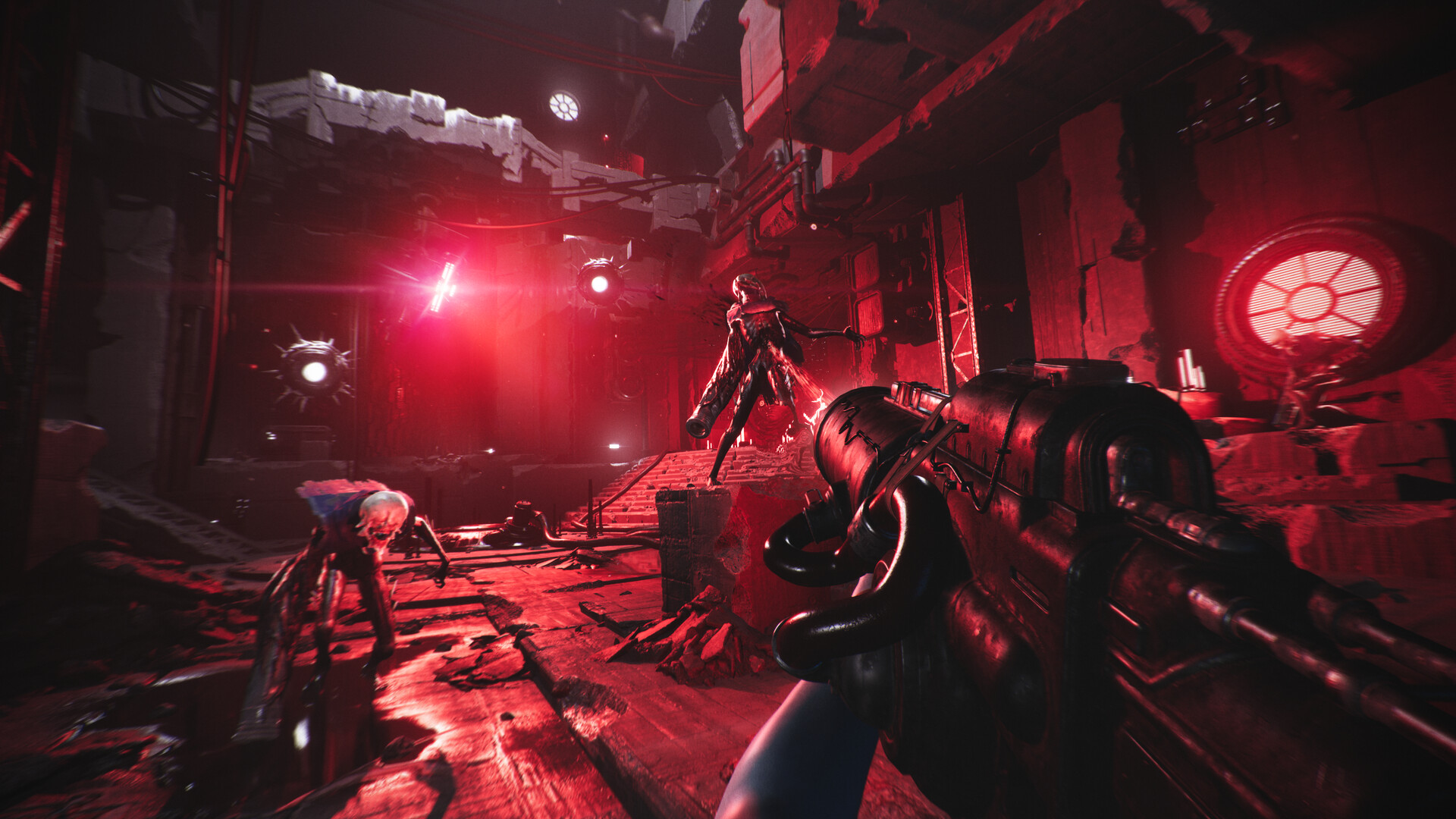
© Kwalee. Official media via Steam.
The pitch
OverviewFawkes wakes up with a 10,000-day prison sentence and an AI warden named Aylin watching her every move, then gets sent down into the Abyss, a drowned megastructure beneath the surface of the mimic moon Luna, to recover technology nobody wants recovered. That premise, laid out in Kwalee Labs' short description as a "single-player action-adventure that fuses fluid platforming and bullet-hell combat," turns out to be the accurate pitch. Luna Abyss is a first-person shooter built around movement first and shooting second, and for most of its runtime that ordering works in its favor.
What's unusual is how confidently a small studio's debut commits to a specific, unfashionable idea: a grapple hook that warps you through barriers rather than just yanking you toward them, wall-runs and double-jumps stacked into genuine platforming sequences, and a four-gun loadout that never asks you to hunt for ammo or wait out a reload. It plays like a mashup of the movement-shooter lineage filtered through a cosmic-horror prison narrative, and it mostly earns the comparison rather than just borrowing the silhouette. Critics largely agreed: Luna Abyss landed with a Metacritic score in the low 80s, with individual outlets ranging as high as 9 out of 10, and Steam's own community sits at roughly 85 percent positive across hundreds of reviews, a "Very Positive" rating that's held steady since launch.
The context around the release matters too, and it would be dishonest to leave it out. Luna Abyss launched on May 21, 2026, on PC, PlayStation 5, and Xbox Series X|S, to a warm critical reception, and weeks later Kwalee laid off the entire nine-person team at Kwalee Labs, its studio CEO calling the decision "completely outside of our control." That doesn't change what's on the disc, but it does mean this is very likely the only game this studio will ever finish, which colors how you read a first outing this assured, and it's the kind of detail a buyer deserves to know before clicking purchase.
How it plays
PlayThe platforming is the game's clearest strength. Traversal starts simple and keeps escalating, layering a dash and double-jump on top of the base moveset before handing you the grapple, which doesn't just pull you toward anchor points but lets Fawkes warp through barriers that would otherwise dead-end a route. Wall-running gets folded into vertical set-pieces that ask you to chain moves without stopping, and the Abyss itself is built to reward that momentum, an alien megastructure of collapsed architecture and vertical shafts that turns getting from A to B into its own kind of combat encounter.
Combat runs on four weapons, an automatic rifle, a shotgun, a sniper rifle, and a rocket launcher, and Kwalee Labs made the smart, small decision to strip reloading out entirely so nothing interrupts the flow between platforming and firefights. Enemies swarm in genuine bullet-hell patterns, filling the screen with projectiles you're expected to read and dodge through rather than tank, which is where the first-person framing actually distinguishes itself from the twin-stick and top-down games the subgenre usually lives in. New traversal tools and new weapons get introduced together often enough that the moveset always feels like it's building toward something, even in the stretches where the enemy list isn't.
The friction shows up in enemy variety. Reviewers converged on roughly seven distinct enemy types, several of which exist mainly to force a weapon swap against a colored shield rather than to demand a genuinely different tactical read. That shield-matching mechanic turns some encounters into a puzzle of picking the correct gun rather than a freeform gunfight, and because the roster doesn't grow much across a run that reportedly lands around fifteen hours, the back half repeats patterns the front half already taught you. It's the one place where a game this technically assured feels like it ran out of runway, and on higher difficulties in particular, players who master the shield-color routine early describe the late game becoming predictable rather than harder.
Structurally, Luna Abyss splits its time close to evenly between shooting and exploring, with environmental storytelling and lore fragments doing a lot of the narrative lifting between set-pieces. Fawkes isn't just clearing rooms, she's excavating the remains of a lost colony the Abyss consumed long before her sentence began, and the scattered logs and environmental clues build that backstory without resorting to lengthy cutscenes. That's a deliberate trade, atmosphere over tempo, and it mostly pays off, though a few reviewers flagged uneven pacing where the platforming and lore-gathering stretches run long enough to dull the momentum the combat just built. Difficulty is adjustable, which matters given how demanding the bullet-hell encounters get on default settings, and the game leans on genuine accessibility options, adjustable text size, color alternatives, keyboard-only and mouse-only control schemes, and full controller support, that indie shooters this size don't always bother shipping.
Aylin, the AI guard narrating Fawkes' descent, is doing more than exposition duty. The prophecy hook and the prisoner framing give the moment-to-moment shooting a reason to exist beyond "next room, next fight," and while the dialogue occasionally makes a swing that lands as more editorializing than characterization, the voice performances anchoring Fawkes and Aylin were singled out by multiple outlets as a genuine strength of the package, carrying scenes that a nine-person studio's budget shouldn't, on paper, be able to afford.
Art & atmosphere
CraftThe Abyss is where Luna Abyss spends its art budget, and it shows. This is a drowned, cosmic-horror megastructure rendered with the kind of environmental density that makes exploration feel purposeful rather than padded, half-submerged industrial architecture giving way to something stranger and more organic the deeper Fawkes descends. The screenshots bear this out: bioluminescent detail against dark, water-logged corridors, scale used to make the player feel genuinely small against the structure, and enough visual variety between zones that the fifteen-hour descent doesn't read as one long corridor repainted.
Sound design carries a lot of the tension during the bullet-hell sections, where the game needs you to read incoming fire by ear as much as by eye, and the voice work for Fawkes and Aylin has been consistently called out as punching above the budget of a nine-person studio's debut. It's not a flashy audiovisual package, and there's nothing here chasing photorealism, but it's a coherent one, and the atmosphere is doing real work toward making a fairly conventional shooter loop feel like it's happening somewhere specific, a mimic moon with its own logic and its own quiet dread rather than a generic sci-fi corridor with better lighting.
Reflects a genuinely strong critical reception (Metacritic 81, several 8-9 scores, 85% positive on Steam) weighed against a thin enemy roster and mid-game pacing that keep it short of the top tier.
Pros & cons
The ledgerIn its favour
- Grapple, dash, and double-jump platforming that keeps evolving and rarely feels rote
- Four-weapon loadout with no reloading keeps the moment-to-moment flow uninterrupted
- Genuine first-person bullet-hell encounters that reward reading and dodging patterns
- Cosmic-horror prison setting and Aylin's AI-warden narration give combat a reason to exist
- Strong voice performances and environmental storytelling for a nine-person studio's debut
- Solid accessibility options, adjustable difficulty, color alternatives, keyboard/mouse-only modes
Against it
- Thin enemy roster, around seven types, that repeats patterns across a ~15-hour run
- Colored-shield weapon-matching turns some fights into a puzzle rather than a gunfight
- Pacing sags where platforming and lore stretches run longer than the momentum supports
- Kwalee laid off the entire dev team weeks after launch, no clarity on future support
- A few scripted story beats land as forced rather than earned
Screens
Official media© Kwalee. Official media via Steam.
The player verdict
Real reviews · Steam- Recommended
“Sadly, the entire development team was laid off by the publisher - directly after release of this gem of a game. Not a purchase to support the developers, then :(”
40 found helpfulvia Steam - Not recommended
“I would pick this up on sale. It's not a bad game, it's got a somewhat interesting story, and some decent mechanics to back it up. There are some strange dialogue choices that feel arbitrary, and one that felt really forced into an agenda…”
17 found helpfulvia Steam - Recommended
“if all companies are destined to fail, whether they produce an indie FPS or a AAA action adventure, then they should be swinging out on risks like this, since it clearly doesn't matter how well you do. i'm glad this game was made and…”
16 found helpfulvia Steam - Not recommended
“As a game it is solid, runs smooth with excellent visual. beautifull distopian atmosphere and look like a decent story. buty the studio fired the whole dev team. if you buy it , it is as it is rn and thats all. i dont reccomend buying.…”
11 found helpfulvia Steam
Verdict
The callLuna Abyss is a confident, occasionally brilliant first-person shooter that gets more right than it gets wrong: the platforming evolves in genuinely satisfying ways, the four weapons all feel good without a reload to interrupt them, and the cosmic-horror prison setting gives the whole thing a reason to hang together. The enemy roster is too thin to fully support a run of this length, and the shield-color puzzle-matching that fills a chunk of the combat can feel more like busywork than a fair fight, but neither problem undoes what the studio built.
It landed to a genuinely positive critical response, including several outlets in the high 8s and 9s and an aggregate that comfortably clears the "very positive" bar on Steam, and that reception holds up on a look at the actual arguments critics made, not just the number they attached to them. Nearly everyone singled out the same things: the movement is the star, the shooting is satisfying in short bursts, and the enemy variety and pacing are where the seams show.
The harder question, given that Kwalee laid off the entire team weeks after launch, is whether you're buying into an ongoing relationship with a studio or a single, self-contained statement. There's no roadmap to speak of and no dev team left to deliver on one if there were. Judged purely as that statement, though, on its own terms and with its flaws intact, Luna Abyss is worth the descent, and a genuinely impressive way for a small studio to have gone out.
Sources
Original review by Aymen Sakouhi from the licensed facts above. Score: 8.2/10.