In Falsus Is lowiro's Bet That a Rhythm Game Can Carry a Story
Verdict: 8.3/10. In Falsus brings lowiro's arcade-sharp charting to PC, wrapped in a deep card system and a fully voiced story. The price is the catch.
Aymen Sakouhi·Writer · Games Hobbyist//5 min read
© lowiro. Official media via Steam.
The pitch
Overviewlowiro spent years turning Arcaea into one of the most respected rhythm games on mobile, the kind of thing people practice like an instrument. In Falsus is the studio's attempt at something harder: take that arcade-grade note design, move it onto a keyboard and mouse, and wrap it in a story you are actually meant to sit with between songs. It is an ambitious swing, and for the most part it connects.
Released on September 9, 2026 for PC and self-published by lowiro at 39.99 euros, In Falsus is a rhythm game tied to an intricate card system and a layered narrative. You follow five interconnected protagonists through a near-future world bound by truths, each of them pulled into a strange government program that slowly pries those truths apart. The songs are the point, but the fiction around them is not an afterthought.
That combination is why the game has landed the way it has. Steam sentiment sits at Very Positive, and the enthusiasm from rhythm fans is specific: this is the arcade-style charting they wanted on PC, from a team that has already proven it knows how to build a note. The reservations are just as specific, and they mostly come down to money and commitment.
Because In Falsus is not a casual pick-up. It asks for 39.99 euros up front, it leans toward players who already love the genre, and it expects you to care about a fully voiced Japanese scenario between your runs. Meet it on those terms and it is one of the most complete rhythm packages on PC this year. Come in cold and the barrier is real.
How it plays
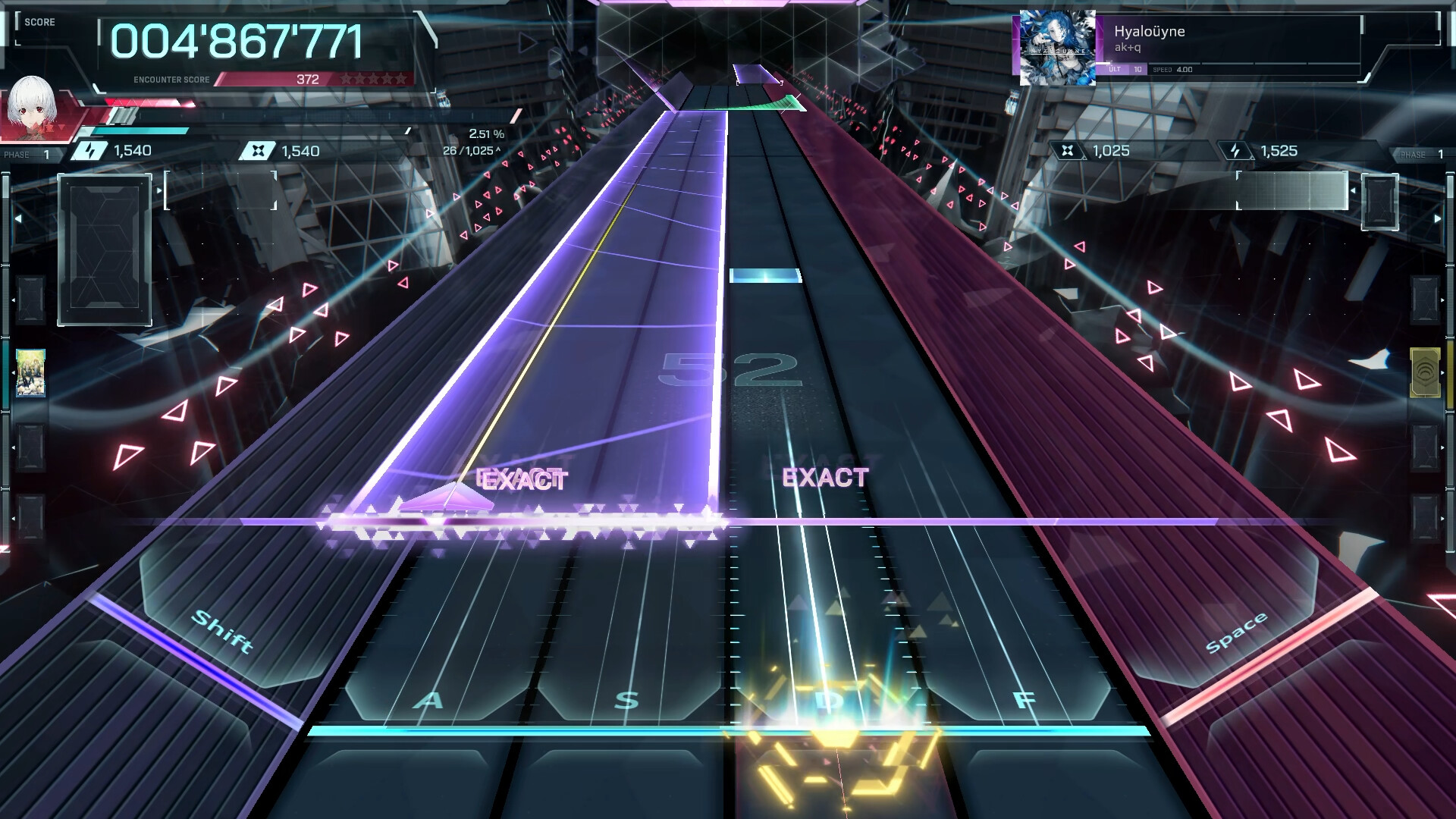
PlayAt its core, In Falsus runs on a signature control scheme built around six keys and the mouse. Notes stream toward you while a sweeping aerial Field asks the mouse to carry motions the keys cannot, and the two hands have to learn to cooperate. There are four difficulty tiers, and the jump from comfortable to genuinely testing is steep, which is exactly what a dedicated rhythm crowd tends to want. The charting is the headline attraction, and it feels authored by people who chart for a living rather than generated to fill a track list.
That pedigree shows in the feel. Inputs read cleanly, the timing window is honest, and the harder charts are built to be practiced and beaten rather than simply survived. If you came from Arcaea expecting lowiro's precision to translate, it does. The novelty here is the mouse, which turns the aerial Field into a second instrument. It takes real time to click, and the first hour can feel like patting your head while rubbing your stomach, but once it lands it gives the game a texture most keyboard rhythm titles do not have.
Around the notes sits a surprisingly deep card system. You collect materials, craft unique Cards that grant gameplay advantages, and arrange those materials inside Blueprints, grids that reward smart placement with stat boosts and bonuses. You can equip up to five Cards at once, so the loadout becomes its own small puzzle: every Card is different, every Blueprint is a layout problem, and optimizing them gives the between-song downtime an actual reason to exist. It is a genuine progression layer rather than a cosmetic bolt-on.
The narrative is delivered as a fully voiced Japanese ADV scenario, the visual-novel format lowiro clearly wanted to lean into. Five protagonists, each with their own perspective, are recruited into the government program at the story's center, and their threads gradually knot together. It is more substantial than the throwaway framing most rhythm games settle for, and if you are the kind of player who reads every line, there is a real arc to follow. If you are not, the game lets the music carry you and the story recede.
For content, the package is generous. There are over 70 songs, more than 40 of them originals, drawn from artists at the front of Japan's independent music scene alongside international composers, and the styles range widely enough that no two sessions feel identical. It is single-player only, with 25 achievements to chase, and the long tail comes from climbing difficulty tiers and refining Card builds rather than from any competitive mode.
The friction is honest to name. This is a premium-priced, single-player rhythm game aimed squarely at people who already love the genre, and the difficulty can spike sharply between tiers in a way newcomers may find discouraging. There is no co-op or competitive hook to fall back on, so the entire value proposition rests on the charts, the songs, and the story being enough. For the target audience they are. For everyone else, 39.99 euros is a lot to ask of a maybe.
Art & atmosphere
CraftVisually, In Falsus is unmistakably a lowiro game: clean, anime-styled, and confident about negative space. The playfield keeps its focus tight, the aerial Field sweeps in as an elegant second layer rather than clutter, and the interface stays legible even as the charts get busy. It is a look built to disappear into flow, which is the right instinct for a rhythm game, and the visual-novel sequences give the cast enough presence to make the story feel like a place rather than a menu.
The soundtrack is the real work of craft here, and it is where the money shows. More than 70 tracks, over 40 of them written for the game, pull from Japan's independent scene and a spread of international artists, and the range is the point: this is not one producer's signature sound stretched thin but a curated set that keeps surprising you. The best charts are the ones built to serve their song, and In Falsus has enough of those to justify calling itself a music game first.
The full Japanese voice acting ties the presentation together. It lends the ADV scenes weight they would lack as silent text, and it signals how seriously lowiro takes the fiction. The whole production reads as deliberate, from the restraint of the UI to the breadth of the music, and that coherence is a large part of why the game feels worth its asking price to the people it is aimed at.
Superb charting, a deep card system, and a large, eclectic soundtrack make this a standout PC rhythm game, held just short of great by a steep price and a hardcore-leaning barrier to entry.
Pros & cons
The ledgerIn its favour
- Arcade-grade charting from the Arcaea team, tuned for keyboard and mouse
- The aerial Field and mouse control add real texture once they click
- A genuinely deep Card and Blueprint crafting layer that rewards experimentation
- Over 70 tracks, more than 40 originals, spanning a wide range of styles
- A fully voiced Japanese story treated as more than throwaway framing
- Very Positive player sentiment from a demanding rhythm-game audience
Against it
- At 39.99 euros it is a steep ask next to most PC rhythm games
- Leans hard toward committed genre fans rather than newcomers
- The six-key-plus-mouse scheme takes real time to learn
- Single-player only, with no competitive or co-op hook
- Difficulty can spike sharply between tiers
Screens
Official media© lowiro. Official media via Steam.
The player verdict
Real reviews · Steam- Recommended
“Great gameplay concept that's inspired by other arcade rhythm games similarly how they did Arcaea. Although I'm on a ISO keyboard layout, the one with small shift, and it's hard to hit the left side note when there's an extra button. For…”
10 found helpfulvia Steam - Recommended
“Played from demo to release, I'd say, this game is very unique, the controls are unique unlike many other rhythm games, and it's difficult, but it's fun, visual art is literally fire, the song list is also fire. you can play this on any…”
4 found helpfulvia Steam - Recommended
“Been playing the demo and waiting for this game to come out, so far everything looks super clean and song list is fire. Gameplay is difficult to pick up but very satisfying to play. Recommended for people looking for a challenging rhythm…”
2 found helpfulvia Steam - Recommended
“You're getting a pretty lengthy, seemingly solid visual novel along with a very solid rhythm game that brings new rhythm game gimmicks to pc that are usually only seen in Arcades! The charting seems pretty good so far, and the control…”
2 found helpfulvia Steam
Verdict
The callIn Falsus is lowiro doing what lowiro does best, then quietly proving it can do more. The charting carries the studio's arcade DNA onto PC without watering it down, the mouse-driven aerial Field gives the whole thing a signature that other keyboard rhythm games lack, and the Card system turns the space between songs into a puzzle worth solving. Layer a fully voiced story on top and you have a rhythm game that actually wants to hold your attention when the music stops.
The cost of all that ambition is a game that knows exactly who it is for and does not pretend otherwise. It is premium priced, it is single-player, and it expects commitment, both to the difficulty curve and to reading its fiction. Newcomers can absolutely learn it, but they will feel the 39.99-euro asking price more sharply than a lapsed Arcaea player will.
At 8.3, In Falsus is an easy recommendation to rhythm-game devotees and a considered one to everyone else. If tight charting, a huge and eclectic soundtrack, and a story you can sink into sound like your evening, this is among the most complete packages the genre has produced on PC this year. Just go in knowing it asks for real money and real investment, and rewards both.
Sources
Original review by Aymen Sakouhi from the licensed facts above. Score: 8.3/10.