Hollow Knight and the Art of Getting Beautifully Lost
Our Hollow Knight review: Team Cherry's beautiful, brutal Metroidvania, from nail combat and charm builds to the dead kingdom of Hallownest.
Aymen Sakouhi·Writer · Games Hobbyist//5 min read
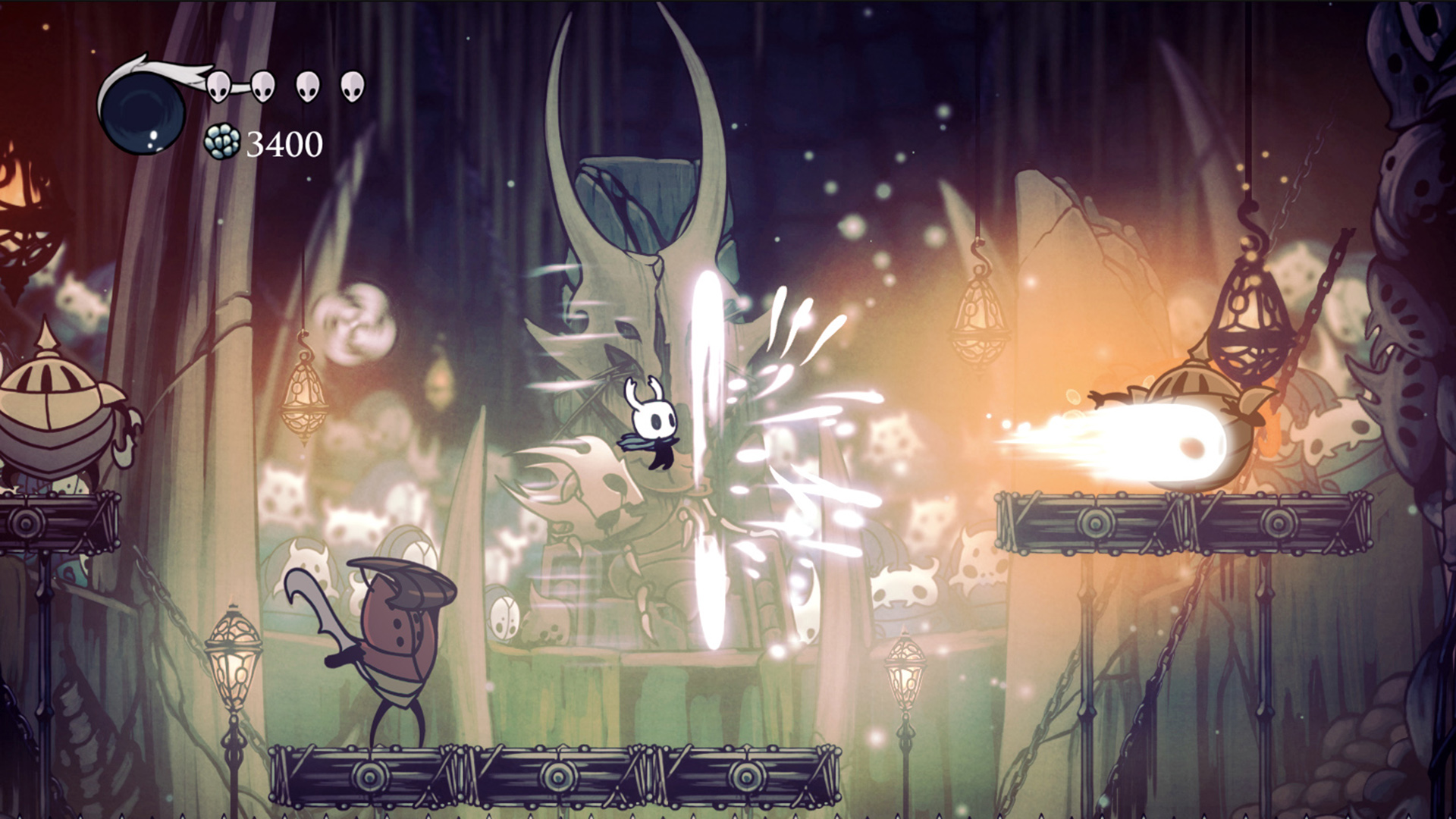
© Team Cherry. Official media via Steam.
The pitch
OverviewTeam Cherry began Hollow Knight as a modest crowdfunding pitch and finished it as the game every other Metroidvania now quietly measures itself against, which is not the arc anyone drawing up a campaign about bugs would have dared predict. It drops you at the lip of a forgotten mining town, points you down a single creaking elevator into the dark, and then, with remarkable nerve, stops explaining itself. There is no quest marker, no tutorial eager to hold your hand, only a small knight, a nail, and a kingdom that has already ended without telling you why.
What waits below is Hallownest, a dead insect civilization built in descending layers, each a different flavor of ruin: rain-drowned cities, fungal wastes, a royal waterway, a lightless nest whose name has become shorthand among players for pure dread. You explore it as a silent wanderer armed with a nail for a blade and a thin reserve of soul for magic, assembling both the map and the tragedy at whatever pace your curiosity sets.
This is the Metroidvania idea taken seriously and then taken a very long way. Progress is gated not by keys or experience numbers but by your own expanding vocabulary of movement, so the world rearranges itself every time you learn to dash, cling to a wall, or throw yourself upward. The design trusts you to notice, to remember the sealed door you drifted past two hours ago, and to go back and open it on your own initiative rather than a waypoint's.
The lineage is plain enough, Metroid and Symphony of the Night with a streak of Dark Souls in the bloodstream, and yet the game rarely feels borrowed. It absorbs those influences and then out-executes most of them, which is why, years and one long-awaited sequel later, it still functions as the bar the genre is politely expected to clear.
How it plays
PlayCombat runs on a single weapon and a single resource, and the friction between them is the whole engine. The nail is a short-range strike with real heft, and every clean hit banks soul into a small meter. That soul is currency for two competing needs: you can pour it into a heal, or you can spend it on a handful of spells. Healing forces you to stand still for a beat, which mid-boss is an open invitation to be punished, so the game turns even your recovery into a wager. Greed kills you here far more reliably than clumsiness does.
Sitting over the top is the charm system, and it is where Hollow Knight stops being a fixed build and becomes a form of self-expression. Charms are equippable trinkets, each costing a number of notches from a capped pool, and the loadout you assemble decides how you actually fight. You can lean into brute nail damage, spin up a dedicated spellcaster, chase a fragile glass-cannon setup that trades away healing for a heavier swing, or build purely for safety and traversal. There is rarely a wrong answer, only trade-offs, and reshuffling charms in front of a wall you keep dying to is its own quiet species of problem-solving.
Exploration is the other half, and it is unusually stubborn about handing you information. You do not begin a region with a map; you buy it, zone by zone, from a cartographer who is always sitting somewhere inconvenient and humming to himself, and until you find him the area is a blank you have to hold in your own head. Even once you have the paper, you cannot see your position on it without equipping a particular charm, a choice that looks hostile written down and works beautifully in play, because it makes disorientation feel like a designed condition rather than a failure. Getting lost in Hallownest is the intended experience, not a defect in it.
The bosses are the spine holding the whole thing upright. From the clean two-on-one duel with the Mantis Lords to the marathon endurance trials of the endgame pantheons, the encounters are readable, fair, and genuinely difficult, the sort that convert a stack of failed attempts first into muscle memory and then into something close to elation. Team Cherry has a rare instinct for the gap between a fight that is hard and one that is merely unfair, and it lands on the right side of that line far more often than it slips.
For a debut from a studio you could count on one hand, the sheer volume verges on the indecent. The base map is vast, and Team Cherry then bolted on four substantial free content packs, layering in new bosses, a whole colosseum of combat trials, and extra playable modes at no additional cost, which is the kind of generosity that makes the sticker price read like a rounding error. The flip side of all that abundance is a near-total absence of accessibility scaffolding: no difficulty settings, no meaningful hints, and a pool of geo, your currency, that you drop on death and must reclaim from your own lingering ghost.
It is not spotless in the minute-to-minute. Early fast travel through the Stag stations is thin, so some stretches decay into long trudges back through rooms you have already emptied, and the optional platforming trials, the notorious white palace chief among them, tip over from demanding into faintly sadistic. But the fundamentals never stop feeling good: the weight of the nail landing, the crisp little pogo bounce off an enemy's skull, the way movement grows more articulate the longer you sit with it. Annoyance and satisfaction are braided together so tightly here that even the friction reads as part of the texture.
Art & atmosphere
CraftHallownest is drawn by hand in charcoal and washed-out watercolor, all soft edges and bruised blues, its caverns lit by the sickly glow of things that have no business being luminous. The art direction grasps that a dead kingdom needs to feel recently dead, still furnished and faintly warm, so every screen is stacked with parallax detail that makes the rooms read like dioramas sealed under glass. The regions commit hard to their separate identities: the rain-lashed grief of the City of Tears, the acid greens of the fungal reaches, the crawling claustrophobia of Deepnest, a place even the game's devotees will warn you about before you wander in.
The characters are near-silhouettes, small hunched shapes with pinprick white eyes, and yet they emote with startling clarity through posture alone. The knight never speaks and has barely a face, but its body language, resolute, weary, now and then frightened, carries an enormous amount of the storytelling, and the supporting cast of peculiar bugs registers as vivid despite being animated in only a handful of expressive frames each. It is a lesson in doing a great deal with deliberately little.
Christopher Larkin's score is the other half of the spell and arguably the element that lifts the game from excellent to unforgettable. Mournful piano and swelling strings turn the endless downpour of the City of Tears into something adjacent to mourning, and the music knows precisely when to drop away and leave you with nothing but your own footsteps and the drip of water. The sound design matches it, every ring of the nail off stone and every wet skitter in the black tuned for atmosphere rather than spectacle. Few games have ever made a finished, ruined world feel this reluctant to let you go.
A near-perfect Metroidvania whose only real barrier to a flawless score is the same deliberate opacity that makes it special.
Pros & cons
The ledgerIn its favour
- Hallownest is a hand-drawn world with real atmosphere and a distinct identity in every region
- The nail-and-soul economy turns even healing into a tense risk-reward decision
- Charm loadouts allow genuine build variety and self-expression
- Bosses are consistently tough, fair, and memorable
- Christopher Larkin's score is among the finest the genre has produced
- An enormous base game deepened further by four free content packs
Against it
- Deliberately opaque, with almost no guidance for newcomers
- The map system withholds basic navigation until you hunt down specific tools
- Thin early fast travel makes some backtracking a slog
- Optional late-game platforming tips from demanding into punishing
- No difficulty options or accessibility scaffolding of any kind
Screens
Official media© Team Cherry. Official media via Steam.
The player verdict
Real reviews · Steam- Recommended
“No gamer should go without playing this game. I argue it's necessary. This is my favorite game of all time and in my honest opinion it is the best metroidvania ever made. I love Silksong as well, but I need more time to learn more about it…”
35 found helpfulvia Steam - Not recommended
“deepnest!!!!!!! i may be a easily scared loser but deepnest sucks!!!!!! get the game and stop looking at negative reviews”
21 found helpfulvia Steam - Recommended
“Hollow Knight is a metroidvania widely regarded as one of the best games of all time by people, I am someone who has played a lot of Metroidvanias so I will give my fair review if its so-called legendary status holds grounds. If you do not…”
15 found helpfulvia Steam - Recommended
“"Every corner of Hollow Knight is crafted with care. The atmosphere, soundtrack, exploration, and boss fights come together to create one of the greatest games ever made."”
13 found helpfulvia Steam
Verdict
The callHollow Knight is a generous game wearing the costume of a severe one. It withholds direction, punishes carelessness, and insists you meet it on its own terms, but for anyone willing to do that it delivers a sense of place and hard-won mastery that almost nothing else in the genre can match. The free updates only widened an already sprawling map, turning a large adventure into something that can comfortably swallow sixty hours and still leave corners you never found.
It is not for everyone, and pretending otherwise would be dishonest. The vagueness and the difficulty will shed some players inside the first few hours, and the game will neither chase them nor apologize. But for those who want a world that rewards attention rather than obedience, it is close to essential, and it remains, years on, the clearest argument anyone has yet made for what a modern Metroidvania is capable of being.
Sources
Original review by Aymen Sakouhi from the licensed facts above. Score: 9.3/10.