Hand of Fate: Hordes Bets the Dealer's Deck on a Bullet Heaven, and the Wager Mostly Pays
The Dealer returns, dealing tarot cards into a roguelike bullet-heaven auto-shooter. Promising but rough in early access. Our verdict: 7.3/10.
Aymen Sakouhi·Writer · Games Hobbyist//6 min read
© Spicy Koala. Official media via Steam.
The pitch
OverviewThe Hand of Fate games always lived at a strange intersection. They were card games that suddenly turned into brawlers, tabletop fantasy that kept flipping into real-time combat, all of it narrated by a Dealer whose dry menace did more for the mood than any boss fight. Hand of Fate: Hordes takes that identity and drops it into one of the most crowded rooms on Steam: the bullet heaven, the auto-shooter lineage that Vampire Survivors turned into a genre overnight.
Developed by Spitfire Interactive and published by Spicy Koala, this is a spinoff that knows exactly which two things it wants to fuse. You still draw cards to shape a run, still answer to the Dealer (Anthony Skordi returns to the role, and his voice remains the series' single most recognizable asset), but the moment-to-moment loop is now the familiar dance of a survivor-like: you move, your character fires on its own, and you try to outlast an ocean of enemies pouring in from a netherworld past the 13th Gate.
That pairing is the whole pitch. A bullet heaven lives or dies on how its builds snowball, and a deckbuilder lives on the tension of what you draw next. Hordes bets that letting you stack cards, blessings, and modifiers before and during a run will give the usual numbers-go-up power fantasy an actual spine of decisions. When it works, it feels like the series finally found a combat system that matches its card-table soul.
This is an early-access launch, though, and the wording matters. What you are buying today is a foundation, priced at roughly ten dollars with a launch discount, with the developers openly promising more heroes, quests, dungeons, bosses, and weapons over the months ahead. So treat this as impressions of a work in progress rather than a verdict on a finished game. The bones are good. Some of the muscle is not on yet.
How it plays
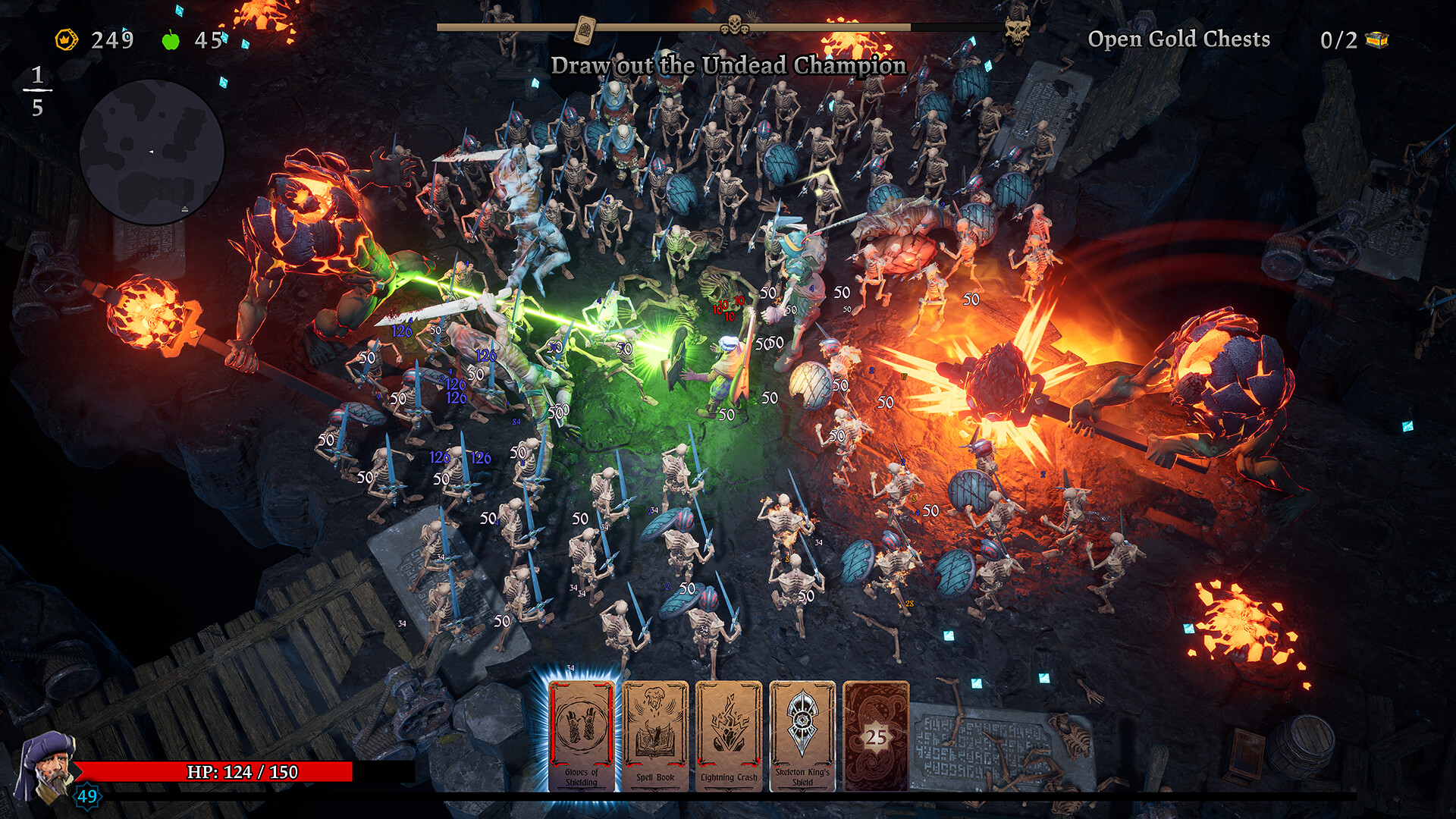
PlayThe core loop will be instantly legible to anyone who has played a survivor-like. You pick one of four heroes, drop into an arena, and the enemies come in escalating waves while your chosen character auto-attacks whatever wanders into range. Your direct job is positioning: threading between mobs, kiting the dangerous ones, and staying alive long enough for your build to come online. Everything else is about what that build turns into.
The four heroes are the first real point of variety. They split roughly across ranged, melee, and magical styles, so the Trickster, Goblin, Warrior, and Rebel each ask you to play the same arenas differently. A hero built around close-range sweeps wants very different positioning from one that thins the horde at distance, and that alone gives the early roster more texture than a lot of one-avatar auto-shooters manage at launch.
Where Hordes tries to distinguish itself is the deck. Cards, weapons, blessings, and modifiers stack into your run, altering encounters, granting new effects, and introducing fresh risks in exchange for reward. The idea is that you are not just picking the next upgrade from a random trio; you are assembling a hand, curating what fate can deal you. At its best this delivers the specific pleasure the genre trades in: a run that starts unremarkable and, three good draws later, becomes a screen-clearing engine you engineered rather than stumbled into.
The Dealer frames all of it. His challenges and taunts give the structure a personality that most survivor-likes simply do not have, and it is the clearest argument for why this game exists as a Hand of Fate title rather than a generic reskin. The tarot dressing is not just a coat of paint; it is the reason the deck metaphor lands at all.
Here is where early access stops being a disclaimer and starts being the review. The build in players' hands right now is rough in ways that matter. The interface is unintuitive, and a bullet heaven is a genre where you make constant fast decisions from menus, so a clumsy UI is not a cosmetic complaint; it taxes the exact thing the game asks you to do well. The tutorial does a poor job of teaching how the card systems actually interact, which means the most interesting part of the design is also the part players report bouncing off first. And the metaprogression, the between-run sense of permanent growth that keeps this genre's hooks in you, is widely called the weakest link: without a satisfying reason to come back and grind toward something, the loop can feel like it resets to zero.
None of that is fatal, and it is worth being fair about scale: this is a small team shipping an ambitious fusion into a genre defined by a few polished giants. The systems underneath are sound and the concept is genuinely good. But content volume is thin by the standards of the games it is competing with, and the friction around teaching, menus, and long-term progression is exactly the sort of thing that determines whether an early-access survivor-like builds a community or quietly stalls. The roadmap says the team knows this. The current build is why the score is not higher.
Art & atmosphere
CraftVisually and sonically, Hordes leans hard on the one thing the franchise has always owned: the table. The tarot motif runs through the presentation, cards and arcana framing a dark-fantasy netherworld of endless enemies, and it gives the game a coherent identity in a genre that often looks like a particle-effect soup with no point of view. When a screen fills with hundreds of foes, the readability of that chaos is the whole art problem, and a strong visual language for your attacks and theirs is worth more than any amount of raw fidelity.
The standout, unquestionably, is Anthony Skordi's Dealer. Voice work is not usually where you judge a bullet heaven, but here it is load-bearing. His delivery supplies the menace, the wit, and the sense that a hand is being dealt against you, and it single-handedly lifts the between-fight moments above the mechanical. It is the connective tissue that makes the whole thing feel authored rather than assembled.
As an early-access object, the craft is uneven, and honestly so. The audiovisual mood is strong at the level of concept and voice, but the interface is where the presentation currently lets it down, and in this genre the UI is not separate from the art; it is the surface you actually live on. A menu that fights you undercuts even a great aesthetic. The foundation for a striking, legible, tarot-soaked survivor-like is clearly here. Whether it reads as polished spectacle or rough promise depends on updates that have not shipped yet.
A genuinely clever deckbuilder-meets-bullet-heaven with a standout Dealer, held back for now by rough UI, a weak tutorial, thin metaprogression, and the modest content that comes with an early-access launch.
Pros & cons
The ledgerIn its favour
- The deckbuilding-into-bullet-heaven fusion is a genuinely smart fit for the series' card-table DNA
- Four heroes across ranged, melee, and magical styles give the early roster real variety
- Anthony Skordi's returning Dealer is a standout, lending personality most auto-shooters lack
- Cards, blessings, and modifiers can snowball a run into the exact engineered power fantasy the genre loves
- A low entry price and an openly communicated roadmap for a small, ambitious team
Against it
- Unintuitive UI is a real problem in a genre built on fast, constant menu decisions
- A weak tutorial hides the card systems that are supposed to be the main draw
- Metaprogression is thin, undercutting the between-run pull that keeps survivor-likes sticky
- Content volume is modest next to the polished giants it competes with
- It is early access: much of the promise is on a roadmap, not on your screen today
Screens
Official media© Spicy Koala. Official media via Steam.
The player verdict
Real reviews · Steam- Not recommended
“I enjoyed hand of fate 1/2, this game is not hitting right for me in this early access build. The narrative frequency is way too high. About every six seconds you open a chest or activate a shrine, which pauses the game to drop two…”
31 found helpfulvia Steam - Not recommended
“The game has a unique atmosphere & many interesting mechanics that evolve the genre, enjoyable gameplay, but the build is still very rough atm. This includes the unintuitive UI/UX, a poor tutorial, and terrible metaprogression like +1%…”
29 found helpfulvia Steam - Not recommended
“Looking at the global achievements it seems like just about everyone playing this has dropped off around stage 3 or 4, and once you get there you see why. There are a lot of really cool ideas on display for a survivors style game, but the…”
19 found helpfulvia Steam - Recommended
“I only got 90 minutes in, but it seems to be everything on the tin so far. It is still early access, but it seems to be hitting those Hand of Fate vibes while doing this dungeon bullet hell/heaven stuff. So far, I ran into no bugs or…”
17 found helpfulvia Steam
Verdict
The callHand of Fate: Hordes has the best kind of early-access problem: the idea is right and the execution is behind it. Marrying a deckbuilder to a bullet heaven is not a gimmick, it is the most natural home the series' combat has ever had, and with the Dealer presiding over the carnage the game earns its place as a real Hand of Fate spinoff rather than a trend-chasing reskin. When a run comes together, you feel exactly why this fusion should work.
The caveats are the ones early access exists to carry. The interface fights you, the tutorial undersells the systems that matter most, the metaprogression does not yet give you a reason to keep coming back, and there simply is not as much game here as the polished veterans of the genre offer. The strongly positive player reception tells you the core is fun enough to shine through the rough edges, but reception and readiness are different things.
So this is a qualified recommendation, and the qualifier is you. If you love bullet heavens, love the Hand of Fate voice, and are happy to buy into a promising foundation while it is actively built out, this is an easy, cheap yes with a lot of upside. If you want a complete, frictionless survivor-like to sink dozens of polished hours into tonight, wait a few content updates and check back. The wager is a good one. It just has not been paid out in full.
Sources
Original review by Aymen Sakouhi from the licensed facts above. Score: 7.3/10.