Valheim Turned a Crowded Genre Into a Viking Ghost Story
Our Valheim review digs into Iron Gate's Norse survival hit: boss-gated progression, weighty combat, physics-based building, and great co-op.
Aymen Sakouhi·Writer · Games Hobbyist//5 min read
© Coffee Stain Publishing. Official media via Steam.
The pitch
OverviewFew games have arrived as quietly as Valheim and then refused, quite so stubbornly, to leave. Iron Gate's Norse afterlife slipped into Steam Early Access in early 2021 looking, at a squint, like one more entry in an overstuffed genre: chop the trees, outrun starvation, nail together a hut before dark. Then several million people bought it inside a few weeks, and the thing tipped over into a genuine phenomenon almost entirely on the strength of how good it feels to simply stand around in its world.
The premise is pure mythology. A great bird drops your dead Viking into a tenth realm, a purgatory of forest and swamp and mountain, and the local goddess lays out the terms: you earn your way onward by hunting down and killing the beasts that rule each biome. It wears the survival-crafting template but sands most of the tedium off it, trading busywork for a rhythm of scouting, preparation, and steadily rising stakes.
What Valheim reaches for, and mostly grasps, is the old pleasure of a world that feels genuinely uncharted. Every map is procedurally generated, so nobody can simply hand you a route through it; the coastline you sail past and the dark forest you decide, unwisely, to camp beside are yours to discover and yours to regret. It wants exploration to carry real weight, and it backs that ambition with a landmass large enough to stay intimidating for a very long time.
In a category crowded with games that mistake a longer crafting tree for depth, Valheim stands apart by being confident about atmosphere and unhurried about progression. It is less interested in survival as a spreadsheet than in survival as a mood, and that instinct is what separated it from the pack and then kept it there long after the launch spike had faded.
How it plays
PlayThe loop is unusually clean for the genre. Each biome, from the gentle Meadows through the murky Black Forest to the fever-swamp beyond, gates a tier of materials and a summonable boss whose death unlocks the next rung of the tech tree. You do not grind character levels; you grind knowledge and equipment, and the distinction matters enormously. A better pickaxe opens a new biome, which yields new materials, which craft new gear, which open the next biome again. It is old-fashioned tool-gated progression executed with a rare clarity of purpose.
Combat is deliberate and governed entirely by stamina, closer to a lightweight action game than a numbers check. Blocking, parrying, dodge-rolling, sprinting, and every swing of an axe all draw from the same green bar, so a scrappy fight in the Swamp can unravel fast the instant you find yourself winded with a Draugr closing in. Parrying is the skill the game quietly wants you to learn, a well-timed block staggering an enemy and cracking it open, and internalizing that rhythm is the difference between a warrior and a fresh corpse on the tombstone-strewn shore. Food underpins all of it, since what you eat, and you can stack up to three different dishes at once, sets the size of both your health and your stamina pools, quietly turning cooking into a core combat stat rather than a survival afterthought.
Building is a genuine highlight and, for a good many players, the real reason to stay logged in. The construction system is physics-aware: beams sag and snap under load, structures need actual support, and a roof stretched too far from a wall will simply fall down and take your enthusiasm with it. It rewards anyone who wants their longhouse to read as a longhouse rather than a floating cube, and the comfort mechanic, which grants a rested bonus for a well-appointed home, ties the aesthetics back into the survival math so the effort is never purely decorative.
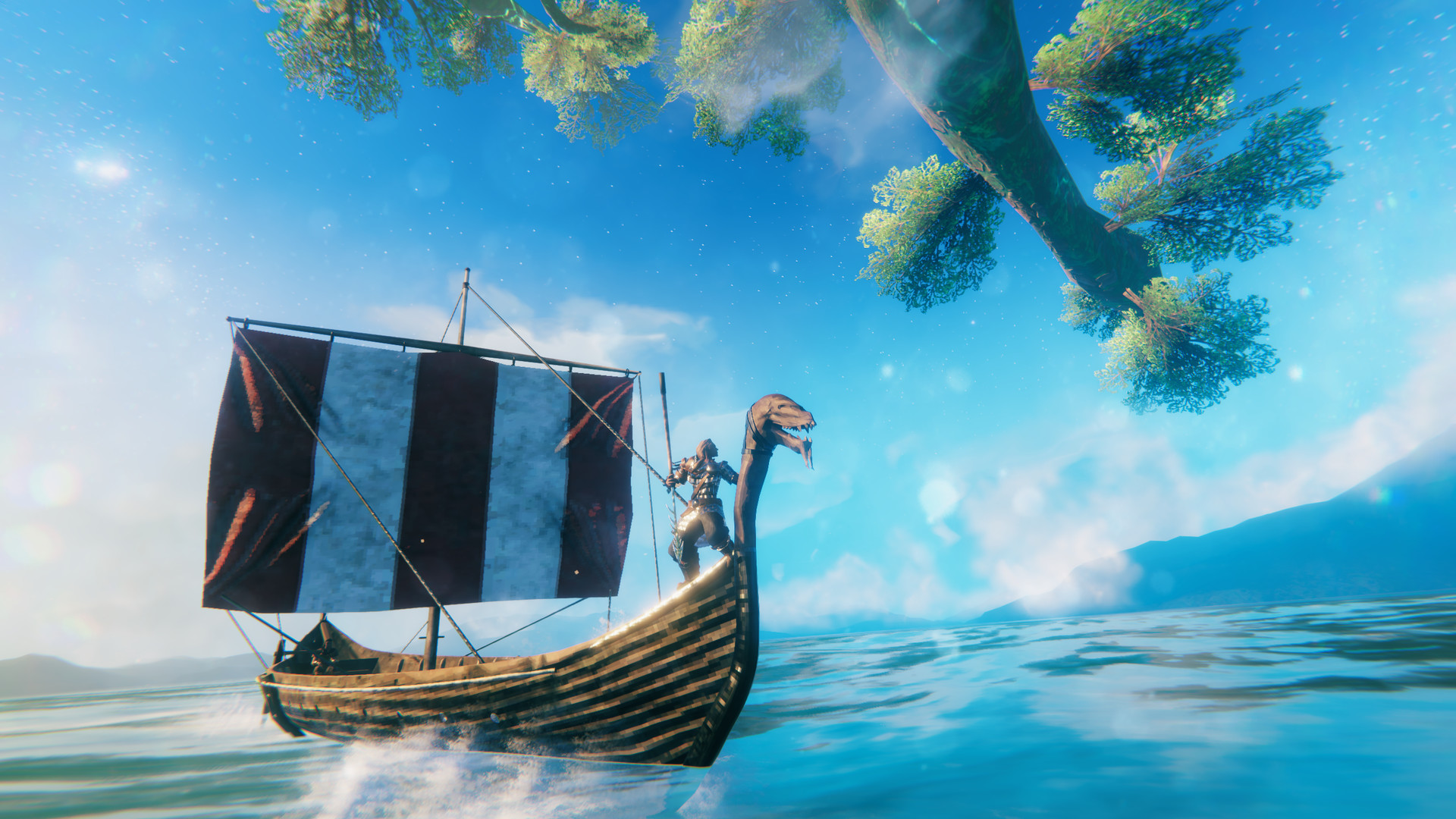
There is a satisfying amount of world to move through, and the moment you graduate from a flimsy raft to a proper longship and strike out across open ocean is one of the game's quiet peaks, right up until a serpent finds you in a squall. Traversal is also where some of the friction lives. The later biomes stretch the pacing thin, and long open-water crossings, becalmed and waiting on a wind that refuses to turn, can curdle into dead time that no amount of scenery quite redeems. Portals take some of the sting out, stitching distant outposts into a fast-travel network, but Iron Gate pointedly refuses to let you carry ore or ingots through them, so hauling metal home still means a slow, vulnerable boat trip, a deliberate friction players have argued about since launch.
Where Valheim genuinely transforms is in co-op. A shared server for up to ten players turns solitary logistics into a division of labor: one friend farming, another out prospecting for silver in the mountains, a third insisting the base urgently needs a second story, and the seasonal terror of a night raid on your walls becomes a story you tell afterward rather than a lonely catastrophe. The rough edges soften considerably when there is somebody else around to laugh at the shipwreck with you.
The seams do still show, and it would be unfair not to say so. This has been an Early Access game for a long stretch, and it plays like one in places: the mid-game Swamp difficulty spike sends plenty of newcomers home, inventory and hotbar management are more functional than graceful, and the gaps between major content updates have tested even the faithful. What is remarkable is that even unfinished, Valheim already feels more coherent and complete than most survival games manage at their supposed 1.0.
Art & atmosphere
CraftValheim performs a quiet sleight of hand: blocky, low-detail models lit like an oil painting. Up close, the trees and the shambling Draugr are almost crude, all hard edges and flat texture. Then Iron Gate drapes the whole scene in volumetric fog, dithered shadow, and long amber shafts of dawn, and the tenth Norse world turns genuinely, unexpectedly beautiful. It is a masterclass in spending your rendering budget on light rather than on polygons.
Each biome commits to a single, legible mood, carried mostly by color. The bright wet green of the Meadows, the choking sickly haze of the Swamp, the blue-white hush of the Mountains, so crossing a border feels less like loading a new zone than stepping into a different painting with different rules. The weather system does a lot of unglamorous heavy lifting; a rolling storm at sea is genuinely frightening in a way a static skybox never could be.
The audio is sparing and deliberately lonely: wind through timber, the creak of your own half-built hall, the distant call of something in the trees you would strongly prefer not to meet. The score stays mostly out of the way, a spare arrangement of plucked strings that only rises to meet you when a boss stirs, and that restraint is exactly the point. This is a purgatory that somehow makes solitude feel intended rather than empty, a strange and specific achievement for a game largely about beating monsters to death with a bronze axe.
An unusually confident, atmosphere-first survival game held just short of greatness by its long Early Access rough edges and mid-game pacing lulls.
Pros & cons
The ledgerIn its favour
- Clear, satisfying boss-gated progression that never resorts to grinding levels
- Stamina-driven combat with real weight and a genuinely rewarding parry
- Physics-aware building that rewards actual craftsmanship
- Striking atmosphere and lighting wrung from a deliberately modest art style
- Exceptional in co-op for up to ten players
- A procedurally generated world that stays genuinely uncharted
Against it
- Still in Early Access, with uneven and thinner late-game biomes
- Long open-water sailing can curdle into dead time
- A sharp mid-game difficulty spike in the Swamp turns players away
- Notable droughts between major content updates
- Inventory and hotbar management are more functional than graceful
Screens
Official media© Coffee Stain Publishing. Official media via Steam.
The player verdict
Real reviews · Steam- Not recommended
“after almost 1k hours in this game, i can say, it is a really frustrating game. The early game seems pretty balanced. the progression feels good. exploration is fun and exciting. but once you hit mid to late game, its abysmal. Oh whats…”
131 found helpfulvia Steam - Recommended
“Played this game with my partner a lot who recently passed. I have picked it back up and it's given me a lot of comfort in my grief to share a game with someone I love and memories of the times we played it. Can't wait for 1.0.”
121 found helpfulvia Steam - Recommended
“---{ Graphics }--- ☐ You forget what reality is ☐ Beautiful ☐ Good ☑ Decent ☐ Bad ☐ Don‘t look too long at it ☐ MS-DOS ---{ Gameplay }--- ☑ god tier ☑ Very good ☐ Good ☐ It's just gameplay ☐ Mehh ☐ Watch paint dry instead ☐ Just don't ---{…”
49 found helpfulvia Steam - Recommended
“Quite frankly, this is an incredible game, no matter what you compare it to, which is even more impressive given it's not out of early access yet The devs are continuously supporting with bug fixes, small and regular updates and even…”
46 found helpfulvia Steam
Verdict
The callValheim works because it understands that atmosphere is a mechanic, not a garnish. Its low-poly art and extraordinary lighting turn a storm at sea or a first glimpse of a lumbering Troll into something you actually remember, and the feel of surviving, the stamina, the weight, the earned safety of a lit fire, is confident enough to carry the slower stretches. It is not finished, and its roadmap has always asked for patience, but what already exists plays more whole than most of its rivals ever will.
Solo, it is good: a moody, absorbing grind. With a few friends splitting the jobs across one shared world, it becomes something close to essential co-op, the rare survival game people actually finish rather than quietly abandon. Go in knowing the Swamp is waiting to humble you somewhere around the middle, and that the wait between updates can be long, and there is very little here to regret.
Sources
Original review by Aymen Sakouhi from the licensed facts above. Score: 8.5/10.