Dispatch Turns a Superhero Help Desk Into the Best Telltale Game Nobody Made
Our Dispatch review: AdHoc Studio's superhero workplace comedy pairs sharp writing and a stacked voice cast with real-time team management. A choice-driven gem.
Aymen Sakouhi·Writer · Games Hobbyist//4 min read
© AdHoc Studio. Official media via Steam.
The pitch
OverviewThe pitch for Dispatch sounds like a punchline. You are not the caped hero smashing through a skyscraper; you are the person at a desk deciding which barely-functional hero to send when the skyscraper starts smashing. And yet AdHoc Studio, a team stocked with veterans of the Telltale golden age, has spun that deliberately unglamorous premise into one of the most confident narrative games in years.
You play Robert Robertson III, formerly the armored hero Mecha Man, whose signature suit gets destroyed in the opening act. Grounded and adrift, he takes a job running dispatch for a squad of villains-turned-heroes, a dysfunctional roster of misfits you must deploy, manage, and slowly try to hold together. It is a superhero story told from the middle-management chair, and that angle turns out to be far richer than the joke it starts as.
Released across eight episodes now available in full, Dispatch marries two things that rarely coexist this well: a genuinely funny, character-driven workplace comedy and a choice-based narrative with real teeth. The writing is the star, but it is anchored by a voice cast that would headline a prestige series, with Aaron Paul, Laura Bailey, and Jeffrey Wright among the names bringing the ensemble to life.
What makes it work is sincerity underneath the snark. For all its comic timing and office-politics bickering, Dispatch is actually about people who are bad at their jobs and worse at their feelings slowly, grudgingly becoming a team. It made a lot of players believe in superhero stories again precisely because it is less interested in the powers than in the person signing off on who uses them.
How it plays
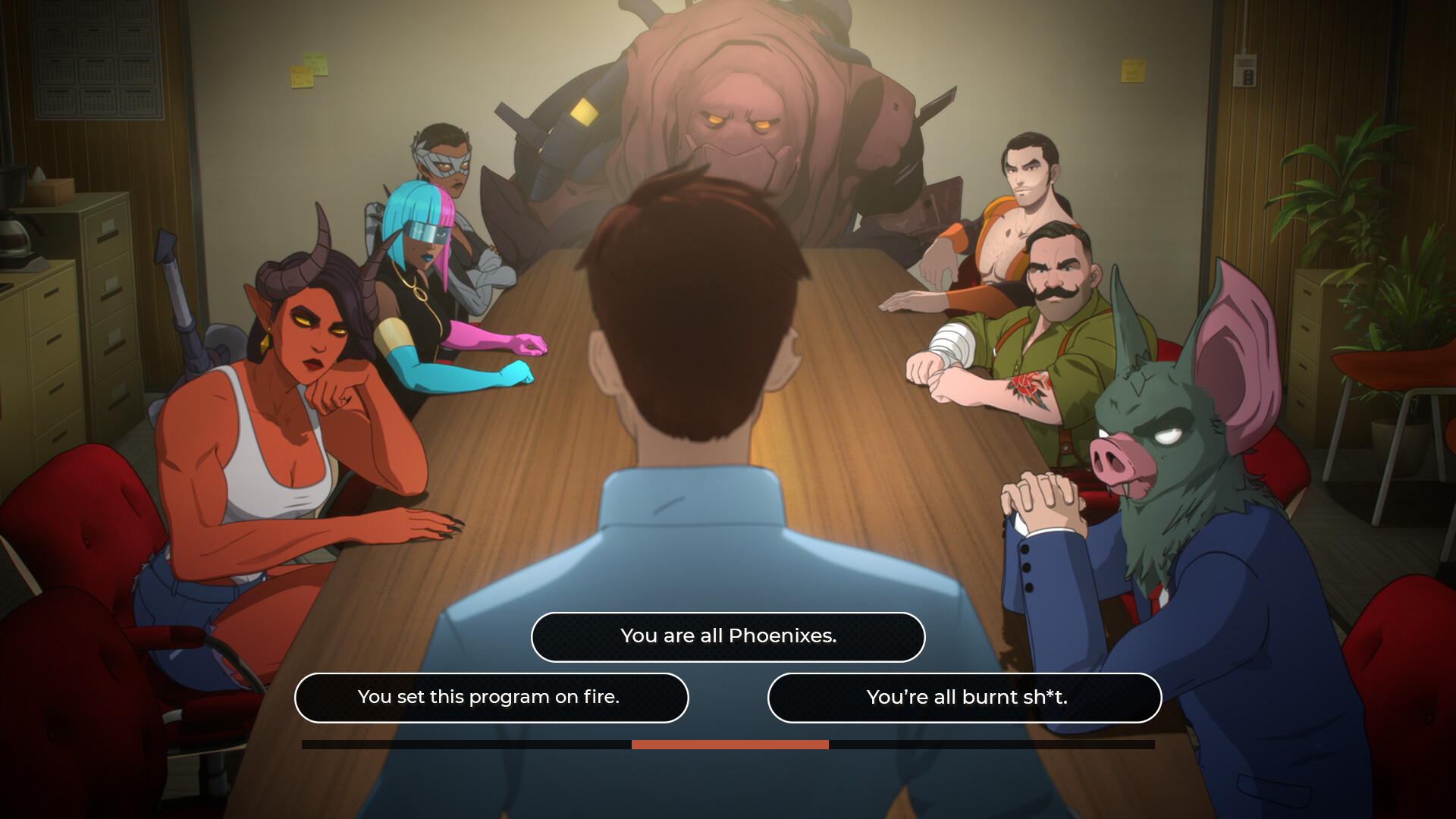
PlayDispatch splits its time between two modes, and the balance is smarter than it first appears. The bulk is classic AdHoc narrative adventure: dialogue trees, relationship management, and branching choices that ripple across episodes, delivered through fully animated, seamless cutscenes that genuinely feel a cut above the studio's Telltale lineage. This is the emotional engine, and it is where the writing and performances do their work.
The other half is the actual dispatching, and it is more involved than a narrative game usually bothers with. Emergencies come in across the city, each hero has strengths, weaknesses, and a temperament, and you have to assign the right misfit to the right crisis in real time while resources and cooldowns tick against you. It usually resolves into a puzzle with a specific gimmick per scenario, and micromanaging a roster of unreliable heroes under a clock can get genuinely tense, a small strategy layer that keeps the downtime between story beats active rather than passive.
The two halves feed each other. Who you send, who you bench, and who you let fail colors how the team feels about you and about each other, so the management is not a minigame bolted on beside the story but a way of expressing your choices within it. A hero you keep sidelining resents it; one you keep throwing into danger reacts accordingly. It is a clean, legible loop that makes your dispatch decisions feel like character decisions.
Choice and consequence are the real draw, and Dispatch is built to be replayed. Outcomes fork meaningfully, relationships can be nurtured or torched, and there are hidden beats and alternate paths that reward players willing to run it back and choose differently. The branching is not the illusion of choice some narrative games settle for; it changes enough to make a second pass feel like a different read on the same cast.
If there is a limit to the gameplay, it is the ceiling any choice-driven narrative game runs into. The dispatch puzzles, enjoyable as they are, are relatively light strategy, and once you understand each scenario's gimmick they rarely surprise you a second time. This is a game you play primarily for its writing and its people, with mechanics that support that story ably rather than standing fully on their own.
Art & atmosphere
CraftDispatch looks like a modern animated series that happens to be playable, and that is clearly the intent. The character designs are stylish and expressive, the color work is bright and confident, and the fully animated cutscenes flow with a slickness that makes the whole thing read like a show you are steering rather than a game with story sequences pasted in. The step up in animation quality over the studio's forebears is immediately obvious and does a lot to sell the comic timing.
The presentation leans into its workplace-sitcom-meets-superhero-cartoon identity with real assurance. The city and the dispatch office are rendered with enough personality to feel lived in, and the visual language of the hero deployments keeps the strategy readable without breaking the animated-show illusion. It is a game that understands its own tone completely and never undercuts it with a mismatched aesthetic.
But the aesthetic centerpiece is the voice work. The cast sells jokes, lands emotional turns, and gives even minor heroes a distinct comic register, and the writing gives them material worth performing. Sound and music underscore the sitcom rhythm without overplaying it, and the result is a production that feels expensive in the ways that matter: not in spectacle, but in performance, timing, and the confidence to let a good cast simply talk.
A superbly written, brilliantly voiced narrative comedy whose choices genuinely matter, held just short of the top tier by light strategy and a tone that occasionally overshoots.
Pros & cons
The ledgerIn its favour
- Sharp, genuinely funny writing that also earns its emotional beats
- A stacked voice cast, including Aaron Paul, Laura Bailey, and Jeffrey Wright
- Fully animated cutscenes that outclass the studio's Telltale lineage
- Real-time dispatch puzzles keep the downtime between story beats active
- Meaningful branching and consequences that genuinely reward replaying
- Team management doubles as character expression, not a bolted-on minigame
Against it
- The dispatch strategy is light and stops surprising once you learn each gimmick
- Its comic tone occasionally tips into obnoxious rather than charming
- Mechanically it leans on the story, and won't hold players who want deep systems
- As an episodic narrative game, its replay value depends on caring about the cast
Screens
Official media© AdHoc Studio. Official media via Steam.
The player verdict
Real reviews · Steam- Recommended
“I'm so glad that Telltale (some of them, at least) are finally back and have made a f#ckin' amazing game, and as a huge fan of theirs, I regret not playing this masterpiece when it was released... Holy sh#t, I was hyped as f#сk playing…”
171 found helpfulvia Steam - Recommended
“How to do a game right. An original IP with 10/10 voice acting, a charming artstyle, phenomenal dialogue, a great story, witty/funny writing, and awesome action scenes. This game truly had me hooked from start to finish. The character…”
52 found helpfulvia Steam - Recommended
“Never fear, Captain Backlog is here! ( Admittedly much later than planned ). Sworn protector of unplayed games and master of ignoring overwhelmingly positive reviews until everyone else has already had their way with it! I heard people…”
41 found helpfulvia Steam - Recommended
“Phenomemamanal I always wanted to be a superhero dispatcher this feels like a dream come true. Story : incredible Soundtrack : slaps Humour : hits perfectly Voice Acting : perfect Artstyle : 10/10 My only complaint is that the game is too…”
25 found helpfulvia Steam
Verdict
The callDispatch is proof that a great premise is really just a great angle on people, and that AdHoc Studio understood the assignment completely. By moving the camera off the hero and onto the exhausted dispatcher managing them, it finds a fresh, funny, and surprisingly heartfelt way to tell a superhero story, and it backs that up with writing and performances strong enough to carry a prestige show.
It is not a mechanical heavyweight, and it does not pretend to be. The dispatch puzzles are a clever, tension-building spice rather than the main course, and how much you get out of the game scales directly with how much you invest in its dysfunctional cast. For players who want systems to sink their teeth into, that ceiling is real.
But as a choice-driven narrative comedy, this is close to the top of its class, the best Telltale-style game in years by a comfortable margin and a high-water mark for the studio. If you have ever loved a branching narrative adventure, or you just want a smart, warm, very funny story about a group of screwups learning to work together, Dispatch is an easy recommendation and one of the year's most pleasant surprises.
Sources
Original review by Aymen Sakouhi from the licensed facts above. Score: 8.7/10.