Devil May Cry 5 Review: Capcom Remembers How to Show Off
Devil May Cry 5 is a gorgeous, generous character-action showcase with three distinct fighters. Combat this expressive is rare — our review.
Aymen Sakouhi·Writer · Games Hobbyist//6 min read
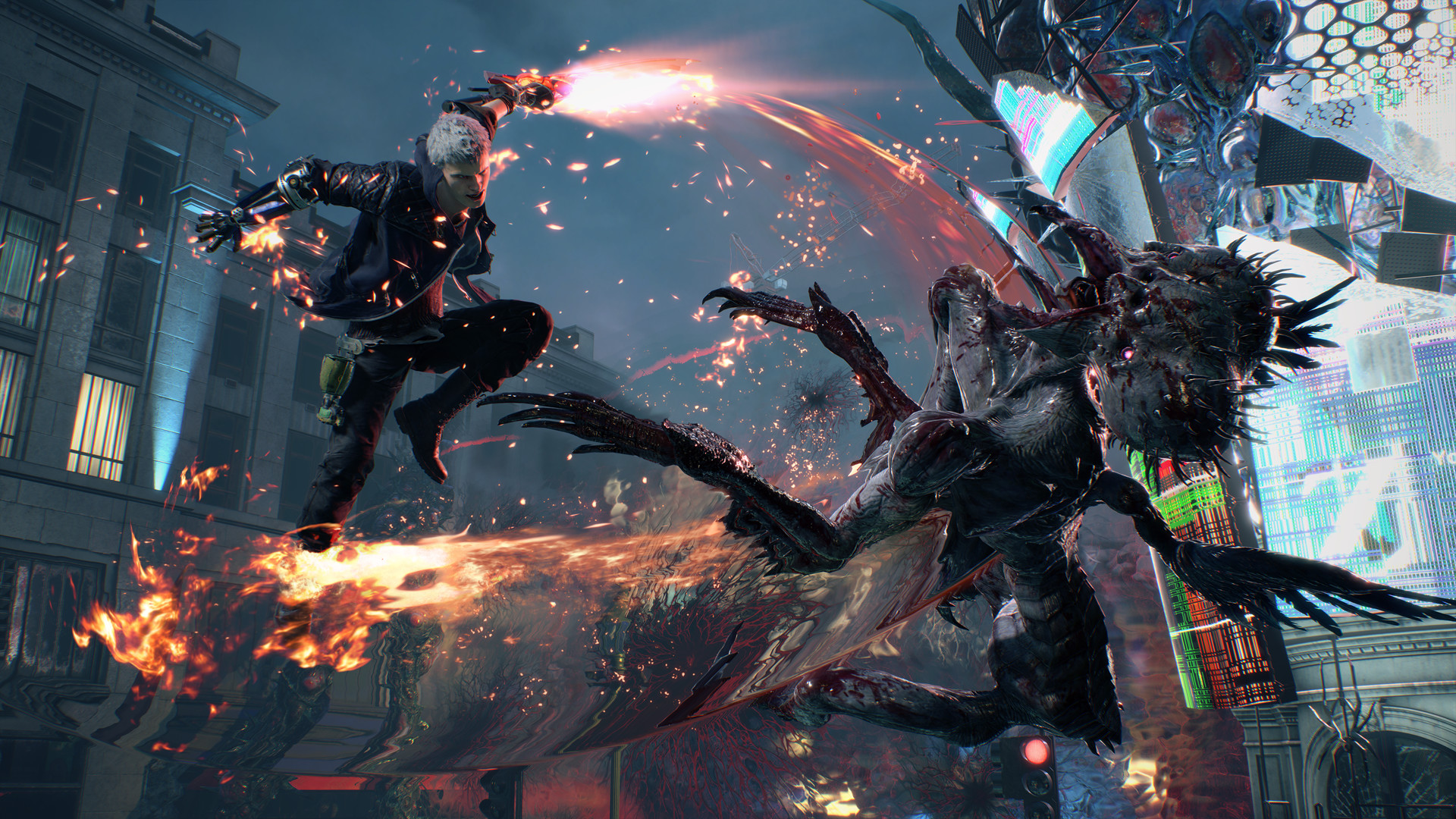
© CAPCOM Co., Ltd.. Official media via Steam.
The pitch
OverviewFor most of the 2010s, the big, loud, deeply technical character-action game looked like a museum piece. The genre that Devil May Cry more or less invented had thinned to a handful of stragglers, and the reboot Capcom outsourced in 2013 had split the fanbase clean down the middle. Then Devil May Cry 5 strutted onto the stage as if it had never been away, loud and ridiculous and entirely convinced of its own charm, and reminded everyone why the form was worth missing in the first place.
This is a direct sequel to the fourth game, built in Capcom's RE Engine and set some years later as a demonic tree called the Qliphoth erupts through the middle of Red Grave City. You divide your time among three demon hunters, and the plot is exactly the operatic, straight-faced nonsense the series has always run on: family grudges, a cryptic stranger, and a great deal of shouting about power. Nobody has ever come to Devil May Cry for the screenplay, and the game is entirely comfortable with that.
What sits underneath all the swagger is a genuinely serious argument about what an action game can be. Devil May Cry 5 is constructed around a grading system that watches how you fight rather than merely whether you survive, which quietly turns every encounter into a performance with an audience. The pitch is not 'win the fight' but 'win it beautifully,' and the entire design bends itself toward making that distinction matter to you.
It also landed as a statement of intent. This was Capcom mid-renaissance, riding the same engine that had just revived Resident Evil, planting a flag for a genre most publishers had quietly written off. The result is both a revival and a flex: proof that character-action still had a pulse, delivered with the easy confidence of a studio that had suddenly remembered it was very good at this.
How it plays
PlayYou rotate between three playable hunters, and the contrast between them is the entire design thesis. Rather than one fighter with a deep toolkit, you get three narrower philosophies of violence, each demanding that you relearn what a good fight even looks like. The campaign paces itself by alternating them, so your mastery never quite calcifies into routine before the game pulls the rug and hands you someone new.
Nero pairs a sword and a revolver with the Devil Breaker, a set of swappable robotic arms that range from a grappling hook that yanks enemies across the arena, to a bullet-time bubble, to an arm that simply detonates. He is the accessible entry point, but there is real depth in learning when to burn a Breaker and when to hoard it, since certain moves destroy the arm outright and you carry a limited stock. He is the closest thing here to a tutorial that never actually stops teaching.
Dante is the maximalist, and playing him well feels like conducting an orchestra with your thumbs. He hauls four melee weapons and multiple firearms at once and layers four combat styles on top that you swap between mid-combo: one for melee flourish, one for gunplay, one for evasion, one for raw aggression. The learning cliff is severe and the ceiling is somewhere up in the stratosphere, and no other character in the genre offers this many simultaneous options to either fumble or nail.
V, the newcomer, is the genuine wild card. Frail and bookish, he never lands a blow himself; instead he commands a summoned trio of demons from a safe distance, sending a panther and a bird to wear enemies down before strolling in to deliver the finishing cane-strike in person. It reframes the whole rhythm of combat into something closer to a real-time strategy puzzle, and it is comfortably the most divisive idea in the package. Some players adore the change of pace; others merely tolerate him until Dante comes back.
Everything the three of them do feeds the Style meter, which climbs a letter grade at a time from a stern D toward the coveted, screaming triple-S as you vary your attacks, stay inventive, and avoid taking hits. It is an elegant, self-reinforcing loop: the game rewards improvisation over rote mashing, so playing well and looking good collapse into the same act, and truly mastering a character starts to feel like learning an instrument. Missions are short, self-contained, and scored, which nudges you to replay a sloppy run and buff it into something you would actually want an audience to see. There is a serious amount of game here for the committed, as well. A first campaign runs somewhere around fifteen hours, the difficulty tiers escalate from breezy Human up through the legendarily unforgiving Dante Must Die, and the free post-launch Bloody Palace adds a hundred-floor survival gauntlet built purely for score-chasers. The reasons to keep playing comfortably outlast the credits.
The trouble is nearly everything that happens between the fights. The level design is largely a string of combat arenas linked by handsome but inert corridors, and the back half leans hard on samey red-and-organic hellscapes that blur together in the memory. The story, enjoyable as its po-faced lunacy is, stops the momentum cold with lengthy cutscenes right when the combat has you buzzing. And a full-priced game selling red orbs, the very currency you already earn by playing, as an optional real-money purchase sits awkwardly no matter how easy it is to ignore in practice.
Art & atmosphere
CraftThe RE Engine gives Devil May Cry 5 a strange double nature. Its hunters wear photoreal, performance-scanned faces you could mistake for a prestige crime drama, and then those faces spend the entire game doing things no prestige drama would ever permit: backflipping off a demon's skull, riding a motorcycle that splits down the middle into two swords, striking a pose mid-combo for an audience of precisely nobody. The tension between scanned realism and cartoon excess should collapse, and instead it becomes the whole aesthetic.
Capcom shoots its cast like rock stars. Dante's coat catches the light as he twirls, Nero's Devil Breaker throws sparks with every swing, V trails ink-black familiars that dissolve into smoke, and the screen answers your competence with escalating flash: particle spray, screen-filling flourishes, and that triple-S rank blazing in the corner like a spotlight swinging onto you. Red Grave City itself is forgettable set dressing, a generic ruined metropolis, but the fighters standing in front of it are dressed to kill and lit to match.
The sound is where the whole thing locks together. The battle themes are adaptive: songs like Nero's soaring 'Devil Trigger' and Dante's snarling 'Crimson Cloud' layer in vocals and guitars only as your Style rank rises, so the music quite literally rewards you for looking good and falls silent the moment you flail. Weapons crunch, guns snap, and demons shriek with real physical presence, and the entire audio mix is engineered so that a high-rank run feels like the drop in a song you are performing live rather than merely hearing. It is one of the vanishingly few games where the soundtrack doubles as a scoreboard.
One of the deepest, most satisfying combat systems in modern action gaming, wrapped in a campaign whose level and environment design never once keep pace with it.
Pros & cons
The ledgerIn its favour
- Among the deepest and most expressive combat systems in the genre
- Three hunters who play radically and genuinely differently
- The Style grading loop rewards creativity over button-mashing
- Short, scored missions built from the ground up for replay
- RE Engine visuals are crisp, characterful, and beautifully lit
- Adaptive battle themes that track your performance in real time
Against it
- Linear, largely uninspired level design between the fights
- Later environments blur into repetitive organic hellscapes
- Story cutscenes routinely kill the combat's momentum
- V's summon-based playstyle simply won't click for everyone
- Red-orb microtransactions sit awkwardly in a full-price game
Screens
Official media© CAPCOM Co., Ltd.. Official media via Steam.
The player verdict
Real reviews · Steam- Recommended
“pirated this game on my first laptop than after 6th dmc game not getting announced, it motivated me to buy the 5th and replay it again.”
17 found helpfulvia Steam - Recommended
“I opened this game with my expectations very low especially with my PC. Once I got in, I was immediately obsessed. I LOVE this game. One of my favorite games that I have opened up. The game, the story, and the characters are all perfect. I…”
11 found helpfulvia Steam - Not recommended
“I wish Steam's review system had a mixed review option. Positives; Dante's gameplay is cool, bloody palace is the best it has ever been, the weapons besides DSD and the bike are incredible, the sin devil trigger is epic, we finally have a…”
7 found helpfulvia Steam - Not recommended
“I spent about 25 minutes battling the Goliath and got obliterated very suddenly. I didn't have enough red orbs to revive, but I did have gold orbs, which I was about to use before I accidentally clicked through to the store. A weird…”
7 found helpfulvia Steam
Verdict
The callDevil May Cry 5 is not trying to reinvent its genre so much as prove the genre still deserves to exist, and on that count it is an outright triumph. The combat is among the most expressive, generous, and rewarding in any action game ever made, and the three-character structure keeps a lengthy campaign from ever settling into a single comfortable groove. Very few games hand you this much to play with, or this many reasons to show off while you are doing it.
The caveat is that the package around the fighting is merely fine. If you only intend to mash your way to the credits, what you will get is a good-looking, slightly repetitive romp with some baffling downtime and a plot delivered at full operatic volume. The value here scales directly with your appetite for self-improvement; the more you want to master, the more staggering the whole thing quietly becomes.
So it lands as a game for a particular kind of player: the one who replays a stage not because they failed it but because a B-rank clear is frankly beneath them. For that person, Devil May Cry 5 is a system deep enough to chase for years. For everyone else, it is a stylish, uneven, wildly confident comeback that is very much worth meeting halfway.
Sources
Original review by Aymen Sakouhi from the licensed facts above. Score: 8.8/10.