007 First Light: IO Interactive Finally Earns the Number
Our 007 First Light review: IO Interactive turns Hitman-grade sandbox design on a young Bond origin story, with generic gunplay and low-stakes stealth as the catch.
Aymen Sakouhi·Writer · Games Hobbyist//6 min read
© IO Interactive A/S. Official media via Steam.
The pitch
OverviewJames Bond has been badly served by video games for most of this century, so the pitch behind 007 First Light carries real weight: put the studio that built Hitman's murder sandboxes in charge of a young, unproven 007 and let his methods, not his gadgets, define him. IO Interactive spent three console generations teaching players to case a room, manipulate a crowd, and improvise a kill from whatever is lying around, and First Light is the first Bond game built from the ground up to let that expertise loose on 007 himself.
The setup is an origin story rather than a greatest-hits tour. This is Bond before the Double-O status, a reckless MI6 recruit under the training programme run by the gruff instructor John Greenway, still finding out what kind of agent he wants to be. The tagline is literally "Earn the Number," and the game structures its whole campaign around that idea, sending its young hero through gala infiltrations, safehouse raids, and field missions where he has not yet learned to be as controlled as the Bond audiences know from the films.
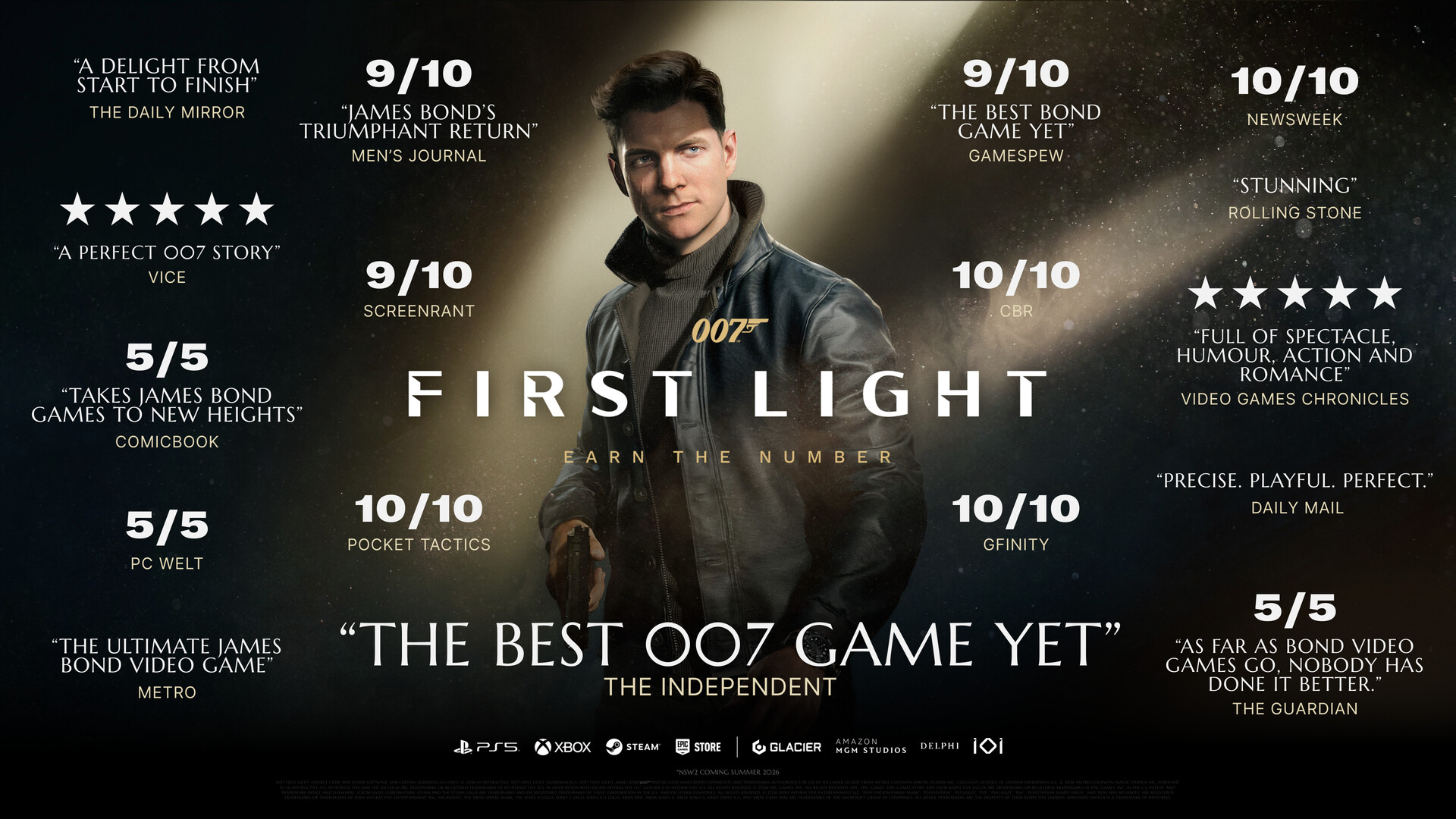
Reception has been strong and remarkably consistent for a licensed action game: an 84 on Metacritic, a Very Positive tag on Steam built from over 21,000 reviews at roughly 91% approval, and multiple outlets calling it the best Bond game in a very long drought. That consensus is not universal, and the cracks in it are worth taking seriously, but First Light lands as a rare case of a movie license getting matched with a studio that actually understood the assignment.
How it plays
PlayThe spine of the game is pure IO Interactive: dense, systemic sandbox levels where a single objective can be solved a dozen different ways. A gala-style infiltration midway through the campaign is the clearest showcase, offering routes through disguise, seduction, forged credentials, hacked security, or a straightforward fight, and the game is content to let a player stumble into a solution nobody designed on purpose. That structure, lifted almost wholesale from Hitman's playbook and reapplied to a single continuing protagonist instead of a series of standalone contracts, is First Light's clearest reason to exist. Social tools like Lure and Bluff let Bond talk, charm, or deceive his way past problems that a lesser game would just make you shoot or sneak around, and the Q-Lens gadget turns hacking and surveillance into a genuine tool of first resort rather than a cutscene prompt.
Combat splits into two very different halves. Melee is the clear standout: a parry-and-dodge system reviewers have compared to Uncharted 4 and the Batman Arkham games gives one-on-one fights real rhythm and weight, and IO visibly invested more care here than in the shooting. Gunplay, by contrast, is the game's most consistent complaint. It works, and it is aided by a Focus mechanic that slows time for precision shots, but the enemies rarely ask more of you than the same rifle-carrying grunt in slightly different armor, and firefights lack the variety and improvisation the stealth and melee systems build so carefully elsewhere.
Stealth is where the Hitman pedigree gets complicated. First Light borrows the toolkit, the vents, the disguises, the patrol routes, but not the stakes. Getting made rarely derails a mission the way it would in Hitman; bodies cannot be hidden, and a blown cover usually just tips a level into open combat rather than ending it. For players who came from IO's assassination games expecting the same tension around a single mistake, that is a real step down, and it is the single most common criticism from people who otherwise like the game a lot. In practice, most players end up fighting or talking their way through encounters rather than ghosting them, because the game rarely punishes them for it.
Pacing leans hard on variety even where the game does not fully earn it. Chapters mix stealth infiltration, brawls, gunfights, chases, boss encounters, and vehicle sequences, and the driving sections in particular feel present because a Bond game is supposed to have them rather than because they add much. The roughly 15-hour campaign is generous for a single-player action-adventure at this budget level, and IO backs it with a post-game Tactical Simulations mode, timed Escalations and longer Operations with their own progression and leaderboards, clearly designed to keep players in the sandbox once the story wraps.
None of this reads as a studio taking big swings. First Light refines rather than reinvents, sanding down IO's established formula for a new protagonist instead of gambling on anything genuinely new, and a handful of players hit stutters or outright crashes at launch, softened somewhat by forgiving checkpointing. It is, in the end, a very well-executed version of a design IO already knew how to build, applied to a character who finally deserved it.
Accessibility and comfort options are unusually thorough for a AAA action game of this scale. Full controller support with DualSense-specific haptics and adaptive triggers sits alongside adjustable difficulty sliders, camera comfort settings for players sensitive to motion, custom volume mixing, and detailed subtitle options, all of which is a welcome baseline rather than an afterthought bolted on post-launch. It does not fix the gunplay or add stakes to a blown disguise, but it does mean the sandbox itself is reachable by a wider range of players than most of IO's back catalogue managed.
Not every reaction has been as warm as the aggregate scores suggest, and it is worth naming that dissent rather than smoothing it over. A vocal minority of Steam reviewers describe the campaign as short and rigidly linear, the spy plotting as formulaic, and the gadgets as underused set dressing rather than genuine tools, a complaint that lines up with the gunplay criticism above: several of First Light's systems are present without always being load-bearing. That reading sits at odds with the broader consensus, but it is a fair enough description of the game on a bad mission, when the sandbox narrows and the linear connective tissue between set pieces is all that is left standing.
Art & atmosphere
CraftVisually, this is IO Interactive's most accomplished work to date. Locations are dense and specific rather than generic globe-trotting backdrops, crowded with hundreds of independently moving NPCs that give galas, resorts, and safehouses a genuinely lived-in feel, and the studio's path-traced lighting option pushes reflections and shadow detail well past what the Hitman trilogy managed. Character models hold up in close-up cutscenes as well as they do across a crowded room, which matters for a story this dependent on faces and body language.
The voice cast is doing real work rather than coasting on the license. Patrick Gibson's younger, rougher-edged Bond, Kiera Lester's Moneypenny, and Lennie James's Greenway all land as specific people rather than franchise placeholders, and the writing gives Greenway in particular room to be more than a gruff-mentor cliche. Sound design backs the melee combat especially well, giving every punch and thrown object the same meaty weight the mechanics promise, even where the gunplay around it stays comparatively flat.
A polished, purposeful Bond debut backed by strong critical and player reception (84 Metacritic, 91% positive on Steam), held back from the top tier by generic gunplay and stakes-free stealth.
Pros & cons
The ledgerIn its favour
- Hitman-caliber sandbox missions with genuinely multiple viable solutions
- Melee combat with real weight and rhythm, closer to Arkham than a typical action game
- An origin story and voice cast (Gibson, Lester, James) that earn their comparisons to Bond's best
- Dense, path-traced environments crowded with hundreds of NPCs that feel genuinely lived-in
- A generous roughly 15-hour campaign backed by a post-game Tactical Simulations mode
- Social tools like Lure and Bluff that make talking your way through a scene a real option
Against it
- Gunplay rarely escalates past interchangeable armed enemies
- Stealth borrows Hitman's toolkit but not its stakes, so detection is rarely punished
- Melee loses its rhythm once multiple attackers pile on at once
- Driving sections feel obligatory rather than essential
- Refines IO's established formula rather than taking real creative risks
Screens
Official media© IO Interactive A/S. Official media via Steam.
The player verdict
Real reviews · Steam- Recommended
“007 First Light is the perfect example of modern AAA game development and all that's both good and bad about it. Here's the nutshell: The gameplay mechanics (shooting, brawling, investigation) are strong and compelling and the game is full…”
208 found helpfulvia Steam - Recommended
“Review by [url=https://store.steampowered.com/curator/34633003-Gaming-Masterpieces/lists/] Gaming Masterpieces - The greatest games of all time on Steam. Is this game a masterpiece? Yes, probably. In 007 First Light, you get to experience…”
42 found helpfulvia Steam - Not recommended
“Giving this game a negative review doesn't seem right but I can't in good faith give it a positive one either. It's a spiritually Sony exclusive game where theres a game included in the cutscenes. It's visually unbelievable and technically…”
42 found helpfulvia Steam - Not recommended
“The game works as intended but lacks substance. A short extremely linear campaign (with a cookie cutter spy story), extreme lack of freedom, gadgets that feel like an afterthought, heavy focus on hand to hand combat with repetitive…”
40 found helpfulvia Steam
Verdict
The call007 First Light is the Bond game the license has needed for a decade: a studio with genuine, hard-won expertise in systemic, player-authored missions finally pointed at 007 instead of borrowing his name for a generic shooter. The sandbox design, the melee combat, and a surprisingly sturdy origin story carry it a long way, and the reception it has earned, both from critics and from a large, largely satisfied Steam audience, reflects a game that mostly delivers on its premise.
It falls short of greatness for reasons that are easy to name: gunplay that never gets more inventive than its enemies, stealth that borrows Hitman's tools without Hitman's consequences, and a general unwillingness to take the kind of risk that would have made it more than a very good synthesis of ideas IO already knew how to execute. Judged as a Bond game, it is close to the best there has been in years. Judged as the next step from the studio that made Hitman what it is, it plays things carefully safe. Neither judgment cancels the other out, and the gap between them is exactly where First Light lives: a confident, generous, occasionally cautious game that earns its number without quite pushing past the ceiling IO built for itself years ago.
Sources
Original review by Aymen Sakouhi from the licensed facts above. Score: 8.4/10.