Zero Parades Review: A Spy Thriller Haunted by Disco Elysium's Ghost
ZA/UM's espionage RPG trades Revachol for Portofiro, adds a bruising new mental-state system, and can't quite escape the shadow of Disco Elysium.
Aymen Sakouhi·Writer · Games Hobbyist//5 min read
© ZA/UM. Official media via Steam.
The pitch
OverviewZERO PARADES: For Dead Spies asks a question its makers can't dodge: what is ZA/UM without the three people who built Disco Elysium? Robert Kurvitz, Aleksander Rostov, and Helen Hindpere were pushed out of the studio in 2021 amid an ugly legal fight over who actually owned the company and its next game, a dispute Kurvitz eventually dropped for lack of evidence before founding a new studio elsewhere. Zero Parades is the answer the remaining ZA/UM sent back into the world: another dialogue-driven espionage RPG, another grim little city wedged between competing ideologies, another wrecked protagonist trying to hold a life together one skill check at a time.
You play Hershel Wilk, cryptonym Cascade, an operant for the communist Superbloc who spent five years off the grid after a mission that gutted her old cell, the Whole Sick Crew. The story drops her back into Portofiro, a town squeezed between the Superbloc, the technocratic EMTERR, and the technofascist La Luz, right as La Luz's cultural revolution starts overwriting the town's signs, architecture, and loyalties. Cascade is meant to rebuild her network and finish what she started. Whether she can rebuild herself is the actual plot.
It's an odd position for a review to sit in: everything about Zero Parades invites comparison to a game its current developer no longer employs the authors of, and pretending otherwise would be its own kind of dishonesty. What's true is that critics have responded well (a Generally Favorable 83 on Metacritic across dozens of reviews, 87% positive over more than 1,400 early Steam reviews) while a vocal slice of the audience remains unconvinced, judging by a rougher user-score split. Both reactions are earned, and neither tells the whole story on its own.
How it plays
PlayMechanically, Zero Parades doesn't reinvent what Disco Elysium built so much as refine it. You walk Portofiro's streets, talk to nearly everyone twice, and resolve friction through dice-rolled skill checks rather than combat. Cascade's abilities split into three faculties, Intellect, Relation, and Action, each carrying five sub-skills that behave less like stats and more like competing voices in her head: Shadowplay pushes her toward deception and tradecraft, Cold Reading toward people, Nerve toward violence held just barely in check. Points invested don't only raise numbers; they change which voice speaks up mid-conversation, and a heavily built skill will interrupt scenes uninvited, for better or worse.
Layered on top is an Ideas system that carries over the spirit of Disco Elysium's thought cabinet: Cascade picks up ideologies, half-formed theories, and personal convictions across the story and internalizes them for passive bonuses and new dialogue branches. It's the game's clearest inheritance from its predecessor, and it still works, rewarding curiosity and letting two players' versions of Cascade diverge meaningfully depending on what they chose to believe by the end. Where the writing really earns its keep is in how those beliefs interact with the political backdrop: the running argument between the Superbloc's communism, La Luz's technofascism, and EMTERR's raw capitalism isn't scenery, it's the thing Cascade's internalized ideas are actually arguing about, and the game is unusually willing to let her be wrong.
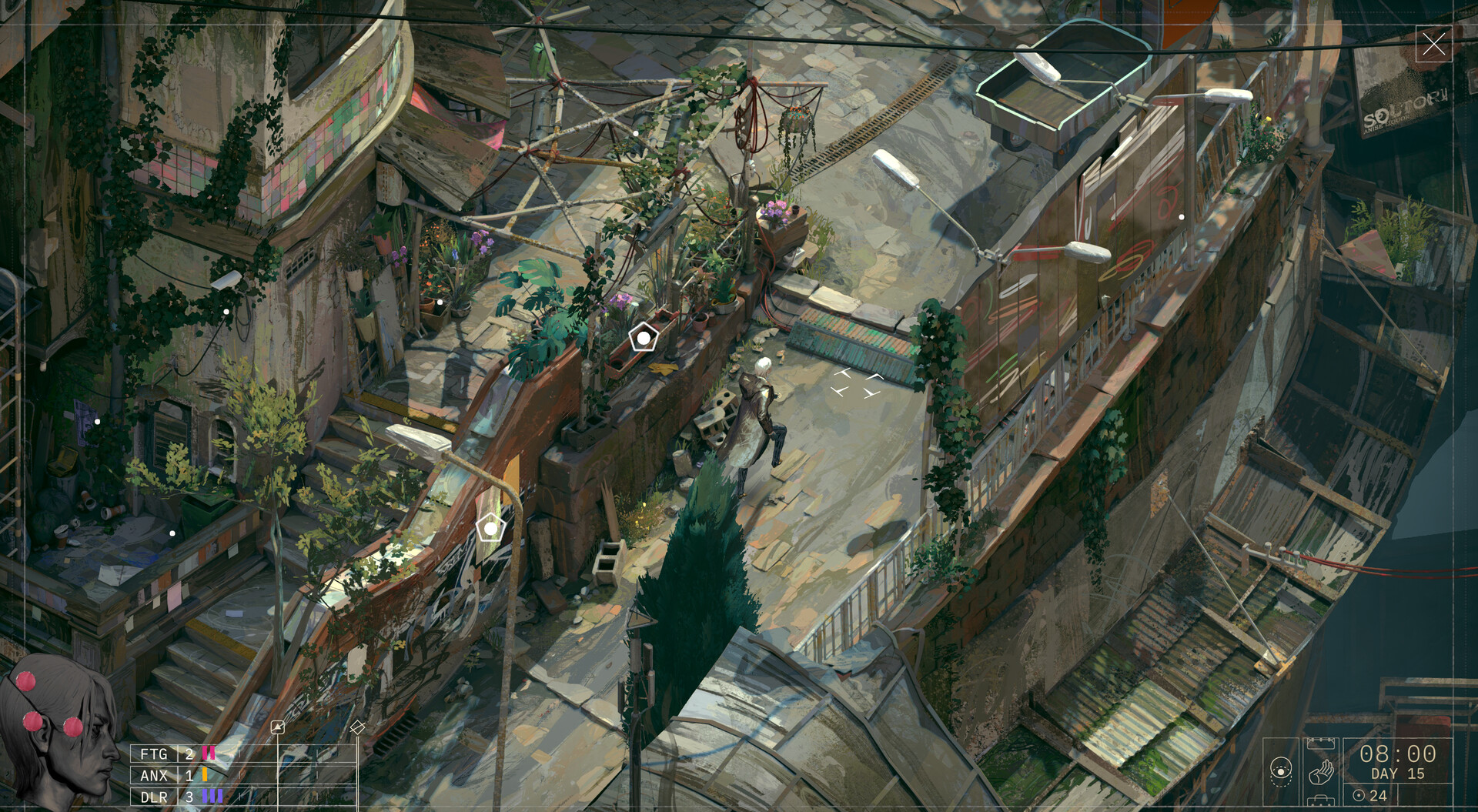
The real mechanical addition is the mental-state system: three meters, Fatigue, Anxiety, and Delirium, that climb as Cascade pushes herself, fails checks, or absorbs the story's steady drip of horror. Rest, cigarettes, pills, and drink knock them back down, but let any one of them max out and the game doesn't just soften the blow, it forces a permanent skill-point sacrifice to bring it back under control. That sounds punishing on paper, and it is, but in practice it reframes failure as consequence rather than a reload prompt. An interrogation gone wrong doesn't just cost you information, it costs you a piece of who Cascade is by the time she walks out of the room. It's the sharpest system ZA/UM has added since the original dice.
New this time are short, timed action beats dropped into moments of physical danger, quick decisions under pressure rather than combat proper, which mostly work as tension breaks between the game's dominant mode of standing still and reading. That dominant mode is also where Zero Parades tests patience: the opening five or six hours wander before the mystery around the Whole Sick Crew's fate takes hold, and the game's appetite for digression, fully voiced tangents about local wildlife or bureaucratic minutiae included, occasionally outpaces its discipline. Some reviewers have also flagged that it isn't always obvious which faculty governs a given check until after the roll resolves, a clarity problem the original game mostly avoided.
Once the mystery does lock in, though, the momentum holds for a long time. Reviewers who logged full playthroughs cite something in the neighborhood of thirty hours to see the Whole Sick Crew plot through, with the drip-feed of revelations about what actually happened five years ago paced well enough to justify the slow start in hindsight. The side material carries real weight too rather than padding the runtime: individual character arcs about grief, complicity, and whether people who did bad things under a bad system deserve a second chance land with a specificity that the game's headline plot sometimes has to earn more slowly.
Technically, Zero Parades shipped rougher than a game this dialogue-forward should. Environment pop-in, the odd frame hitch, ledge-traversal bugs, and a skill-check display bug that on rare occasions forces a restart have all been reported at launch. None of it breaks the experience, but all of it suggests a game that could have used another few months in the oven.
Art & atmosphere
CraftPortofiro looks and sounds like a cousin of Revachol: hand-painted grime, peeling propaganda, a palette that treats decay as a deliberate choice rather than an accident. La Luz's cultural revolution starts overwriting the town's signage and architecture mid-story, and the game is smart about letting you watch a place's identity get replaced in real time instead of just narrating it at you, walls repainted, statues swapped, old slogans papered over with new ones as you pass back through streets you thought you already knew. The supporting cast carries a lot of that atmosphere: a unionized, philosophically inclined talking monkey who chairs the local trade council, a bootleg CD hustler named Petre, a phone-sex operator called the Duchess whose line seems to connect to more callers than it should. They're vivid enough to make Zero Parades feel like ZA/UM's own thing rather than a Disco Elysium reskin, even when the brushwork and the grimy noir framing are clearly drawn from the same hand.
The score is the one inconsistent piece of the presentation, genuinely acidic and unsettling in the scenes that matter most, an off-key, half-industrial hum under the game's darkest interrogations, but thin and generic in stretches that clearly needed a composer's attention and didn't get one. It's a small crack in an otherwise confident package, and a more noticeable one than it would be in a less dialogue-heavy game, where sound is doing a good half of the emotional labor.
A Generally Favorable 83 on Metacritic and 87% positive across Steam's launch reviews back up genuinely sharp writing and a smart new failure system, docked for a slow opening act and launch-week technical rough edges.
Pros & cons
The ledgerIn its favour
- Whip-smart, layered writing anchored by a fractured, guilt-wracked protagonist in Cascade
- The Fatigue/Anxiety/Delirium system turns failure into narrative consequence instead of a reload screen
- Portofiro's cast, from a unionized talking monkey to a phone line with too many callers, rivals Revachol's best
- A genuine political throughline, communism versus technofascism versus capitalism, that gives the mystery real teeth
- The Intellect/Relation/Action faculty system and Ideas mechanic reward curiosity and replay
Against it
- A slow, digression-heavy opening act that tests patience before the mystery grabs hold
- Launch-window technical rough edges: pop-in, hitching, and an occasional skill-check display bug
- It's not always clear which faculty governs a given check until after you've already rolled it
- Inconsistent score, atmospheric where it counts but thin and generic elsewhere
- Never fully escapes the shadow of Disco Elysium, and knowing why colors the experience
Screens
Official media© ZA/UM. Official media via Steam.
The player verdict
Real reviews · Steam- Recommended
“It often feels like a sincere effort to recapture some of what made Disco Elysium special. Still, it has plenty of depth, is clearly well made, and proved well worth playing. Its biggest challenge is simply that Disco Elysium set an…”
141 found helpfulvia Steam - Recommended
“Reviewing this game on it's own merits comes with a big asterisk because of the drama that went down after the release of the studio's last game, Disco Elysium. Following the release of that game, investors took control of Za/um and…”
89 found helpfulvia Steam - Not recommended
“Whoever is looking to buy this because they loved Disco Elysium, let me give you a heads up: it is not that good. Zero Parades feels like it is missing many of the elements that made Disco Elysium a masterpiece. While it clearly aims for a…”
71 found helpfulvia Steam - Recommended
“Review by [url=https://store.steampowered.com/curator/34633003-Gaming-Masterpieces/lists/] Gaming Masterpieces - The greatest games of all time on Steam. Is this game a masterpiece? Yes, probably, despite the drama around the development…”
38 found helpfulvia Steam
Verdict
The callZERO PARADES: For Dead Spies isn't the Disco Elysium follow-up its own premise implicitly promises, and it's better off judged as what it actually is: a sharp, occasionally overstuffed espionage RPG about guilt, ideology, and whether a broken person, or a broken studio, gets to be forgiven for what it did to survive. The writing is the draw, the mental-state system is the genuine innovation, and the sluggish first act is the toll you pay to reach both. It's rough in places a tighter production schedule would have sanded down.
It won't convert anyone who specifically wanted the sequel this current version of ZA/UM can no longer make, and that grief is fair to hold onto while still enjoying what's here. For everyone else willing to meet it on its own terms, it's a smart, bleak, frequently funny RPG that earns its own name, shadow and all.
Sources
Original review by Aymen Sakouhi from the licensed facts above. Score: 8.1/10.