The Last of Us Part I Is a Masterpiece Wrapped in a Complicated Port
The Last of Us Part I review: a masterful story and best-in-class accessibility, undercut by a rough PC launch port and a premium price.
Aymen Sakouhi·Writer · Games Hobbyist//5 min read
© PlayStation Publishing LLC. Official media via Steam.
The pitch
OverviewThe Last of Us barely needs an introduction, which is part of the problem this particular release has to solve. Naughty Dog's 2013 survival drama is among the most decorated stories the medium has produced, a game that turned a fungal apocalypse into an unbearably intimate two-hander and has been re-released, re-examined, and adapted for prestige television in the years since. Everybody, it can feel, has already been here.
Part I is the studio rebuilding that game from the foundation up on the technology behind its sequel. Joel, a smuggler hollowed out by grief, is hired to move Ellie, an immune fourteen-year-old, across a ruined and quarantined America, and what begins as a simple job curdles slowly into something far more dangerous to them both. Every environment, face, and animation has been reconstructed, and on a modern console the result has never looked or moved better.
What the remake is reaching for is the definitive edition, the version that finally pairs the writing's ambition with hardware equal to it. On its own terms it largely succeeds, and the craft on display is close to overwhelming. The complication is the door you have to walk through to reach it, because the story of this release is inseparable from the state it arrived in.
The PC version, specifically, is a more fraught proposition than the console one. The masterpiece underneath is not in question and never was. The port that first delivered it to PC was, at launch, a mess, and how warmly anyone can recommend this particular package comes down to two things: your patience at the threshold, and how much you are being asked to pay for the privilege.
How it plays
PlayAs a thing you actually play, moment to moment, it remains genuinely gripping. Combat is deliberate and ugly in all the right ways: ammunition is scarce, melee is brutal and close, and human enemies flank you, call your position to one another, and generally refuse to line up politely to be shot. Every fight becomes a scramble rather than a power fantasy, and the constant negotiation between hiding and simply surviving the next thirty seconds is the entire point of the design. The infected demand a different discipline entirely, and the clickers in particular, blind but lethal at a single touch, turn whole rooms into slow, breath-held puzzles where one misstep ends the run in a spray of red.
The survival systems reinforce that pressure without ever overcomplicating it. You scavenge rags, alcohol, blades, and tape, then craft them at a cost into shivs, health kits, molotovs, and nail bombs, always trading one scarce resource against another, since the same alcohol that heals you can just as easily burn a room down. Listen mode lets you peek at enemy positions through walls, workbenches slowly improve your weapons, and a thin trickle of supplements buys modest upgrades, but the game never once lets you feel comfortably strong for long.
The rebuild's real triumph, though, is in the acting and the staging. Overhauled faces, lighting, and animation give the original performances room the aging PS3 hardware simply could not, and it is the small, quiet moments that benefit most: a giraffe glimpsed over a ruined wall, a bad joke traded in a doorway, a wordless glance that carries a whole unspoken relationship. These beats land harder than most games manage with their loudest climaxes, and the fidelity is exactly why. The reworked enemy AI helps sell it, flanking with more intelligence and reacting to fallen comrades, so the human encounters feel less like spawning waves and more like frightened people who wish you had never walked in.
The accessibility work is genuinely industry-leading, inherited and expanded from Part II and still a high-water mark for the medium. It is an exhaustive suite, covering everything from full audio description and high-contrast display modes to granular combat and traversal assists, and it makes the campaign playable for people the original flatly locked out. If nothing else about this remake advanced the form, that alone would have earned it a seat at the table.
As a package it is complete rather than expansive. The main campaign is here in full, the excellent Left Behind prequel chapter is folded in, and there are the usual harder difficulties, a permadeath mode, a speedrun timer, and a deep photo mode for anyone chasing a reason to linger. What there is not is anything meaningfully new to the story or its structure; this is the same journey, restaged rather than rewritten, and it makes no pretense otherwise.
Which leaves the port itself, and the price tag stapled to it. At launch the PC version stuttered, crashed, chewed through VRAM, and forced marathon shader-compilation waits before you could even reach the menu, an ugly showing for a game whose console version was a technical showcase. A long run of patches has since smoothed the worst of it, but the first impression was genuinely poor, and it remains a costly way to replay a decade-old story that many players already own, faithfully preserved rather than rethought, on cheaper hardware.
Art & atmosphere
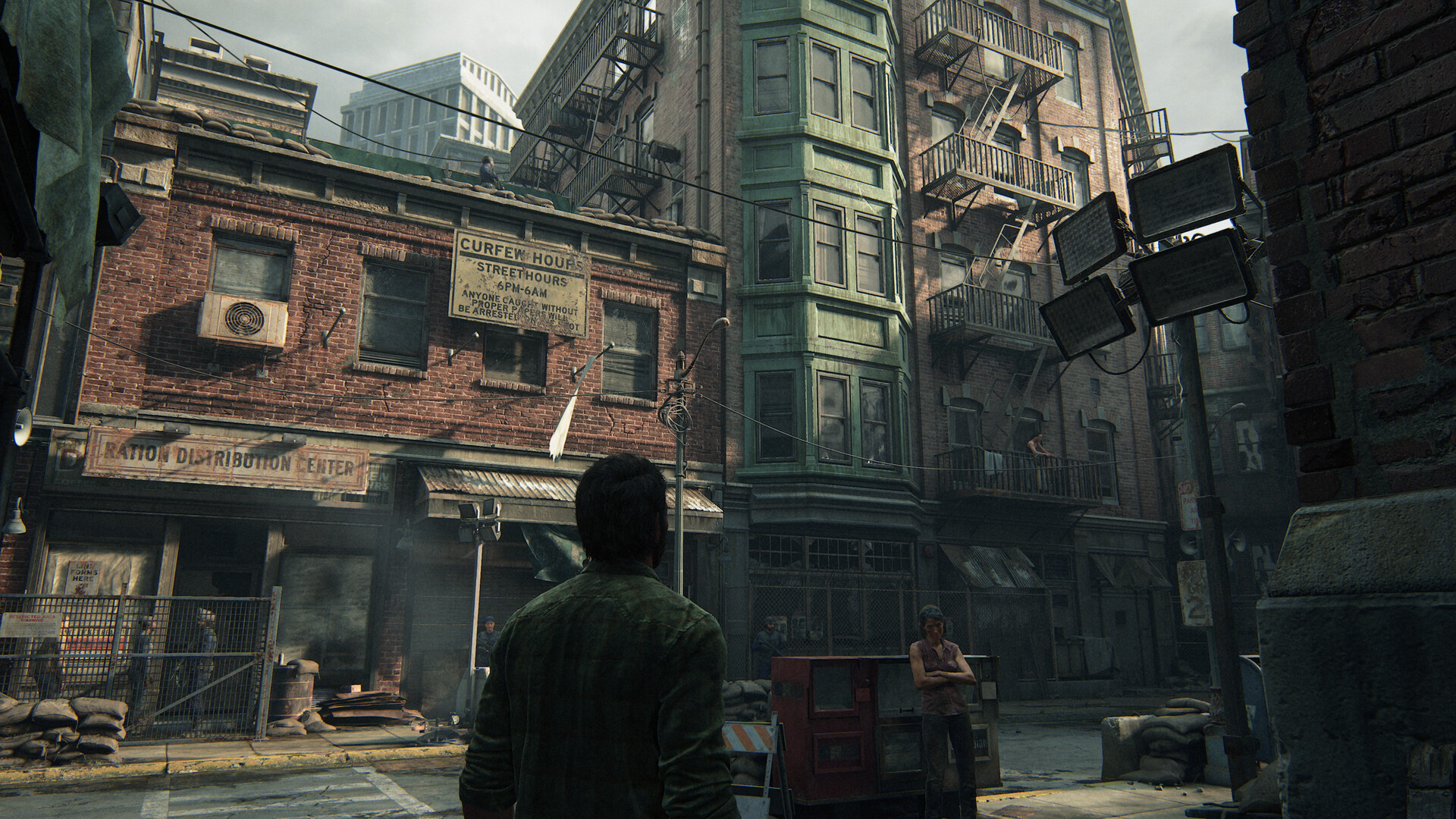
CraftPart I is Naughty Dog operating at the absolute top of its game. This is a ruined America in which nature has, decisively and without contest, won the argument: storefronts swallowed by moss, whole streets buckling under root and vine, shafts of light falling through collapsed ceilings onto water that should not be there. The seasons turn with the story, from a damp and hopeful spring toward a snow-choked winter that mirrors the slow cooling of the heart at its center, and the palette stays naturalistic and muted throughout, trusting overgrowth and weather to carry the emotional freight rather than any showy color grade.
The rebuild spends most of its budget on faces, and it shows. Reworked skin, eyes, and the smallest muscle movements let a swallowed line or a flicker of doubt carry more weight than most games wring out of an entire scripted cutscene, with lighting calibrated to flatter every one of them. It is technology deployed in the service of performance rather than spectacle, which is precisely the right instinct for this particular story. Environmental storytelling does much of the rest, a scrawled note or a child's abandoned toy filling in a whole life the game never once stops to narrate aloud.
And then there is Gustavo Santaolalla's score, still one of the great pieces of music the medium has produced: that lonely, faintly detuned ronroco and spare acoustic guitar, a piece built from more silence than notes, content to let one plucked string ache in a space where a full orchestra would only bludgeon. The infected supply the horror, the clickers' wet, blind echolocation stalking you through the dark, and the guitar supplies the grief. Between them they do more with restraint than most soundtracks manage with everything turned up to maximum.
A masterful story and stellar accessibility, dragged down by a rough launch port and a steep price for a faithful rather than reimagined remake.
Pros & cons
The ledgerIn its favour
- One of the medium's finest stories, beautifully and faithfully restaged
- Tense, improvisational survival combat built on genuine scarcity
- Industry-leading accessibility options, exhaustive and thoughtful
- Stunning facial animation and lighting that elevate every quiet scene
- Gustavo Santaolalla's restrained, aching score remains a high point
- A complete package with the Left Behind prequel chapter included
Against it
- A launch PC port plagued by stutter, crashes, and shader waits
- A premium price for a faithful remake rather than a reimagining
- Little genuinely new for anyone who played an earlier version
- Combat and structure still show their linear, decade-old roots
Screens
Official media© PlayStation Publishing LLC. Official media via Steam.
The player verdict
Real reviews · Steam- Recommended
“Back in June 2013 when the game originally released I was 12 years old, I didn't own a PlayStation so the only way I got to enjoy this game was by watching people play it on YouTube. Today it is July 8th 2026, a little after 2AM. It is my…”
56 found helpfulvia Steam - Not recommended
“I was forced to buy this piece of ♥♥♥♥ port because Sony is holding this legendary game hostage. The game is amazing, don't get me wrong, but this awful port of a mediocre remake runs worse than diarrhea. Even if you somehow had a NASA PC…”
35 found helpfulvia Steam - Recommended
“To anyone buying this game and trying to avoid spoilers like I am, this game is truly mentality hard to play, If you have played GTA V or Red Dead Redemption 2 like I have thinking you've played the most mature games around and you can…”
14 found helpfulvia Steam - Recommended
“Bought a game about zombies, left with emotional damage. I thought I knew what was coming because the internet has talked about this game for years. Didn't matter. The characters feel so real that by the end I just sat there staring at the…”
14 found helpfulvia Steam
Verdict
The callThe Last of Us Part I contains a masterpiece, and that was never once in doubt. What is in doubt is whether this specific package is the way you should choose to experience it. Nobody sane disputes the craft, and the accessibility suite is a genuine template the rest of the industry should study, but a launch port that arrived badly broken, plus a full-price tag on a ten-year-old and faithfully preserved story, muddy what should have been the simplest recommendation imaginable.
If you have somehow missed it until now, and your rig can finally run it after the long trail of patches, the story by itself justifies the ticket and then some. It remains one of the finest things the medium has to offer, and encountering it for the first time is an experience worth protecting.
If you have made this particular journey before, on any of its earlier platforms, there is far less here that demands you make it again. Come for a first time, or come for the accessibility that finally opens the door to you, but come in clear-eyed about what you are buying and what it cost to get it running.
Sources
Original review by Aymen Sakouhi from the licensed facts above. Score: 7.9/10.