Terraria Is Still the Sandbox Everyone Else Keeps Copying
Our Terraria review unpacks Re-Logic's sprawling 2D sandbox: boss-driven progression, four combat classes, deep crafting, and a steep learning curve.
Aymen Sakouhi·Writer · Games Hobbyist//5 min read
© Re-Logic. Official media via Steam.
The pitch
OverviewTerraria has been described as a two-dimensional Minecraft so many times, and for so many years, that the shorthand has curdled into something close to an insult. Yes, you mine, and yes, you build, but Re-Logic's sandbox is far more interested in what happens the moment you swing a sword at something that swings back. Beneath the pixel-art surface sits one of the deepest action-RPG progression systems anyone has ever bolted onto a crafting game, and treating it as a mere block-stacker misses roughly nine tenths of the point.
More than a decade after its 2011 release, and after a run of enormous free updates most studios would have happily charged full price for, it stands as one of the most content-dense games you can buy at any price. This is a world you excavate, arm yourself against, and then slowly conquer, boss by boss, until the sky itself starts trying to kill you. The sheer scope is genuinely hard to hold in your head.
What Terraria wants to be is a sandbox with a spine, a game where the freedom to build anything is wired directly into a long, legible ladder of things to fight. Freedom without direction tends to curdle into boredom; Terraria answers that by making almost every construction project, and every mined vein of ore, feed straight back into your readiness for the next escalating threat.
It arrived early enough to help define the entire indie-sandbox wave and then simply refused to be surpassed by it, absorbing a decade of updates until the box could barely contain what was inside. Plenty of games have since borrowed its structure. Very few have come close to matching the raw density of stuff packed into it.
How it plays
PlayThe rhythm is a constant back-and-forth between building and battling. You mine for ore, craft steadily better gear, and use that gear to summon and defeat bosses, each of which cracks the world a little further open. A downed boss might seed brand-new biomes, unlock new tiers of material, or flip the entire game into its notorious Hardmode second act, which effectively doubles the length of the adventure and sharpens every threat inside it. Progression is vast but, crucially, legible: there is nearly always an obvious next goal glinting somewhere on the horizon.
Combat is faster, twitchier, and far more central than newcomers tend to expect. The marquee bosses are elaborate bullet-hell setpieces that demand you prepare an arena, kit yourself out with mobility accessories, and commit to a class, be it melee, ranged, magic, or the pet-army theatrics of the summoner. Each of those four builds plays genuinely differently, with its own arsenal and its own late-game power fantasy, and respeccing to try another is one of the game's quieter pleasures.
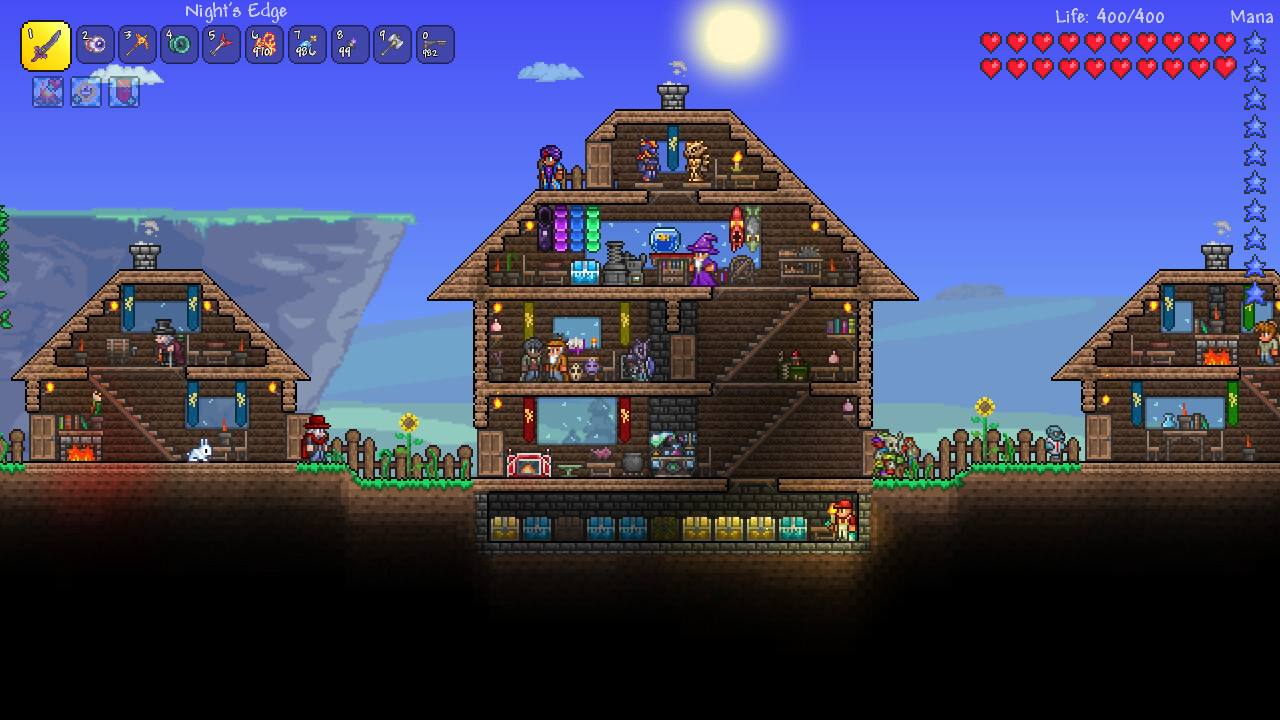
Building is not a separate hobby bolted onto the side; it is load-bearing, in every sense of the word. Housing attracts a growing cast of NPC vendors who sell the gear and services you need to keep progressing, so your town is functionally part of your character sheet. A well-designed boss arena, with platforms, campfires, and heart lanterns laid out just so, is frequently the difference between a clean kill and a humiliating wipe. The game rewards the player who thinks like an engineer at least as much as the one who thinks like a warrior.
The volume of things to make, find, and kill is close to overwhelming, and largely in the best way. There are dozens of biomes, each with its own palette and hazards, hundreds upon hundreds of craftable items, secret events, fishing, NPC quests, and enough optional bosses to keep a completionist busy for months. The world piles scripted events on top of all that: blood moons that flood the night with the shambling dead, goblin and pirate invasions that batter your town, a solar eclipse that unleashes a parade of horror-movie monstrosities, and eventually the long grinding escalation toward the Moon Lord, a final boss that lands as a genuine examination of everything you have built. Mobility keeps pace with the rising threats, too: grappling hooks give way to wings, then to mounts and rocket boots, until a character who once plodded from cave to cave is flying, dashing, and blinking across the map. Long after you have beaten what looks like the final boss, the game keeps producing new corners you had no idea were even there.
It is also, quietly, one of the great co-op games. Drop a few friends into a shared world and the labor divides itself along natural lines, one person mining and smelting, another architecting the base, a third obsessively engineering the next arena, and the boss fights turn from tense solo trials into chaotic group theater. The whole thing scales up socially far more gracefully than most sandboxes of its era ever did.
The cost of all this depth is a genuinely brutal on-ramp. Terraria explains almost nothing about itself, its crafting tree is a labyrinth that all but demands a second screen open to the wiki, and the default controls and inventory management have aged into something you tolerate rather than enjoy. The opening hours can be a confused scramble of not knowing what to build, where to dig, or why you keep dying. Push through that fog and the systems finally click into place, but the game does astonishingly little to help you get there.
Art & atmosphere
CraftTerraria hides an astonishing quantity of craft inside sprites barely larger than a thumbnail. Re-Logic's pixel work looks humble at a glance and turns out to be enormous in aggregate: dozens of biomes, each with its own distinct palette and personality, from the bruised purples of the Corruption to the candy pastels of the Hallow to the ash-and-ember glow of the Underworld. The dynamic lighting does a great deal of quiet, unshowy work, a single torch carving a warm pocket out of total black while you dig deeper than is strictly wise.
What is easy to miss, precisely because the art is so unassuming, is how much of the game's sense of scale and dread is delivered through those tiny sprites. A boss that fills a third of the screen reads as genuinely enormous next to your thumbnail-sized avatar, and a descent into the dark feels claustrophobic despite being rendered in cheerful little blocks. The presentation is a toy chest that keeps quietly revealing it was a whole world all along.
Scott Lloyd Shelly's soundtrack is the underrated hero of the entire production, a set of catchy, biome-specific themes that will lodge in your skull for years and swell into brassy panic the moment a boss the size of the screen finally answers your summon. The audio design gives each layer of the world its own character, the cheerful surface, the tense caverns, the hellish glow at the very bottom, so that you can practically hear where you are with your eyes shut. It looks like a plaything and reveals itself, hour by patient hour, to have been an entire world in disguise.
A genre-defining sandbox of extraordinary depth and value, dragged just short of a perfect score by a hostile, near-unexplained on-ramp.
Pros & cons
The ledgerIn its favour
- A staggering depth of items, bosses, biomes, and events
- Boss-driven progression with a constant, legible sense of momentum
- Four full combat classes that each play distinctly
- Building is meaningfully wired into progression, not just decoration
- Years of substantial free content updates
- Outstanding value and genuinely excellent co-op
Against it
- A steep, largely unexplained learning curve
- Crafting all but requires the wiki open alongside it
- Dated interface and fiddly inventory management
- The opening hours can be a confusing, aimless scramble
Screens
Official media© Re-Logic. Official media via Steam.
The player verdict
Real reviews · Steam- Recommended
“Always enjoyed this over Minecraft during my high school days when it first came out. Still a fantastic game till this day. If you can get a group of friends together to enjoy it, I highly suggest to do so.”
90 found helpfulvia Steam - Not recommended
“Stop looking for bad comments of this game and buy it. This game is AMAZING with hundreds of hours of gameplay. I've played 88 hours and I've barley scratched the surface. If you're looking for a fun, open word game with endless game play,…”
59 found helpfulvia Steam - Recommended
“Honestly, Terraria is one of those games that completely hooks you :) It looks like a simple 2D pixel sandbox at first, but the progression gets absolutely unhinged >.< You start off genuinely terrified of a basic blue slime :( and before…”
28 found helpfulvia Steam - Recommended
“Impossible without the help of the wiki still extremely fun. one of the best games you will ever play”
16 found helpfulvia Steam
Verdict
The callTerraria's longevity is not an accident or a fluke of timing. It is the product of a small studio treating its own game as a decade-long promise and layering in content, patch after unpaid patch, until the box simply burst at the seams. The result is a sandbox that works beautifully as a solo obsession and works even better shared with a couple of friends splitting mining, building, and boss duty between them.
It asks for real patience with its opacity and its aging interface, and it is, without much exaggeration, worse at onboarding than games a fraction of its size and ambition. But push through that hostile first act and you are looking at one of the deepest, best-value adventures available on any platform, a foundational work the genre has been quietly borrowing from for more than ten years and shows no sign of stopping.
Sources
Original review by Aymen Sakouhi from the licensed facts above. Score: 9.0/10.