States of Power Is the Rare Grand Strategy Game You Can Actually Finish in One Sitting
Verdict: 7.5/10. A solo-made WWII grand strategy wargame that fits a full match in one session, with a real scenario editor. Accessible and cheap.
Aymen Sakouhi·Writer · Games Hobbyist//5 min read
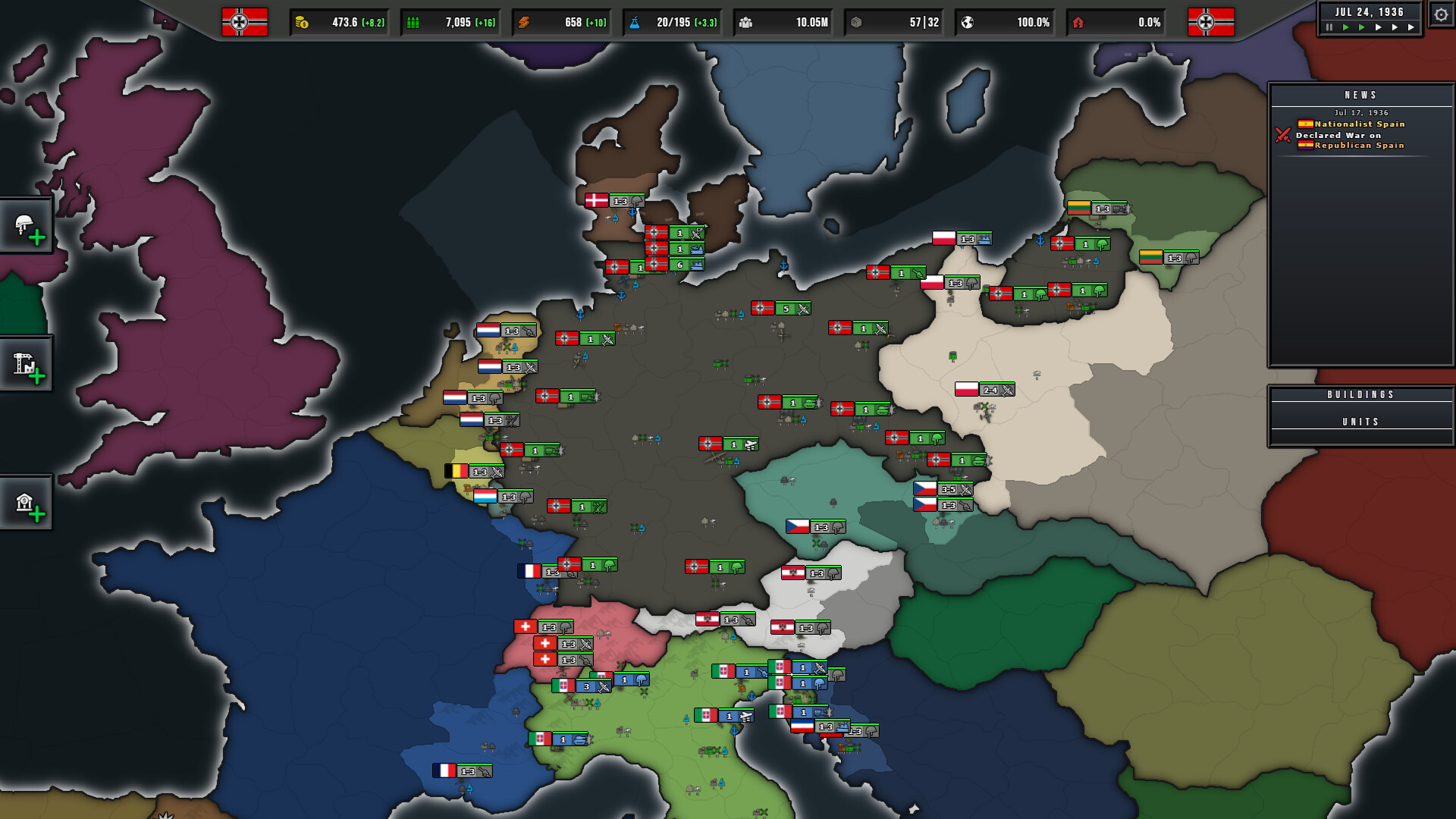
© Sarunas. Official media via Steam.
The pitch
OverviewGrand strategy has a reputation, and it is mostly deserved: hundreds of hours, tutorial menus longer than some novels, and a learning curve you climb for weeks before you feel competent. States of Power is a WWII grand strategy wargame built to break that reputation. Its central promise is that a full match fits in a single sitting, that you can be on the map making decisions within minutes rather than hours, and that the depth arrives through play instead of through a manual. For a genre that so often treats inaccessibility as a badge of honor, that is a genuinely different pitch.
The scope is the familiar grand-strategy triad. You command a nation's armies, its economy, and its diplomacy, balancing production and expansion against the ambitions of rivals across a world map, in singleplayer or online against other people. What sets it apart is not the ingredients but the serving size. Where the genre's heavyweights are marathons, this is designed as a complete, contained experience, easy to start and, crucially, easy to finish, which makes it a very different proposition for anyone who has bounced off the usual time sinks.
Released on August 26, 2026 for around ten dollars, States of Power is the work of a solo developer, Sarunas, and it arrives on the back of a demo that earned a warm reception across a couple of hundred players. That context matters. This is not a Paradox-scale production and it is not trying to be. It is a lean, focused, affordable take on a notoriously heavy genre, and it should be judged as exactly that: an accessible entry point and a quick-session alternative rather than a thousand-hour obsession.
How it plays
PlayThe core loop is grand strategy stripped to its essentials and tuned for speed. You develop an economy, raise and command unit divisions, and maneuver on a world map toward dominance, but the game is engineered so that meaningful decisions come quickly. There is no lengthy onboarding gate. You are expected to learn by doing, and the systems are pitched shallow enough to grasp in a session yet layered enough that a strategy veteran can still find room to outplay an opponent. That balance, easy to start and hard to master, is the whole design thesis, and when it lands it makes the genre feel welcoming in a way it rarely does.
The session-length structure is the real innovation, and it reshapes how the game plays. Because a full match is meant to fit into one sitting, the pacing is brisker and the decisions carry more immediate weight than in a sprawling campaign where a single war is one chapter of dozens. It turns grand strategy into something closer to a long board-game night than a second job, and it opens the door to actually completing games against friends online rather than abandoning a save halfway through. For lapsed or curious strategy players, that alone may be worth the low asking price.
The standout feature beyond the core is the built-in Scenario Editor, and it is more ambitious than a solo project's toolset has any right to be. You can create custom countries, redraw borders, design entire scenarios, and script your own events, then publish the result to a Scenario Browser for others to download and play. That community layer is the game's clearest path to longevity: a lean base game with a real editor can grow well past what one developer could author alone, and it turns the modest package into a platform for the people who care most.
The honest limits are the limits of scale. A solo-developed grand strategy game cannot match the systemic depth, the AI sophistication, or the sheer content volume of a studio with dozens of hands, and players coming from the genre's giants should calibrate accordingly. The demo's warm reception is encouraging, but the full release is early in its life with a small review base, and how well the AI holds up under pressure and how deep the economic and diplomatic systems truly run are the questions that will decide whether it has staying power beyond its accessible first impression.
Multiplayer is where much of the promise concentrates, since a fast, complete match against a real opponent sidesteps the AI-depth question entirely and plays directly to the session-length design. As with any small-scale online game, the experience will depend on finding people to play with, and the Scenario Browser and community are what will keep that pool alive. Singleplayer is a solid proving ground, but the game feels built, at heart, to be finished with someone else in an evening.
Art & atmosphere
CraftStates of Power is a map game, and it presents itself like one. The visual identity is functional and clean rather than lavish, prioritizing the legibility that a strategy game lives or dies on: you need to read the state of the world at a glance, and the interface is built to serve that over spectacle. This is not a game selling itself on cinematics, and it does not pretend otherwise. Its aesthetic job is clarity, and a solo developer keeping the presentation focused and readable is the right call for the scope.
The restraint is, in its way, honest. Rather than overreach toward production values it could never sustain, the game invests its limited resources where they matter for a wargame, in systems and the tools that let you bend them. The result is a presentation that will not turn heads but will not get in your way either, which for the genre is the more important of the two.
As a piece of craft, States of Power is best understood as the confident, contained work of one person who knew exactly which corners to cut and which to sharpen. It puts its polish into accessibility and into the scenario tools rather than into surface shine, and that prioritization tells you what the game values. It is a lean object, and it wears its leanness as a design choice rather than an apology.
An accessible, affordable solo-made grand strategy game whose one-session matches and capable scenario editor solve the genre's entry barrier, held back by the depth, AI, and content limits of a one-person project and an unproven post-launch community.
Pros & cons
The ledgerIn its favour
- A full grand-strategy match that genuinely fits in one sitting
- Easy to start with no lengthy tutorial gate, while still rewarding veterans
- A deep built-in Scenario Editor with custom countries, events, and sharing
- Singleplayer and online multiplayer, with a warmly received demo behind it
- Accessible and affordable at around ten dollars
Against it
- Systemic depth, AI, and content cannot match studio-scale grand strategy
- Early in its life with a small review base, so long-term balance is unproven
- Multiplayer promise depends on finding a community to play with
- Presentation is functional rather than memorable
- Veterans of the genre's giants may find the depth ceiling low
Screens
Official media© Sarunas. Official media via Steam.
The player verdict
Real reviews · Steam- Recommended
“Great game, followed it since the start of development, basically HOI4 from Temu. Which is a good thing as you don't need to micro manage every single aspect of the game and can be run on a potato.”
15 found helpfulvia Steam - Recommended
“This would be best said to be heart of iron 4 streamlined, its very good at scratching that itch and gets you into the fight fast.”
9 found helpfulvia Steam - Recommended
“I 100% recommend this game, your money cant go to anywhere better. except yk rent and food. I like to think I was the 13th person to get this game and i was here from the beginning Anyhow its the stratergy game we allways wanted but never…”
4 found helpfulvia Steam - Recommended
“I have been waiting for a game like this for a loooong time. For people who want to get into Hearts of Iron but find it too complicated. This is the perfect. I mean PERFECT game for you. Trust me”
4 found helpfulvia Steam
Verdict
The callStates of Power sets out to make grand strategy approachable, and it largely succeeds. By fitting a complete match into a single sitting and dropping you onto the map in minutes, it solves the genre's biggest barrier to entry, and it does so without dumbing the systems down so far that a veteran has nothing to chew on. Add a surprisingly capable Scenario Editor and a community browser, and a solo developer has built something with a real identity and a plausible path to growing beyond its launch state.
The caveats are the honest caveats of a one-person project in a genre defined by large teams. The depth, the AI, and the content volume cannot rival the giants, the game is early enough in its life that its long-term balance is unproven, and its multiplayer promise leans on a community it still has to build. Judge it as an accessible, affordable alternative and a fast-session wargame, not as a Paradox-killer, and it holds up well.
At 7.5, States of Power is a smart, focused entry point to a famously forbidding genre, and a genuinely appealing option for anyone who wants to actually finish a grand-strategy game rather than abandon it. For the price, and for the promise of a complete match in an evening, it is an easy recommendation to the curious and the time-poor alike.
Sources
Original review by Aymen Sakouhi from the licensed facts above. Score: 7.5/10.