Stardew Valley Review: The Farm Sim That Quietly Became a Second Home
Stardew Valley review: ConcernedApe's one-man farming RPG is a deceptively deep sandbox of crops, mines, and small-town life that keeps growing.
Aymen Sakouhi·Writer · Games Hobbyist//6 min read
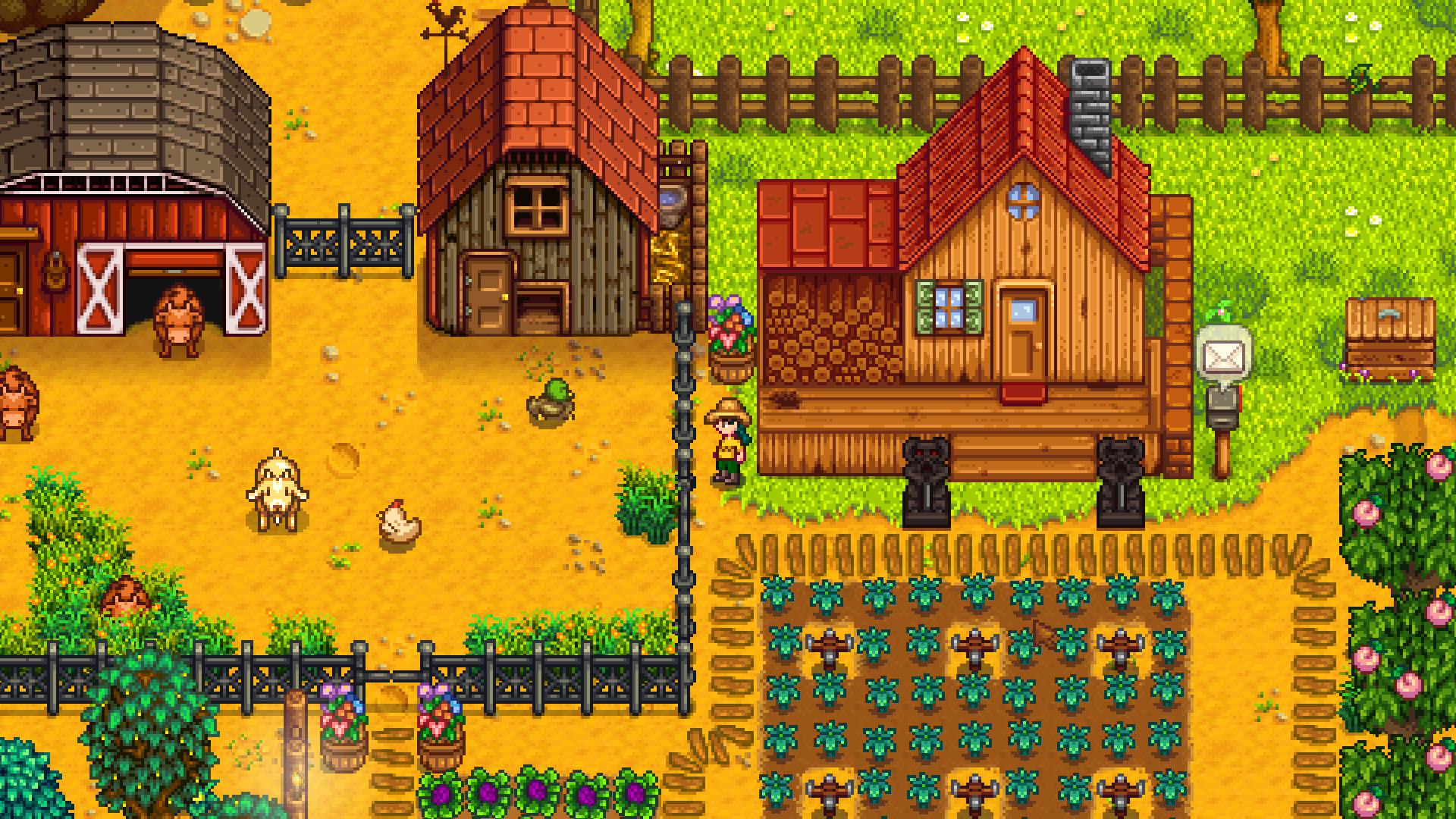
© ConcernedApe. Official media via Steam.
The pitch
OverviewIt is easy to misjudge Stardew Valley from a single screenshot. The pixel art looks cozy to the point of twee, the premise sounds like a gentle diversion, and then it is somehow two in the morning and you are redrawing sprinkler layouts to squeeze another row out of a parsnip harvest you did not know you had opinions about. This is a game built almost entirely by one person, Eric Barone, over several years, and it carries the unbroken focus of a vision that never had to survive a committee.
At its foundation it is a farming role-playing game in the lineage of Harvest Moon, though that description badly undersells how many other games are folded inside it. You inherit a run-down plot on the edge of a small town, trade a soul-deadening corporate cubicle for a patch of overgrown dirt, and what you make of that dirt, whether you become a farmer, a miner, an angler, a forager, a socialite, or a monster-slayer, is left almost entirely up to you.
The pitch is restoration in every sense. You are rebuilding a farm, yes, but you are also nursing a half-forgotten town back toward life, deciding along the way whether it is saved by collective effort or quietly swallowed by the local big-box conglomerate. Beneath the wholesome surface, Stardew turns out to have a surprisingly pointed argument about work, burnout, and where a person's sense of meaning actually comes from.
Plenty of games have chased the same cozy-sim territory in the years since, and more than a few owe their existence to this one's runaway success. Few have matched it, because few pair this much hidden mechanical depth with this much restraint, or keep handing out years of substantial updates for nothing at all. It is comfort food that turns out to have an entire professional kitchen behind it.
How it plays
PlayThe structure is a seasonal calendar with genuine stakes. Each crop grows only in its own season, the in-game year is short, and your daily stamina is finite, so every sunrise becomes a small optimization problem: water the fields, empty the crab pots, feed the animals, and still keep enough energy in reserve to reach the mines before the light fails. It rarely feels punishing, but there is a lovely, constant tension between everything you could theoretically do and the handful of daylight hours you actually have to do it in.
Beneath the farming sits far more game than the packaging lets on. The mines are a compact dungeon-crawler with combat, loot, upgradeable gear, and randomized floors that descend toward the genuinely dangerous Skull Cavern. Fishing has its own tactile, faintly infuriating minigame. Foraging, artisan goods, cooking, and a museum's worth of buried artifacts all sprout their own little economies, and the community-center restoration questline slowly reshapes your goals from mere survival into something like legacy. Skills level up as you use them, tools upgrade at the blacksmith over several in-game days, and nearly every action feeds into some other loop, so even a scattered, unfocused afternoon rarely feels truly wasted.
The town is written with real warmth, which is rarer than it should be in this genre. Every resident keeps a daily schedule, has a birthday, and carries a multi-stage relationship arc that can end in friendship, romance, marriage, and eventually children. Several of them wrestle with things the pixel art politely declines to spell out, quiet depression, addiction, grief, and the writing handles those threads with more care than a farming game strictly needs to. Coaxing a heart event out of the town recluse can land harder than the scripted beats of games ten times the budget.
Co-op multiplayer lets a small group share one farm, splitting the chores or racing to bankroll the same barn, and it turns the solitary rhythm into something companionable without touching its soul. What is genuinely remarkable, though, is how the free updates have compounded over the years. Later versions layered on an entire tropical island, new professions, fresh crops and machines, more festivals, and deeper endgame systems, so a farm you abandoned ages ago has meaningfully more to do the instant you reopen the save. The long game is where the systems quietly unfurl. Once you have restored the community center or bankrolled the local megastore into submission, the valley opens a tropical second farm on Ginger Island, a bottomless dungeon called the Skull Cavern that punishes greed on every floor, and a completion percentage that brushes against nearly every mechanic at once. Five skill trees branch into rival professions, a steady hunt for stardrops raises your energy ceiling, and there are enough machines to turn the whole farm into an automated cash engine, so a save you assumed was finished can quietly swallow another fifty hours.
The friction is mostly front-loaded and mechanical. The first in-game year can feel slow and directionless if you are not the sort of player who happily invents their own goals, since the game trusts you with total freedom long before it hands you a reason to use it. The interface shows its age on certain repeated chores, and inventory and menu management turn fiddly once your farm sprawls across the map. And the combat, functional as it is, remains the weakest limb, something you tolerate on the way to better rewards rather than a pleasure in its own right. A handful of the endgame grinds also lean on luck and repetition harder than they strictly need to, and the game is so allergic to hand-holding that some of its best content stays invisible unless you go digging for it or ask someone who already has.
Art & atmosphere
CraftStardew Valley works within a small, warm box of pixels and knows precisely how much feeling to load into each one. The art is unfussy, chunky sprites and a farmhouse that reads unmistakably as home in maybe forty pixels, but the seasons do the real emotional lifting. Spring's tentative greens give way to summer gold, then autumn rust, then a hush of blue winter snow that turns the glowing windows of the saloon into a small nightly promise on the walk back from the mines.
Barone composed the soundtrack himself, and it shows in the best possible way. The music is unhurried and just a shade wistful, piano and soft synth that shift with the calendar and never outstay a scene, laced through birdsong, rain drumming on the roof, and the satisfying chime of a watering can filled to the brim. The audio design is content to stay quiet, which is exactly why the festivals, with their sudden bustle and color, feel like events worth clearing your in-game schedule for.
The overall effect is comfort rendered in sixteen-bit that somehow never once condescends to you. It would have been easy for a game this cozy to feel saccharine or hollow; instead the valley reads as a place with a history and a pulse, somewhere you return to less because it demands your attention than because it is simply pleasant to be.
A deep, endlessly replayable sandbox built with singular care and expanded free for years, dinged only by a slow opening and throwaway combat.
Pros & cons
The ledgerIn its favour
- Enormous freedom across farming, mining, fishing, foraging, and town life
- The seasonal calendar makes daily planning genuinely absorbing rather than a chore
- Warm, surprisingly thoughtful townsfolk with real, multi-stage relationship arcs
- Years of substantial free updates keep expanding the game for nothing
- Co-op lets you share a farm without diluting the core rhythm
- A staggering amount of content for a budget asking price
Against it
- A slow, goal-light first year can feel directionless
- Combat in the mines is serviceable at best and never a highlight
- Menu and inventory management gets fiddly as the farm grows
- The interface shows its age on some repetitive daily tasks
Screens
Official media© ConcernedApe. Official media via Steam.
The player verdict
Real reviews · Steam- Recommended
“So I bought Stardew Valley thinking I'd relax for an hour. That was January 2026. I have no idea what year it is anymore. The game starts innocently enough. You inherit a charming little farm, meet friendly townsfolk, pet some chickens,…”
532 found helpfulvia Steam - Recommended
“Don't listen to anyone abt how to play the game. Learn it yourself and enjoy the game. Don't turn a chill farming life game into a chaotic mass production industrials aka "Jojo corp replica"”
32 found helpfulvia Steam - Not recommended
“Playing this game moment to moment is a miserable experience. I don't feel cosy, I feel like I'm doing various boring tasks that give me money. You make money in order to make more money, and once you've made enough money, the game is…”
20 found helpfulvia Steam - Recommended
“My love for farming sim games started with the Harvest Moon series. I honestly love this game so much that I have a copy on every console that I own and I might actually prefer it over Harvest Moon. It can be both cozy and/or stressful…”
19 found helpfulvia Steam
Verdict
The callStardew Valley is one of the most quietly generous games you can buy. It asks very little of you up front and gives back almost without limit, molding itself around whatever kind of ambition you bring to it, whether that is a ruthlessly min-maxed profit engine or a slow, unhurried life among neighbors you have grown to genuinely like.
It is not for everyone, and it never pretends to be. If you need constant direction, or you crave sharp mechanical challenge, its gentle open-endedness can read as aimlessness, and the early hours will test your patience before the systems bloom into something richer. This is a game that rewards the players willing to set their own horizon and walk toward it.
But as a sandbox to pour a hundred hours into and then quietly revisit for years afterward, very little on any platform touches it, and the low asking price pushes it past a simple recommendation into something close to essential. It is the uncommon game you can hand to a hardened strategist and a total newcomer alike and trust both of them to find their own way home.
Sources
Original review by Aymen Sakouhi from the licensed facts above. Score: 8.9/10.