StarVaders Rebuilds Space Invaders as a Deckbuilding Tactics Puzzle, and It Is One of the Best Roguelikes on Steam
Verdict: 8.7/10. StarVaders fuses deckbuilding with grid tactics into a mech roguelite where rewinds and combos make every run sing. A must-play.
Aymen Sakouhi·Writer · Games Hobbyist//5 min read
© Joystick Ventures. Official media via Steam.
The pitch
OverviewStarVaders takes the oldest idea in arcade history, aliens marching down a grid toward you, and rebuilds it into something that thinks. You pilot a mech at the bottom of a narrow board while enemies descend from the top, and instead of dodging and firing on reflex, you play cards to move, reposition, and attack. It is a deckbuilder wearing the skin of Space Invaders, and the fusion is far smarter than that pitch makes it sound.
Developed by Pengonauts and published by Joystick Ventures, StarVaders launched on April 30, 2025, and the reception has been close to unanimous. It sits at Overwhelmingly Positive on Steam, around ninety-eight percent across more than two thousand five hundred reviews, and it earned a nomination for Strategy/Simulation Game of the Year at the 29th annual D.I.C.E. Awards. For a small-studio roguelike with no marketing engine behind it, that is the kind of quiet consensus that only forms when a game keeps delivering the same clean click, run after run.
That click is the whole appeal. StarVaders is a puzzle box that resets every hour or so, and each reset hands you a slightly different set of tools and asks you to think your way out again. It is cerebral without being dry, tense without being punishing, and generous in exactly the places roguelikes usually punish you. Judged on its own terms, it is one of the most complete tactical deckbuilders on the platform.
What lifts it above the crowd is how tightly the two genres are welded together. This is not a deckbuilder with a grid bolted on, or a tactics game that happens to use cards. The board and the deck are the same problem, seen from two angles, and learning to read them together is the entire pleasure.
How it plays
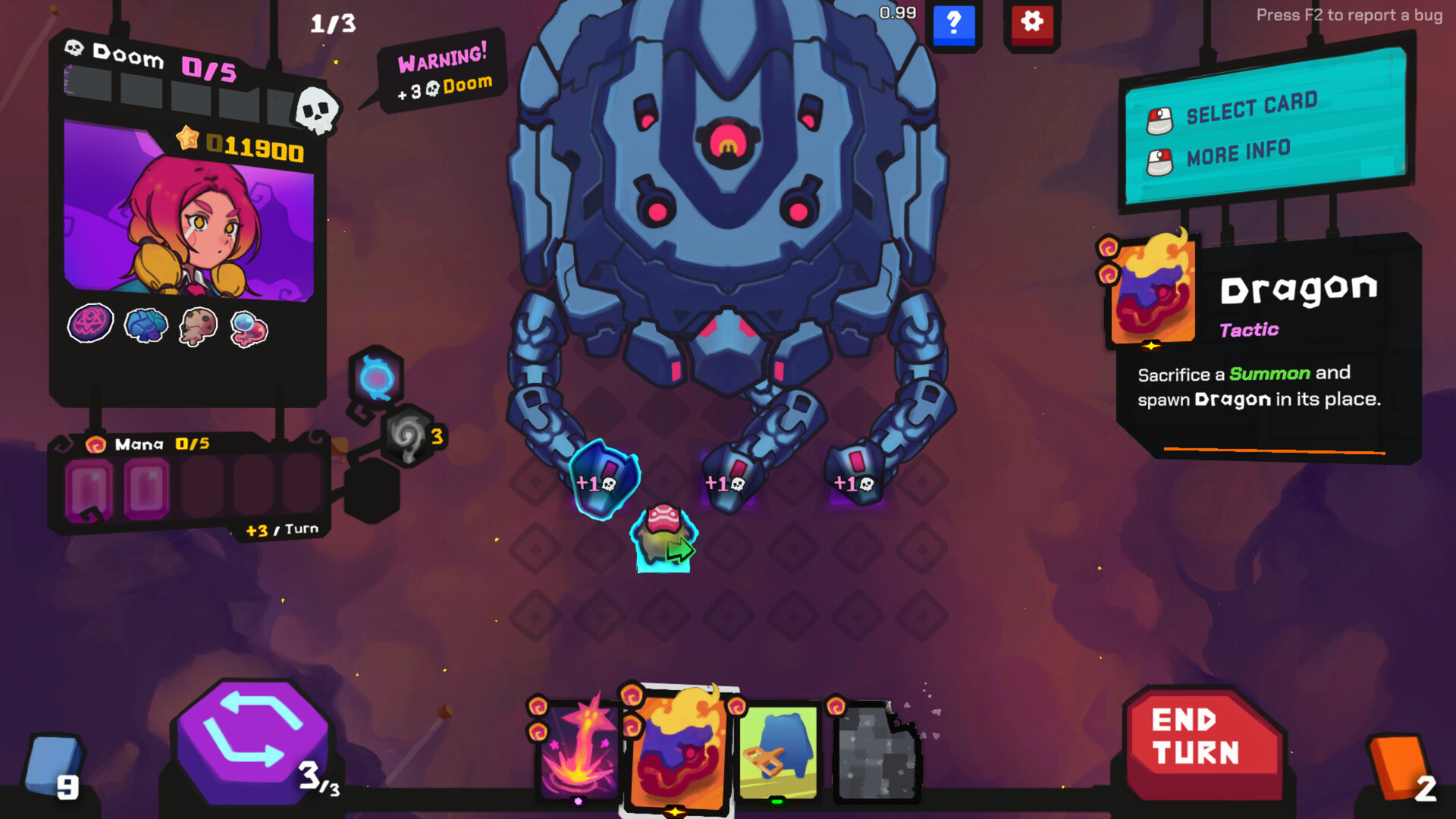
PlayEvery turn is a small logistics puzzle. Your cards do three kinds of work, movement, positioning tactics, and attacks, and the board is tight enough that where you stand matters as much as what you play. Aliens occupy specific lanes and rows, so the game is constantly asking you to line up a shot, then find the card that turns one kill into three. A well-built turn is not about raw damage, it is about geometry: nudge your mech one tile, trigger a repeat, and watch a single attack chain down a whole column.
Heat is the pressure valve that keeps all of this honest. Powerful plays build heat, and overheating carries a cost, so you are always weighing the turn that wins now against the turn that leaves you room to breathe next round. It is a simple resource, but it does a lot of load-bearing work, turning every hand into a question of how hard to push. Greed is punished, and patience is rewarded, but only if you can see two turns ahead.
The rewind is what makes StarVaders feel so uncommonly fair. A chrono-token system lets you take back a move mid-battle, so a misread does not automatically cost you a run. That single mechanic changes the texture of the whole game: because you can undo a genuine mistake, the deaths that do happen feel earned, the result of a plan that was wrong rather than a finger that slipped. It removes the worst kind of roguelike frustration without softening the actual challenge, and more games in the genre should steal it.
Builds come together in a shop between fights, where you buy new cards, remove the dead weight dragging your deck down, and pick up items that reshape how everything interacts. The depth lives in those interactions rather than in the individual cards: a modest attack becomes a run-defining engine once the right item makes it repeat, or move you, or feed heat back into something else. Chasing the combination that suddenly makes your deck hum is the same dopamine loop the best deckbuilders run on, and StarVaders lands it cleanly.
Progression stretches across runs, too. There are multiple pilots and mechs to unlock, each with a more involved playstyle than the last, and new machines open up after you clear the game once, so the ceiling keeps rising as you improve. A full run takes roughly an hour, which is the right length for a game built on tight, complete thoughts, and it runs beautifully on Steam Deck, where the pick-up-and-solve rhythm feels at home.
If there is a limit, it is one of scope rather than quality. This is a focused single-player game with a clear lane, so players who want sprawling meta-progression, dozens of wildly divergent modes, or the endless build permutations of the biggest deckbuilders may find its edges closer than expected. It is deep, but it is deliberately compact, and it knows exactly which ideas it wants to perfect.
Art & atmosphere
CraftStarVaders wears a chunky, bold, comic-book look that suits its arcade bones. Enemies, lanes, and threats read instantly, which is the single most important thing a grid puzzle can get right: at no point are you losing a run because you misread the board. The clarity is the craft here. Every element on screen is shaped so you can parse the whole situation at a glance and spend your attention on the plan instead of the picture.
The presentation has personality to spare on top of that legibility. The mechs have weight, the hits have punch, and the whole thing carries a confident, slightly retro swagger that makes a good turn feel as satisfying to watch as it is to execute. It is not chasing photorealism or spectacle, it is chasing feel, and it nails the tactile snap of a plan resolving exactly as you drew it up.
Sound reinforces the same loop. Attacks land with a crunch, chains build momentum, and the audio feedback tells you when a turn is going right well before the numbers confirm it. For a game about reading a board and committing to a line, that immediate, readable feedback is worth more than any amount of surface polish, and StarVaders spends its effort in precisely the right places.
A brilliantly tight fusion of deckbuilding and grid tactics with a rewind system that makes it feel uncommonly fair, held back only by a deliberately compact scope.
Pros & cons
The ledgerIn its favour
- A genuinely clever fusion of deckbuilding and grid tactics, not one bolted onto the other
- Positioning and combo chains make each turn a satisfying geometry puzzle
- The chrono-token rewind removes cheap deaths without softening the challenge
- Deep item and card interactions reward hunting the run-defining synergy
- Multiple pilots and unlockable mechs keep the skill ceiling climbing
- Roughly hour-long runs and flawless Steam Deck play make it easy to pick up
Against it
- Deliberately compact scope may feel thin to players wanting sprawling meta-progression
- The core loop varies less than deckbuilders with many divergent modes
- Heat and positioning add an upfront learning curve before the systems click
- Single-player only, with no co-op or competitive hook
- Mastery can settle into recognizing familiar optimal lines on repeat runs
Screens
Official media© Joystick Ventures. Official media via Steam.
The player verdict
Real reviews · Steam- Recommended
“Another gem from Humble Choice (February 2026) This game oozes personality. Fantastic art direction, a banger soundtrack, zany characters - all packaged competently into a slick deckbuilder that combines classic rogue-lite deckbuilding…”
2 found helpfulvia Steam - Not recommended
“Got this on a HumbleBundle deal. Given the price, I genuinely tried to like it and give the game a fair go. In the interests of transparency, not a fan of card games but are a fan of Mech ones, so should have been a decent play I’m sure…”
2 found helpfulvia Steam - Recommended
“With the amount of hours of fun this game has provided me, I felt it important to give it a review. It's one of the best deckbuilder's I've played, with cards and relics I initially thought useless playing a pivotal role in at least 1 of…”
2 found helpfulvia Steam - Recommended
“This game is really fun, not quite one of my favourites, but that really comes down to most characters being cool and awesome to play and two super duper doggy ♥♥♥♥♥♥♥ characters that were a blight on my 100% completion. Good things: Lots…”
1 found helpfulvia Steam
Verdict
The callStarVaders is proof that a decades-old arcade premise still has new ideas in it. By treating the descending-alien grid as a puzzle to be solved with a deck rather than a gauntlet to be survived with reflexes, Pengonauts found a loop that is tense, fair, and quietly addictive, and then polished it until almost nothing gets in the way. The rewind system alone should be studied by the rest of the genre.
It is not the biggest deckbuilder on Steam, and it does not want to be. Its scope is tight, its runs are short, and its ambitions are focused on making one exquisite idea sing rather than piling modes on top of it. For most players that focus is a strength, though anyone chasing endless variety should know what they are buying: depth over breadth, precision over sprawl.
At 8.7, StarVaders is an easy recommendation and one of the best tactical roguelikes you can play right now. If you love the moment a deckbuilder build finally clicks, or the satisfaction of a tactics puzzle solved in one clean turn, this delivers both at once. The D.I.C.E. nomination and the near-unanimous player consensus are not hype, they are the sound of a small game that got almost everything right.
Sources
Original review by Aymen Sakouhi from the licensed facts above. Score: 8.7/10.