Sister Other Paranoia Is a Dark, Divisive Mind-Reading Visual Novel
From the Needy Streamer Overload creator, a dark visual novel about a mind-reading writer's isolation. Sharp for some, self-indulgent for others. 7.0/10.
Aymen Sakouhi·Writer · Games Hobbyist//4 min read
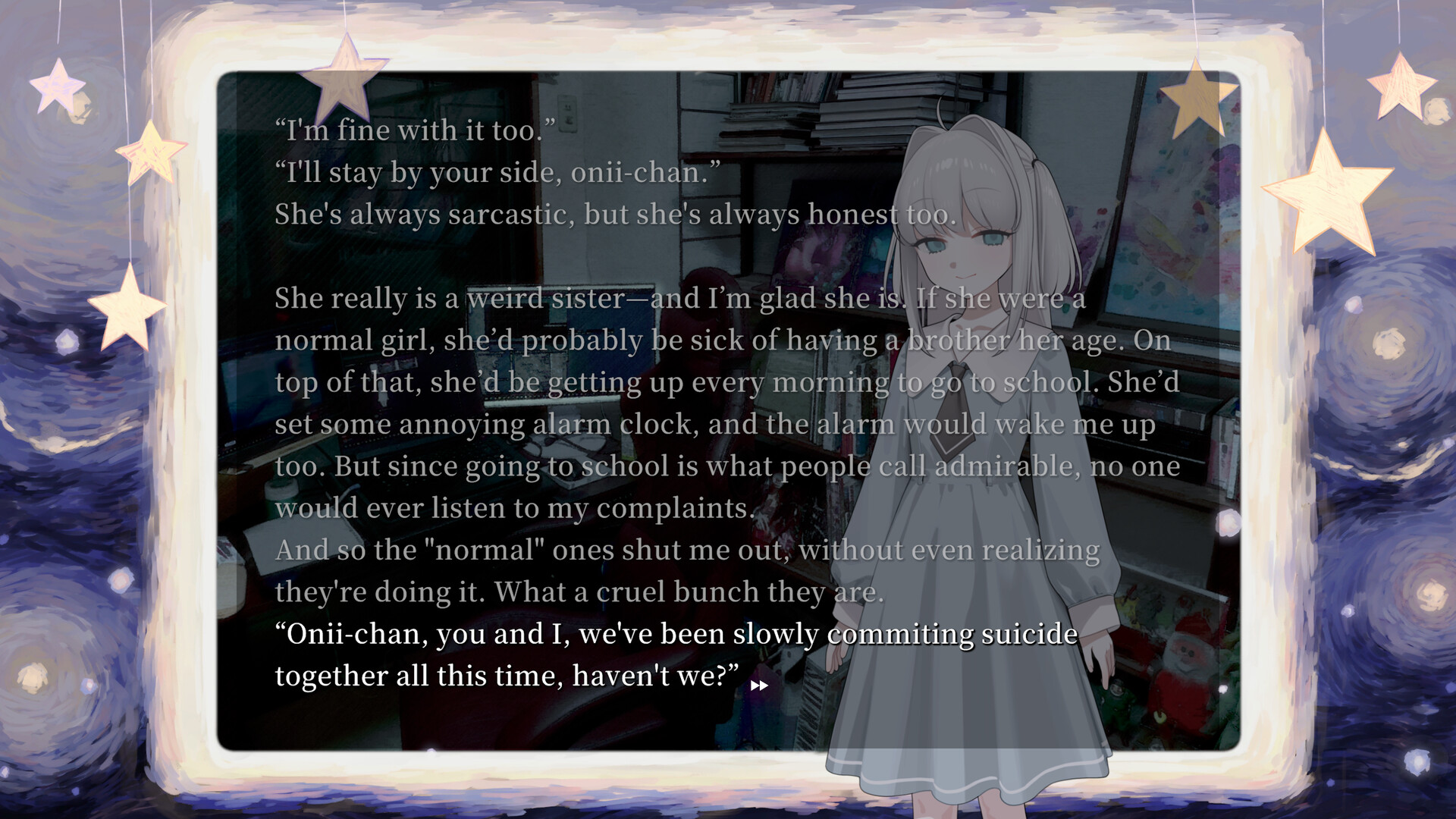
© Serenity Forge. Official media via Steam.
The pitch
OverviewSister Other Paranoia is a dark visual novel from nyalra, the creator best known for the cult hit Needy Streamer Overload, published by Serenity Forge and released on 14 August 2026 for a modest eight euros. It is a short, text-driven character study with a striking hook, and like a lot of nyalra's work, it is designed to get under your skin rather than to comfort you.
The premise is pure psychological unease. You follow a light-novel writer who is painfully oversensitive to other people's emotions, and who then develops the ability to actually read minds, a gift that does not connect him to anyone but instead drives him deeper into isolation and distrust. His one remaining comfort is his younger sister, gifted and lonely in her own way, and the story circles the fragile, complicated bond between them as his hold on other people slips.
Reception has been Very Positive on Steam, though from a small early sample of reviews, and it splits along a clear line. Its admirers find it an absorbing, uncomfortable portrait of a cynical mind that cannot trust anyone, a genuinely engaging descent into paranoia and alienation. Its detractors find it exhausting and self-important, a piece that name-drops literary heavyweights and mistakes cynicism for depth. Both reactions are legible in the reviews, and both are fair depending on what you want from a visual novel.
That divisiveness is the honest heart of any recommendation here. This is a niche, literary, deliberately abrasive narrative game with a distinctive authorial voice, not a broad crowd-pleaser. Judged as what it is, a sharp, uneasy character study from a creator with a real point of view, it is a worthwhile experience for the right reader, and an easy skip for the wrong one.
How it plays
PlayAs a visual novel, the experience is reading, and the quality of the writing is the entire game. There is little in the way of conventional mechanics; you move through the protagonist's narration and interactions, and the draw is the voice, the atmosphere, and the slow, claustrophobic tightening of his psychology. If you do not enjoy dense, introspective, text-first games, nothing here will convert you, and that is worth knowing up front.
The mind-reading conceit is the engine that gives the story its shape. Rather than using it as a power fantasy, the game turns it into a curse: hearing what people actually think corrodes the protagonist's ability to trust or connect, and the narrative uses that to explore isolation, resentment, and the gap between how we perform ourselves and what we hide. When it works, it is a genuinely effective study of a specific kind of alienation, and the writing has real bite.
The flip side, and the reason the reviews divide, is tone. The protagonist is deliberately unlikeable, cynical, and self-regarding, and the prose reaches for literary weight, invoking the kind of authors a certain type of lonely, well-read young man idolizes. For readers on its wavelength, that is the point and the appeal. For others, it tips into feeling pretentious and self-indulgent, a slog that mistakes references for substance. Neither camp is wrong; it depends entirely on your tolerance for a narrator who wants you to find him profound.
At roughly eight euros and a compact length, it does not overstay its welcome or ask for a large investment, which suits an experience this pointed. It is best understood as a short, sharp, authored piece rather than a sprawling VN with branching systems to master. Come for the voice and the psychology; do not come expecting gameplay in the traditional sense.
Art & atmosphere
CraftThe presentation serves the mood, which for a visual novel is most of the job. nyalra's sensibility gives the game a distinct look and tone, an uneasy, intimate atmosphere that matches its subject, and the aesthetic does a lot to keep you inside the protagonist's shrinking world. It is a game about interiority, and the art and framing are built to reinforce that closed-in, watchful feeling.
Sound and pacing carry the unease alongside the writing, keeping the tone taut and slightly oppressive as the protagonist's paranoia deepens. This is not a showcase of spectacle; it is a carefully controlled mood piece, and its craft is in restraint and consistency rather than flourish.
The whole package is unmistakably the work of a specific author rather than a committee, and that is both its strength and its limit. If nyalra's voice resonates with you, the cohesion of vision here is a real pleasure. If it does not, no amount of polish will bridge the gap, because the point of view is the product.
A distinctive, well-crafted dark visual novel with a genuine authorial voice and a sharp psychological hook, deliberately abrasive and divisive enough that its appeal is narrow even where it succeeds.
Pros & cons
The ledgerIn its favour
- A distinctive, uncomfortable premise: mind-reading as a curse that deepens isolation
- A genuine authorial voice from the creator of Needy Streamer Overload
- An effective, absorbing character study of paranoia and alienation for the right reader
- A cohesive, uneasy atmosphere in art, sound, and pacing
- Short and inexpensive, with no padding
Against it
- Deliberately abrasive: the protagonist is cynical and hard to like by design
- Its literary reach reads as pretentious and self-indulgent to a fair share of players
- Pure visual novel: essentially no mechanics, so it lives or dies on the writing
- Niche appeal and a small early review sample; not a broad crowd-pleaser
Screens
Official media© Serenity Forge. Official media via Steam.
The player verdict
Real reviews · Steam- Recommended
“I had an enjoyable time reading Sister Other Paranoia, delving into the mind of a cynical protagonist who is afraid of the outside world. He can't seem to form real connections with acquaintances or friends, and keeps everyone at a…”
40 found helpfulvia Steam - Recommended
“god nerfed me by not giving me a cute imouto. Now i can larp having one by playing this game! Highly reccomend!”
34 found helpfulvia Steam - Not recommended
“"hehe.. they call it schadenfreude" "Who do I think I am, Dostoevsky?" This game is so cringe I actually wanted to rip my eyeballs out. A sore disappointment after needy streamer.”
15 found helpfulvia Steam - Recommended
“ok. the author at least is self aware but, ♥♥♥♥♥♥♥♥ is the read such a slog and so self important just because you know dostoevsky, dazai, hemingway doesnt mean you know your literature--especially since you just mention ♥♥♥♥ by name and…”
15 found helpfulvia Steam
Verdict
The callSister Other Paranoia is exactly the kind of pointed, polarizing narrative game that a distinctive creator makes when they are chasing a feeling rather than a market. Its premise, mind-reading as an isolating curse rather than a gift, is a sharp lens on paranoia and alienation, and for readers on its wavelength it is an absorbing, uneasy descent into a mind that cannot trust anyone. That is a real achievement, and it is why its admirers rate it so highly.
It is also genuinely divisive, and honestly so. The protagonist is unlikeable by design, the prose reaches for literary gravity that some find profound and others find pretentious, and as a pure visual novel there is nothing to fall back on if the voice does not grab you. The split in the reviews is not noise; it is an accurate map of who this is and is not for.
If you love authored, introspective visual novels and you clicked with nyalra's earlier work, this is a small, sharp, inexpensive experience worth your evening. If you want mechanics, likeable characters, or a story that wears its intelligence lightly, this will frustrate you, and that is fine. It knows exactly what it is, and it is aimed squarely at the readers who want it. Score it for them, with clear eyes about everyone else.
Sources
Original review by Aymen Sakouhi from the licensed facts above. Score: 7.0/10.