Omelet You Cook Is Balatro With Eggs, and That Is a Bigger Compliment Than It Sounds
Verdict: 8.3/10. Omelet You Cook is a chaotic cooking roguelike: build omelets off a conveyor belt and chase wild combos. Moreish, if a little luck-swingy.
Aymen Sakouhi·Writer · Games Hobbyist//5 min read
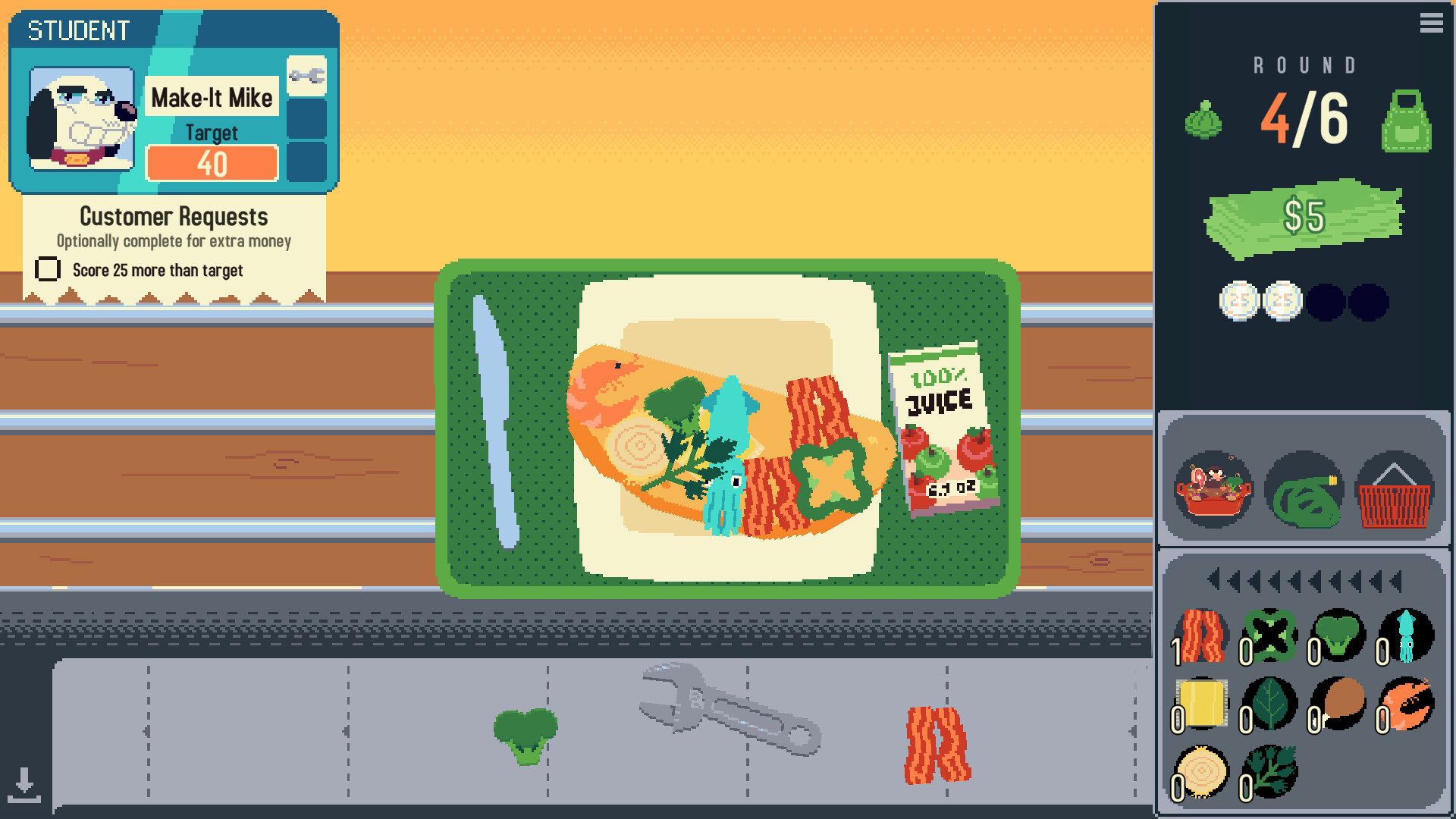
© SchuBox Games. Official media via Steam.
The pitch
OverviewThere is a specific kind of small game that eats a weekend before you notice, and Omelet You Cook is engineered from the shell up to be one of them. It looks, at a glance, like a cute breakfast toy: you make omelets for a cafeteria full of picky students while a rooster named Principal Clucker judges your work. Spend ten minutes with it and the real shape shows through. This is a roguelike about compounding numbers, dressed as a diner, and it is very good at making you say just one more run.
The cleanest way to describe it is the way half the internet already has: Sushi Go meets Balatro, with eggs. Ingredients roll past on a conveyor belt, you grab what you want in real time to assemble an omelet, and the goal is to hit a score target set by whoever is next in line. Between rounds you visit a shop, spend your earnings on new ingredients, tools, and tricks, and slowly bend a modest breakfast into an absurd scoring machine. If you have ever chased a Balatro joker combo at two in the morning, you already know the exact feeling this is reaching for.
Omelet You Cook is the work of solo developer Dan Schumacher, with Hjalte Tagmose, published under SchuBox Games, and it hit its 1.0 release on PC on February 8, 2026 at around twelve dollars. Its reception has been almost comically good: it held a flawless 100 percent positive rating on Steam for months after launch, drew coverage from the likes of IGN and PC Gamer, and now sits at Overwhelmingly Positive across well over a thousand reviews. That kind of number is usually reserved for games with far bigger budgets and far smaller ambitions.
How it plays
PlayA run is a series of orders, each one a target number you have to reach by building an omelet before you run out of ingredients. The twist is the conveyor belt. Instead of picking from a static menu, you pull ingredients off a moving line in real time, which turns every plate into a small act of triage: grab the safe egg now, or gamble on the belt cycling back around to the thing that actually completes your combo. It is a deceptively tense little decision, repeated dozens of times a run, and it is the engine the whole game runs on.
The depth lives in how ingredients talk to each other. Nothing is worth much on its own, but the interactions escalate fast. A dash of hot sauce might ignite the entire omelet for a burst of value; a rare truffle might multiply everything sitting next to it; a category like grains or dairy might feed into a bonus you have been quietly stacking. Learning these relationships is the actual game, and the joy is the classic deckbuilder joy: the moment a run's pieces click and a plain plate of eggs suddenly scores a number that feels illegal.
Between orders you shop, and this is where the Balatro comparison earns its keep. You spend your winnings on new ingredients to seed the belt, on tools that change how you cook, and on tricks that tilt the rules in your favor, gradually building a strategy rather than just reacting to what rolls by. Each run you unlock more of the ingredient pool, so the shape of what is possible keeps widening, and the customers themselves come with quirks and dietary demands that force you to adapt a build you thought was finished.
The game is generous about how you engage with it. There is a relaxed, casual way to play and a sharper, more competitive one, adjustable difficulty, full controller support, and no requirement to react at twitch speed if you do not want to. That range is a real strength, because it lets Omelet You Cook be both a cozy wind-down and a min-maxer's puzzle box depending on the evening, and it broadens the audience well beyond hardcore roguelike players.
The honest friction is variance. Because the belt and the shop are both randomized, a run can hand you a dream engine or quietly refuse to offer the pieces you need, and the difficulty can spike hard enough that a bad draw feels less like a loss you earned and more like one the game decided for you. Casual players in particular can bounce off those walls. There is also a ceiling on content: the ingredient and trick pool, while clever, is not enormous, and dedicated players can see most of what the game has to show in a relatively short time, even with the post-launch updates that have added to it.
What keeps all of that from souring is how quickly a run resets. A defeat costs you a couple of minutes, the shop reshuffles, and the next attempt is already tempting you with a different opening. That short loop is the oldest trick in the roguelike book, and Omelet You Cook executes it with the confidence of a game that knows precisely how addictive its core is.
Art & atmosphere
CraftOmelet You Cook is bright, chunky, and immediately legible, which matters more than it sounds when your core mechanic is reading a moving belt at a glance. Ingredients are drawn as bold, cartoonish icons that are easy to identify in a fraction of a second, the interface keeps your current score and the target front and center, and the whole thing reads cleanly even when a combo is going off and numbers are flying. It is a genuinely well-considered piece of information design wearing a cheerful cartoon coat.
The personality comes from the cafeteria cast. Principal Clucker, the rooster you are forever trying to appease, gives the game a face and a running joke, and the parade of quirky students and their specific demands keeps the tone light and a little silly without ever getting in the way of the math. The presentation is unmistakably in the cozy, wholesome-indie lineage, which is exactly why the game showed up at events like Wholesome Direct, and that warmth is a big part of why a fundamentally spiky scoring game feels so approachable.
Sound and feedback do the heavy lifting on satisfaction. Grabbing an ingredient, triggering a synergy, watching a score tick upward past the target: each has the small, crunchy audio-visual payoff that good roguelikes live and die by. None of it is showy, and it does not need to be. The craft here is in clarity and feel rather than spectacle, and for a game built entirely on repetition, that restraint is exactly the right call.
A razor-sharp cooking roguelike whose conveyor-belt drafting and compounding combos are genuinely addictive, docked only for luck-driven runs, difficulty spikes, and a content pool that clever players outrun.
Pros & cons
The ledgerIn its favour
- The real-time conveyor belt makes every omelet a tense little decision
- Ingredient synergies escalate into genuinely satisfying scoring combos
- Balatro-style shop turns each run into a build rather than pure reaction
- Casual and competitive modes plus adjustable difficulty widen the audience
- Bright, ultra-legible art that stays readable even mid-combo
- Short reset loop makes just one more run almost impossible to resist
Against it
- Randomized belt and shop mean some runs feel unwinnable through no fault of yours
- Difficulty can spike sharply enough to frustrate casual players
- Ingredient and trick pool is clever but not especially large
- Dedicated players can see most of the content fairly quickly
- Luck-heavy design will not suit anyone who wants pure skill expression
Screens
Official media© SchuBox Games. Official media via Steam.
The player verdict
Real reviews · Steam- Recommended
“It's 2am and I am doing one more omelet to feed to a giant chicken. 10/10 would omelet again. To be more precise it's got all the charm of Balatro but it's live action game where you have to make split second decisions. Difficulty also…”
1 found helpfulvia Steam - Recommended
“this feels like a mobile game port. there are a bunch of fun combos you can create but idk i just fall into the same kinda combos. i guess its super middle of the road,, i'd get this on sale”
1 found helpfulvia Steam - Recommended
“There have been lots of rogue games released in the last year or two and a lot have been misses for me. This one has been a really fun shake up for me. The puzzle is great and the pixel art is delightful.”
0 found helpfulvia Steam - Recommended
“Maybe one of the best games out here. simple, high skill ceiling, just enough rogue to be fair and exciting, easy to learn, hard to master, a ton to unlock. Great great game - and it's funny and wholesome. Needs more awards.”
0 found helpfulvia Steam
Verdict
The callOmelet You Cook is a small idea executed with unusual precision. It takes the conveyor-belt drafting of a card game, the compounding-combo high of a modern deckbuilder, and a genuinely charming cafeteria wrapper, and it fuses them into something that is far harder to put down than a game about breakfast has any right to be. The moment-to-moment tension of the belt and the between-run pull of the shop feed each other perfectly, and the result is one of those roguelikes that quietly deletes your evening.
Its limits are the honest limits of its genre and its size. The randomness that makes the highs so high also produces runs that feel decided for you, the difficulty can bite harder than the cozy presentation implies, and the content pool, while smartly designed, is not bottomless. If you need every loss to feel earned and every hour to bring something new, the variance and the ceiling will eventually show.
At 8.3, Omelet You Cook is a small triumph and an easy recommendation to anyone who likes Balatro, cooking games, or the specific dopamine of a snowballing score. For twelve dollars it delivers a core loop as sharp as anything in its lane, wrapped in a tone that makes it welcome on a bad day as well as a competitive one. It earns its extraordinary reputation, and it earns the just-one-more that will cost you far more than one more.
Sources
Original review by Aymen Sakouhi from the licensed facts above. Score: 8.3/10.