Mortal Shell II cuts the formula loose and becomes one of the year's best soulslikes
Verdict: 8.4/10. Cold Symmetry ditches the stamina bar, opens up exploration, and builds a swappable-Shell soulslike that ranks among 2026's best.
Aymen Sakouhi·Writer · Games Hobbyist//5 min read
© Playstack. Official media via Steam.
The pitch
OverviewThe first Mortal Shell was a cult favorite that earned its following honestly, a lean, moody soulslike with one clever idea, the hardened stance, and just enough personality to stand apart from the pile of FromSoftware tributes. It was good. It was also cautious, a small game that knew its limits and stayed inside them. Mortal Shell II is not cautious at all.
This is a sequel that looks at the thing that made the original safe and deliberately throws it away. The stamina meter, that sacred soulslike governor that tells you when you are allowed to act, is gone. In its place is combat you can just do: sprint, swing, bash, and press forward without the game quietly counting your budget in the background. It sounds like a small change. It reshapes the entire feel of the game.
Cold Symmetry has swung big here, and the critical reception reflects it, landing at a strong Metascore in the mid 80s with a chorus of reviewers calling it one of the best soulslikes in years and, in a few cases, one of the best ever. That is heady company, and the game does not clear every bar it sets for itself. But the ambition is real, and more importantly, most of it lands.
The headline pitch is freedom. Freedom in how you move, freedom in how you fight, and freedom in how you build your character through the returning Shell system, now expanded into something with real strategic weight. This is a bigger, faster, more confident game than its predecessor in almost every way, and while that scale occasionally works against it, the trade is worth making. Mortal Shell II is the rare sequel that grows up without losing what made it interesting.
How it plays
PlayEverything starts with that removed stamina bar, because everything else flows from it. Stripping out stamina turns Mortal Shell II from a measured, defensive soulslike into an aggressive, adrenaline-forward one. You are encouraged to keep moving and keep attacking rather than poking and retreating, and the combat gains a rhythm that feels closer to a character action game than a typical Souls crawl. The hardened stance from the original survives as your defensive anchor, so there is still a read-and-react discipline underneath the speed, but the ceiling on aggression is dramatically higher.
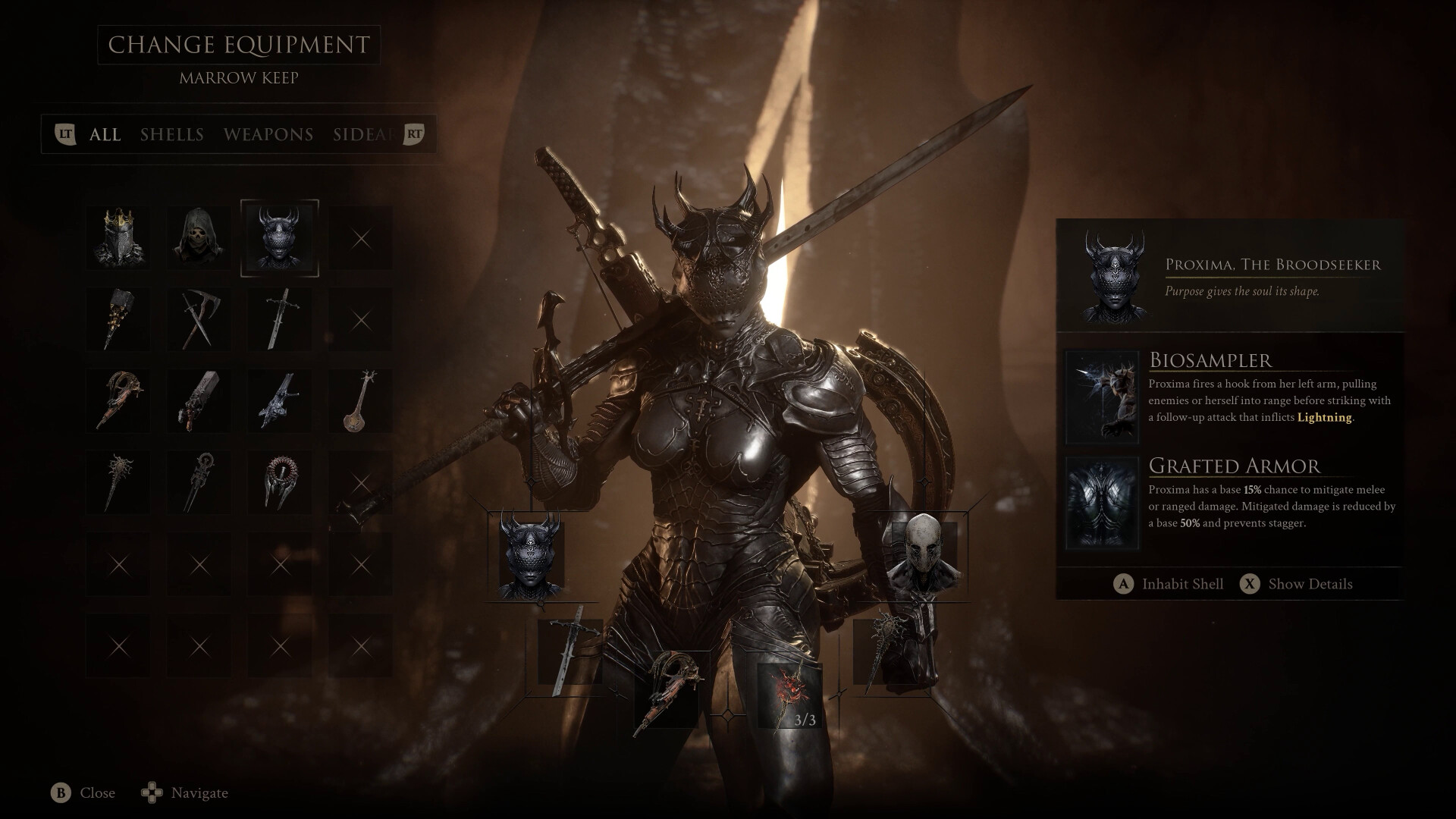
The Shells are the other half of the design, and this is where the sequel finds its depth. You collect a set of discoverable, class-based bodies, eight of them, and you swap between them freely to change your entire approach. One turns you into a heavy tank that soaks and trades. Another leans stealthy and precise. Others sit between, and the fun is in mixing disciplines, borrowing a strength here and a survivability trait there, until you have a hybrid that fits the fight in front of you. It gives the game a build-craft dimension the first one only gestured at, and it rewards experimentation instead of punishing it.
Exploration is the quiet triumph. The world is built to be wandered, with interconnected maps that fold back on themselves and reward curiosity with shortcuts, secrets, and the satisfying click of a level design that clearly had a plan. Several reviewers singled this out as among the best navigation in the genre, and in play it is easy to see why: the game trusts you to get lost and find your own way back, and the world holds up to that trust. Progression is focused rather than bloated, which keeps the forward pull strong.
The bosses are built to test understanding rather than memorization. Instead of asking you to rote-learn one attack pattern and dodge it thirty times, the better encounters probe whether you actually grasp the systems, whether you can read a Shell matchup, exploit an opening, and adapt when the fight shifts. When it works, it is exactly the kind of combat puzzle the genre is supposed to deliver.
What holds it back is the cost of that ambition. Reaching in so many directions at once means some of them collide. There are camera problems in tight spaces, the occasional hit-detection or animation hiccup, and balance that can wobble between Shells and weapons, with a few reviewers noting less variety in gear than the biggest genre heavyweights. A minority of critics found the whole thing overreaching, its mechanics not always cohering into a single clean idea. Those are fair notes. They are also the kind of rough edges you get from a studio choosing to grow rather than play it safe, and they never sink the core, which stays consistently gripping.
Art & atmosphere
CraftMortal Shell II keeps the grim, oppressive aesthetic that gave the original its identity, a dark fantasy of decayed flesh, cold stone, and grotesque beauty, but it deploys it across a much larger canvas. The bump in scale suits the tone. Where the first game felt like a claustrophobic vertical slice, the sequel gives its ruined world room to breathe, and the interconnected areas each carry their own dread and character rather than blurring into one gray corridor.
The art direction does a lot of the storytelling. Mortal Shell has always been coy with plot, and this sequel keeps that reticence, trusting environment and atmosphere to convey mood and history instead of spelling it out. It is a world you read through what you see: the architecture, the corpses, the strange organic horror stitched into the landscape. For players who like their soulslikes evocative and ambiguous, it hits the mark.
Technically it is more ambitious and therefore a little less airtight than the tighter original. The same rough edges that touch the combat, the camera in cramped rooms, the odd animation, surface here too, and the sheer amount of world means the polish is spread thinner than in the compact first game. But the mood never breaks. The presentation carries a confidence the studio has clearly earned, and when the light catches one of its grander vistas, Mortal Shell II looks like a game punching well above the weight class its budget suggests.
A confident, expansive soulslike sequel that removes the stamina bar for fast aggressive combat, deepens the Shell system into real build-craft, and delivers standout interconnected exploration, held back only by camera issues, minor jank, and the cohesion cost of its own ambition. Metascore in the mid 80s and Very Positive on Steam. An 8.4 reflects one of the year's best genre entries, rough edges included.
Pros & cons
The ledgerIn its favour
- Removing the stamina bar makes combat fast, aggressive, and genuinely exciting
- Eight swappable class-based Shells add real build-craft and strategic depth
- Interconnected world design offers some of the best exploration in the genre
- Bosses test system mastery instead of rote pattern memorization
- Grim, evocative dark-fantasy atmosphere on a much bigger, bolder canvas
- Accessible difficulty options widen the door without dulling the challenge
Against it
- Camera struggles in tight spaces, an old soulslike bugbear
- Occasional hit-detection and animation rough edges
- Balance can wobble between Shells and weapons
- Less gear and weapon variety than the genre's biggest names
- The scale of ambition means the systems do not always cohere perfectly
Screens
Official media© Playstack. Official media via Steam.
The player verdict
Real reviews · Steam- Recommended
“I put out a request to add the option to toggle off chromatic abberation and film grain because it gave me naseau, the developer responded and said that they will do it. Cannot give anything except a positive review.”
831 found helpfulvia Steam - Not recommended
“The more time I put into Mortal Shell II, the more my opinion of it has unfortunately soured. I enjoyed the Open Beta considerably more than I expected to, and it gave me the impression that the full game had a lot of potential.…”
340 found helpfulvia Steam - Recommended
“This game lets you possess a 7-foot armored muscle mommy to steamroll enemies without stamina management holding you back. Absolute peak Soulslike, 10/10.”
328 found helpfulvia Steam - Recommended
“About 60 hours in I still absolutely adore this game. Having had a review key early for my podcast, I already beat it in about 40 hours on standard, and am currently in new game plus on "Night Mode" which is their hard difficulty (to…”
327 found helpfulvia Steam
Verdict
The callMortal Shell II is what a sequel should be. It takes a well-liked but modest original, identifies the safe choice at its core, and boldly discards it, and the gamble pays off. Cutting the stamina bar transforms the combat into something fast and aggressive and alive, the expanded Shell system gives it a strategic depth the first game only hinted at, and the interconnected world is a genuine highlight in a genre full of them. This is one of the best soulslikes of the year, and the reviewers reaching for stronger superlatives are not wrong to.
It is not flawless, and it would be dishonest to pretend otherwise. The camera fights you in tight rooms, a few animations and hits land awkwardly, and the sheer reach of the design means not every system snaps cleanly into place. A game this ambitious was always going to show some seams, and Mortal Shell II shows a few.
But the seams are the price of a studio that decided to grow, and that is the right decision. Cold Symmetry has turned a promising cult soulslike into a confident, expansive, standout entry in the genre, one that respects the formula enough to know exactly which rule was worth breaking. If you have any appetite for a dark, demanding, exploration-rich soulslike, this is an easy recommendation and one of 2026's most pleasant surprises.
Sources
Original review by Aymen Sakouhi from the licensed facts above. Score: 8.4/10.