Monster Hunter Wilds Is a Magnificent Hunt Still Arguing With Itself
Our verdict: 7.5/10. Monster Hunter Wilds is a technically stunning, seamless hunt, held back by a long performance saga and a lighter sense of friction.
Aymen Sakouhi·Writer · Games Hobbyist//5 min read
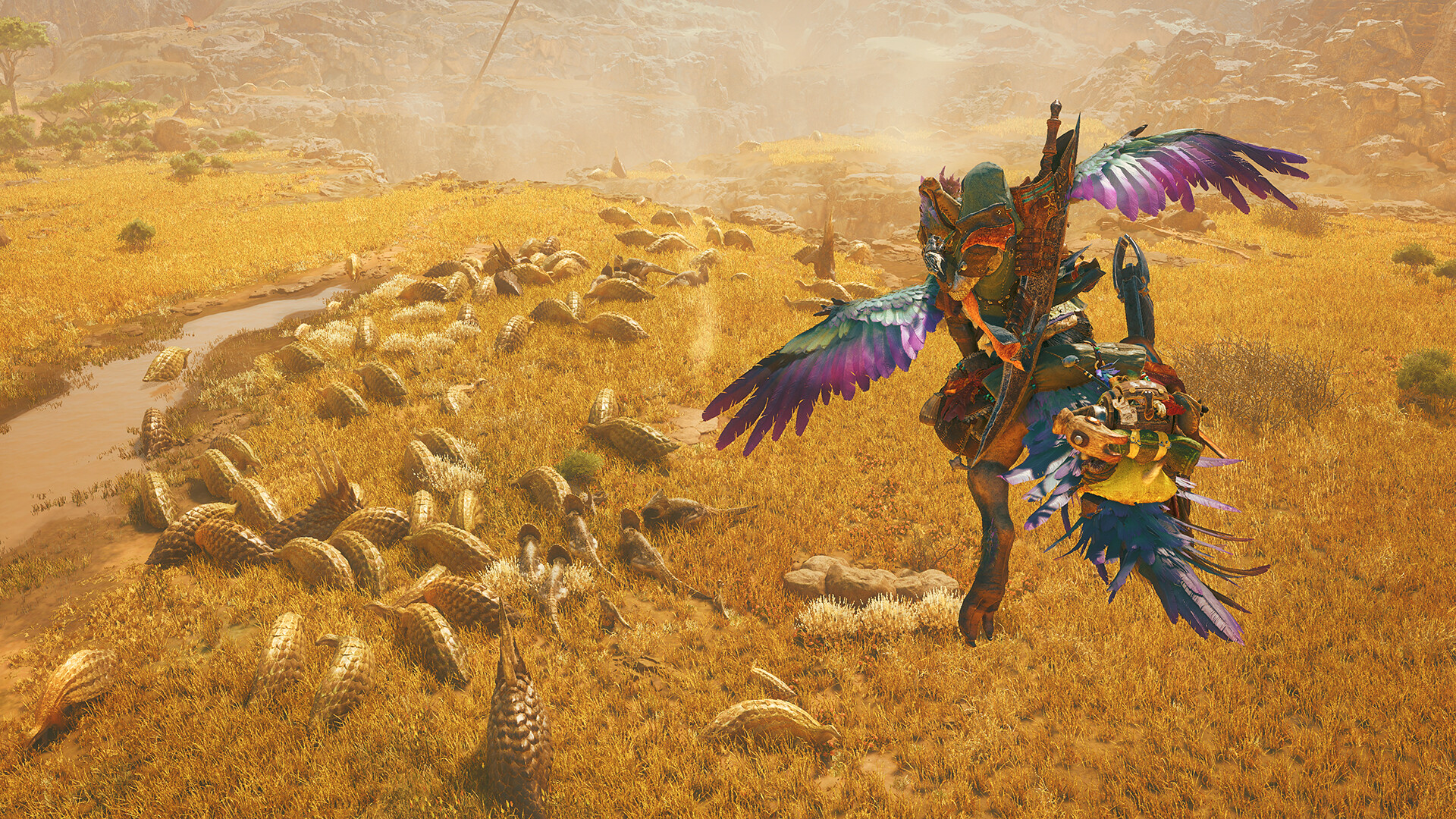
© CAPCOM Co., Ltd.. Official media via Steam.
The pitch
OverviewMonster Hunter Wilds arrived in February 2025 as the most ambitious entry Capcom had ever attempted in the series, and more than a year and a half of updates later it remains one of the most interesting arguments in the genre. Developed and published by Capcom, it set out to turn the hunt into a single continuous world, where weather, herds, and terrain shift around you and a monster can wander from one biome into another while you are still tracking it. On that ambition, it mostly delivers something no earlier Monster Hunter could.
And yet the reception tells a more complicated story than the ambition alone would suggest. Critics were largely enthusiastic at release, praising the scale and the combat, but the Steam community has settled at Mixed, with roughly 69 percent of more than 122,000 reviews positive. That is not the number you expect from a game this accomplished, and the gap is the whole reason this review is worth writing. When a hunt this good lands at Mixed, something real is pulling against it, and here there are two things: a performance saga that has followed the game since launch, and a quieter design argument about whether Wilds streamlined away part of what made the series feel like itself.
This is a verdict on where the game stands now, after a long run of title updates, not a snapshot of its launch week. Some of the roughest edges have been sanded down. Enough of them remain, and enough of the design debate is unresolved, that the Mixed badge still reads as honest rather than unfair.
How it plays
PlayThe core of Wilds is the best the series has felt to move through. Monsters are no longer encounters you load into; they live in a connected map, migrating, feeding, fighting each other, and reacting to the weather systems that sweep across each region. Tracking a target through a sandstorm, watching a turf war break out between two apex predators, and then committing to the fight without a loading screen in sight is the fantasy the series has chased for two decades, and Wilds is the first time it genuinely lands. The Seikret mount that carries you between objectives, the focus-mode wound targeting that rewards reading a monster's body, and the smoother weapon flow all make the moment-to-moment hunt feel fast, legible, and generous.
That generosity is also the center of the design argument. A vocal part of the veteran audience feels that Wilds removed too much of the friction that defined Monster Hunter. Preparation, resource management, and the sense that a hunt had to be earned through knowledge have all been softened, and for players who loved exactly that resistance, the game can feel like it hands you the win before you have had to work for it. The counterargument is just as real: for a huge new audience, that same accessibility is why Wilds is the first entry they have ever stuck with. Both of those readings are true, and which one you hold decides a great deal about how you score the game yourself.
The larger problem, and the one that cuts across every camp, is performance. Wilds has been dogged since launch by crashes, stutter, and demanding hardware requirements, and the community reviews return to this again and again. Capcom has shipped a long series of patches, and the game runs better now than it did at release, but the reputation has stuck, and plenty of recent reviewers still report instability on specific hardware. For a game whose whole pitch is uninterrupted immersion in a living world, technical hitches do more damage than they would almost anywhere else, because they break the exact thing the design is selling.
Underneath all of that, the content loop is enormous and the combat is genuinely excellent. Fourteen weapon types each play like their own game, the endgame has been steadily expanded through updates, and the monster roster remains the series' great strength: readable, characterful, and satisfying to learn. If you can get it running well on your machine and you make peace with the lighter sense of challenge, there are hundreds of hours here that very few games can match.
Art & atmosphere
CraftWilds is a showcase when it is behaving. The living world is its signature achievement, with regions that transform between fertile and hostile as the weather turns, herds that move with a sense of real ecology, and lighting that sells the scale of a storm rolling in across open ground. The monsters are animated with the series' usual craft, each one legible enough to fight by sight alone, and the sound design does enormous work in a hunt, from the distant roar that tells you a target is near to the audio cues that signal a wound landing. It is a game that, at full performance on capable hardware, looks and sounds like the most expensive Monster Hunter ever made, because it is. The irony is that the same technical ambition behind that spectacle is what makes the performance problems hurt: the world is so determined to never stop that any hitch in it registers immediately.
A technically stunning, seamless hunt with the best combat and monster design in the series, held back by a long performance saga and a lighter sense of friction that genuinely divides its audience.
Pros & cons
The ledgerIn its favour
- A seamless, living world that finally delivers the uninterrupted hunt the series chased for years
- Combat that is fast, readable, and generous across all fourteen weapon types
- Monster design and animation that remain the best in the genre
- An enormous content loop steadily expanded by a long run of title updates
- The most welcoming entry point the series has ever offered newcomers
Against it
- A persistent performance saga of crashes and stutter that updates have eased but not erased
- A lighter sense of friction and preparation that many veterans feel loses part of the series' identity
- Demanding hardware requirements for a game that lives or dies on uninterrupted immersion
- A Mixed community reception that reflects genuine, unresolved disagreement rather than noise
Screens
Official media© CAPCOM Co., Ltd.. Official media via Steam.
The player verdict
Real reviews · Steam- Not recommended
“Personally. You should buy this game. Objectively. Just wait until they actually fix the performance issues and release the expansion DLC. The game itself is technically amazing and has come a far way from day one release quality however i…”
126 found helpfulvia Steam - Not recommended
“The biggest problem with Wilds is that it removes almost all friction and with it, a lot of what made Monster Hunter feel like Monster Hunter. Almost every mechanic that used to require preparation, decision-making or knowledge has been…”
125 found helpfulvia Steam - Not recommended
“MHF1 vet here. I love this series, and this entry has a lot of good things going for it. Unfortunately, I still can't personally recommend this game. Crashes are very common on my hardware, and in two full years of patches the devs seem to…”
96 found helpfulvia Steam - Recommended
“Bro this game changed my life. Ever since they dropped all the title updates, it's fixed every issue I would have had with this game.”
10 found helpfulvia Steam
Verdict
The callMonster Hunter Wilds is a magnificent hunt that is still arguing with itself, and the honest verdict has to hold both halves of that at once. On its best day, running smoothly on hardware it likes, it is the most impressive the series has ever been: a continuous, living world full of monsters worth learning and combat worth mastering, with enough content to swallow entire seasons of your time. Critics saw that clearly, and they were right.
The Mixed player reception is just as fair. The performance problems that shadowed launch have improved but not disappeared, and for a game built entirely on never breaking immersion, that is the worst possible place to still be wobbling. The design debate is thornier and more interesting: Wilds chose accessibility over resistance, and in doing so it won a vast new audience while leaving a devoted part of its old one feeling that something essential was smoothed away. Neither side is wrong.
At 7.5, this is a genuinely great action game with real, lingering asterisks. If you are new to Monster Hunter, it is the best door into the series that has ever existed, assuming it runs well for you. If you are a veteran who prized the preparation and the struggle, your reservations are legitimate and widely shared. It is a world worth living in, as soon as it stops tripping over its own ambition.
Sources
Original review by Aymen Sakouhi from the licensed facts above. Score: 7.5/10.