Hearth and Hamlet is a cozy idle citybuilder with surprising depth
Verdict: 7.5/10. It looks like a simple clicker, but this pixel-art medieval idler hides a genuinely deep resource and city-management loop under the calm.
Aymen Sakouhi·Writer · Games Hobbyist//4 min read
© Runic Forge. Official media via Steam.
The pitch
OverviewHearth and Hamlet opens looking like the hundredth cozy clicker on Steam: a campfire, a counter ticking up, a pixel-art village waiting to grow. Give it an hour, though, and it quietly reveals itself as something more considered. Underneath the relaxing surface is a genuine citybuilder, one that cares about resource balance, worker assignment, research, and policy, and that punishes you, gently, if you stop paying attention.
Developed by Phorust Studios and published by Runic Forge, it sets you down in a magic-tinged medieval frontier with nothing but a fire and an empty map, and asks you to turn it into a thriving kingdom. It sits in the incremental genre, so much of the growth happens through numbers going up, but it borrows the satisfaction of a proper city sim: watching a quiet camp slowly become a living, working town.
The game arrived off the back of a popular demo, and it is easy to see why it built a following. It hits a specific, comfortable sweet spot between the low-pressure appeal of an idle game and the tactile pleasure of a management sim, and it executes that blend with more polish and detail than its modest presentation first suggests.
It is not a deep strategy epic, and it is not trying to be. But as a cozy, low-stakes builder to unwind with, it is more thoughtful and more engaging than its clicker exterior lets on, and that pleasant surprise is the whole appeal.
How it plays
PlayThe loop is classic incremental citybuilding: you gather resources, assign workers to jobs, construct and upgrade buildings, and unlock new technologies and policies that expand what your settlement can do. It starts almost aggressively simple, a single interaction at a time, but the systems open up steadily, and by the time you have your first houses and a workshop running, the real shape of the game is visible.
The central skill is balance. You are constantly juggling logging, farming, mining, and research, and the game is unforgiving about neglect: let one input fall too far behind and you can trigger shortages or even a famine, and crucially, this can happen while you are idling. That is the clever wrinkle that separates it from a pure clicker. Because the settlement keeps living while you are away, you cannot simply leave it running and return to free progress; you have to set it up to sustain itself, which turns idle time into a planning problem rather than a pause button.
The upgrade and research trees give the mid-game its momentum. There is a steady drip of new buildings, technologies, and laws to unlock, each one nudging your economy in a new direction and opening the next bottleneck to solve. It is the familiar incremental hook, always one more unlock away from the next satisfying jump, but grounded in a management sim's logic rather than pure number inflation, which makes the progression feel earned.
Where it shows its limits is depth and variety over the long haul. This is a focused, fairly linear experience; there is not a huge amount of strategic branching or replay-driving variability, and once you understand the core balancing act, later stages can settle into a comfortable, low-tension rhythm. That is arguably the point of a cozy idler, but players hoping for a meaty strategy game will hit the ceiling before long.
Quality-of-life is solid for a game of this scope, and the systems are legible and readable, but this is a small, focused title rather than a sprawling one. It does one thing, the calm-but-attentive incremental build, and it does it well.
Art & atmosphere
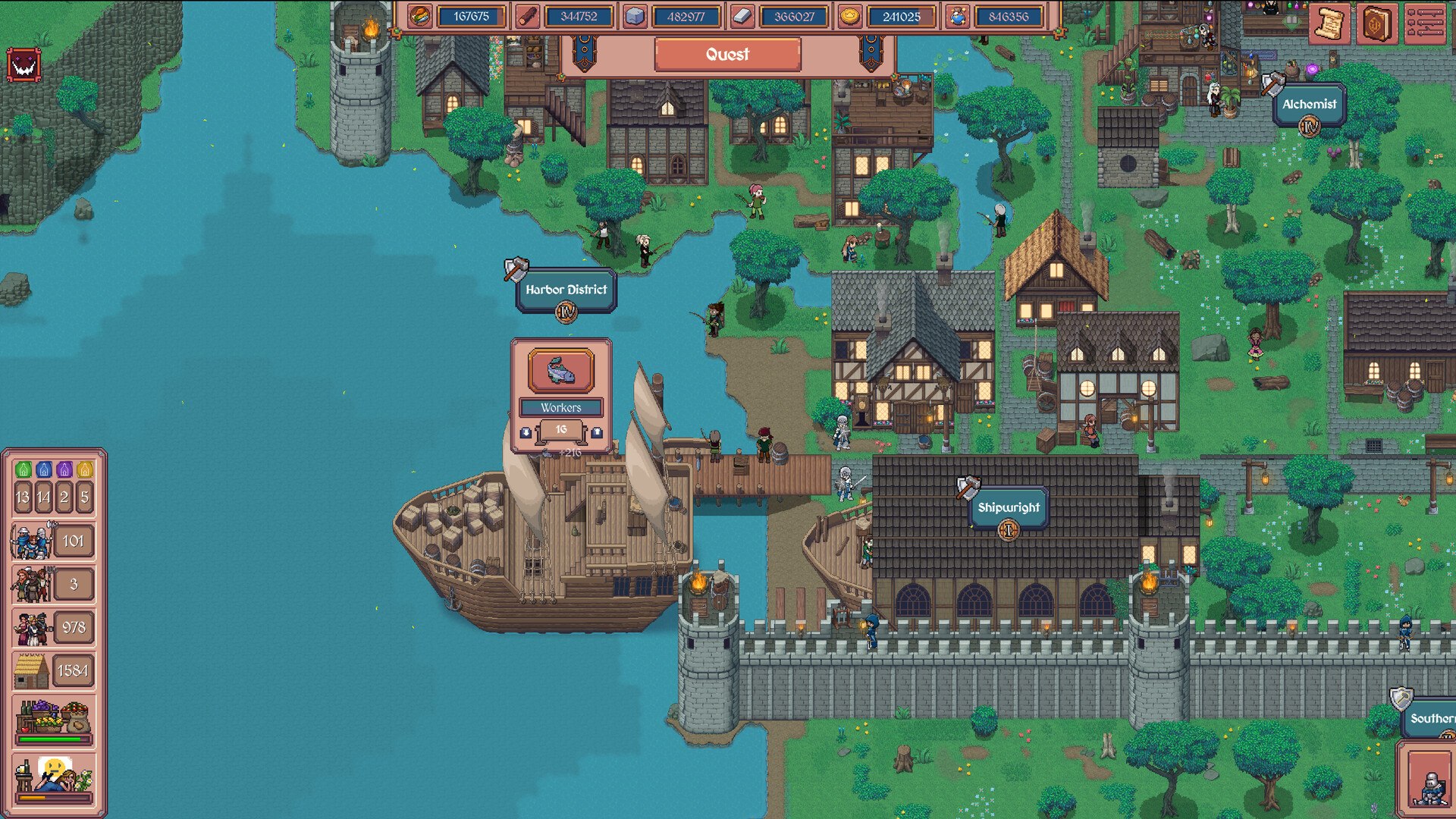
CraftThe pixel art is the game's quiet triumph. It would have been easy to make a functional-looking idler with a bare interface, but Hearth and Hamlet invests real care into its magic-tinged medieval world, and it pays off. The attention to detail is genuinely lovely: villagers move freely across the map, walking to their jobs and returning to their homes, and that simple bit of life-simulation makes the town feel inhabited rather than abstract.
That sense of a living settlement is what elevates the presentation above its genre peers. Watching your hamlet fill in, seeing tiny figures go about their work as your policies and buildings reshape the place, gives the numbers a physical anchor and makes the growth satisfying to look at, not just to read off a counter. It is a small thing done well, and it does a lot to sell the fantasy.
The overall mood is calm and warm, which is exactly right for the genre. The audio and visual design lean into the relaxing, unwind-after-work register the game is going for, and the whole thing has a gentle, unhurried charm. It is not ambitious presentation, but it is thoughtful and cohesive, and it makes a simple idea genuinely pleasant to spend time with.
A cozy incremental citybuilder that hides a genuine, balance-driven management loop and charming, living pixel-art town under its clicker surface, limited mainly by modest long-term depth and a low-tension late game. Warmly received at launch, and a 7.5 reflects a polished, thoughtful, appropriately small game that over-delivers on its humble premise.
Pros & cons
The ledgerIn its favour
- Hides a real, balance-driven citybuilder under a simple clicker exterior
- Idle progression that requires planning, not just waiting, thanks to famine risk
- Steady, satisfying drip of buildings, research, and policies to unlock
- Lovely pixel art with villagers who live and move around a believable town
- Calm, cozy, low-pressure feel that is easy to lose an evening to
Against it
- Limited long-term depth and strategic branching
- Later stages can settle into a low-tension, repetitive rhythm
- Not much replay-driving variety once the core loop is understood
- Small in scope; strategy fans will hit the ceiling quickly
- The early game is slow and misleadingly simple before it opens up
Screens
Official media© Runic Forge. Official media via Steam.
The player verdict
Real reviews · SteamVerdict
The callHearth and Hamlet is a lovely little surprise. It presents as a throwaway cozy clicker and turns out to be a genuinely thoughtful incremental citybuilder, one that respects your attention enough to make idle time a planning challenge and rewards it with the steady, moreish pleasure of watching a settlement grow. The pixel art and the living, wandering villagers give it a warmth that its genre often lacks, and the resource-balancing core has real, if modest, teeth.
Its limits are the limits of its ambition. This is a small, focused, fairly linear game, and once you have internalized the balancing act, the later stages relax into a gentle rhythm that will not hold everyone. Anyone looking for a deep, replayable strategy sim should look elsewhere, because that is not what this sets out to be.
But judged as what it is, a cozy, polished, quietly clever idle builder to unwind with, it is a very easy recommendation. It over-delivers on its humble premise, respects your time, and is genuinely pleasant to spend an evening inside. For the cozy-game and incremental crowd, it is a small gem well worth the modest asking price.
Sources
Original review by Aymen Sakouhi from the licensed facts above. Score: 7.5/10.