GwenBlade Witcheresque Turns Grief Into a Soulslike, and Mostly Lands the Blow
Verdict: 8.0/10. A lightning-paced solo-dev Soulslike about depression and loss, with a clever Shadow death system. Rough in places, but it hits.
Aymen Sakouhi·Writer · Games Hobbyist//5 min read
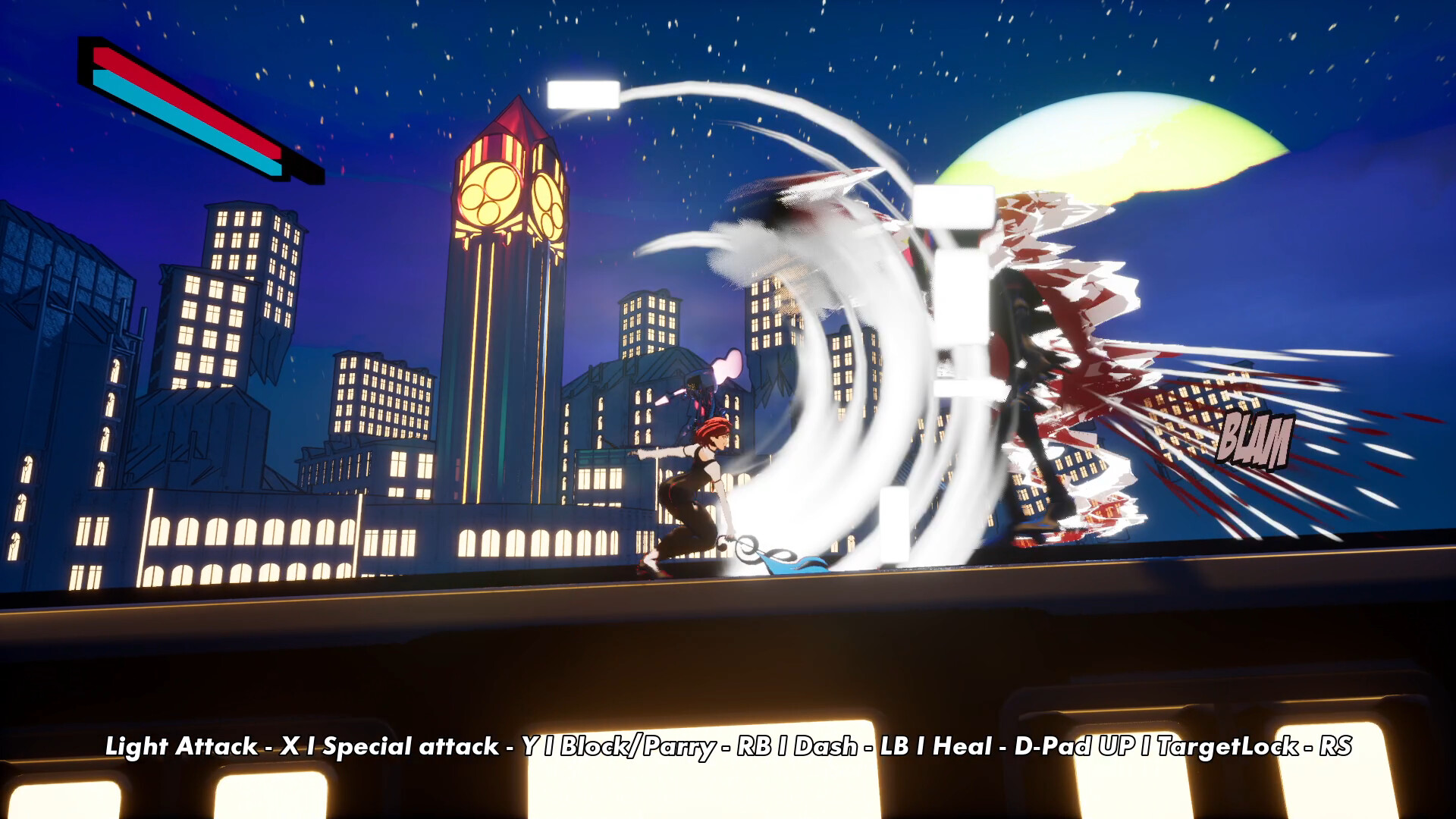
© ArcWillow. Official media via Steam.
The pitch
OverviewGwenBlade Witcheresque wants to be two things at once, and the surprise is how often it manages both. It is a fast, aggressive Soulslike about parrying and poise-breaking your way through a nocturnal city, and it is a story about grief, doubt, and the slow work of moving on from a real-life loss. Most games that reach for that second goal treat the fighting as a delivery system for cutscenes. Here the combat and the theme are the same gesture: you fight the things your own mind produces, and the game keeps asking whether beating them is the same as healing.
You play Jane, stuck in a city that feeds on her fears and her unresolved grief. By night she cuts down monsters born from her own shadow. By day she barely holds herself together. That framing could easily tip into misery-as-marketing, but the writing keeps it specific and human rather than abstractly sad, and the structure gives the darkness somewhere to go.
It is the work of a single developer, ArcWillow, and it carries both the strengths and the limits of a solo project. This is a focused, personal game with a clear point of view and one genuinely clever central system, not a sprawling production with the budget to sand every edge. Coming out of the gate its Steam reception is small but strongly positive, and the earlier demo drew the same warm response. Treat what follows as a review of a distinctive, early-reception indie rather than a mass-tested blockbuster.
What makes it worth your attention is that it commits. It does not hedge the Soulslike combat to make room for the story, and it does not water down the story to prop up the combat. It bets that a difficult fight and a difficult feeling can share the same screen, and for long stretches that bet pays off.
How it plays
PlayThe combat is built on the Soulslike fundamentals, tuned toward speed and aggression rather than patient turtling. You block, parry, and kick, and the goal in most encounters is to break an enemy's poise and open a window for damage. Parrying is the spine of it: read the wind-up, answer it cleanly, and a dangerous exchange becomes yours. Miss the read and the lightning pace punishes you quickly. It is a rhythm you learn with your hands, and once it clicks the fights have real snap.
The standout system is what happens when you die. You leave everything behind, and to get it back you have to face your Shadow, a version of you that fights exactly like you do. It is the familiar Soulslike idea of reclaiming what you lost, rebuilt as a mirror match against your own habits. If you lean on one safe pattern, the Shadow leans on it too, and you feel the cost of your worst tendencies in the most literal way a combat game can manage. Mechanically it is a smart wrinkle. Thematically, in a game about confronting the parts of yourself you would rather avoid, it is the whole thesis compressed into a boss fight.
The supporting systems lean into the same nocturnal-city fiction. You heal at Streetlamps, save progress at Photobooths, and carry a rechargeable Lighter that rewards aggression, so playing boldly feeds the resource that keeps you alive. That loop nudges you away from timid play and toward the confident, forward pressure the combat is designed around. It is a clean bit of design, tying the way you are meant to feel to the way you are mechanically encouraged to act.
Structurally, Witcheresque is the story-forward version of the concept. It trades the usual roguelike run structure for a more authored, campaign-shaped experience heavy on cutscenes, social links, and lore. That is the right call for what this game is trying to say, since a purely randomized loop would flatten the narrative it clearly cares about most. It does mean your mileage depends on how much you connect with the writing and the characters, because they are load-bearing here, not garnish.
The friction is the friction of a solo project. Encounter variety and the overall content volume are modest next to bigger-budget Soulslikes, and some systems are explained more by trial than by tutorial. None of it undercuts the core, but you can feel the seams of a one-person team that spent its energy on the ideas that matter most and left the polish thinner elsewhere. If you need a long, deep, endlessly replayable action game, calibrate expectations. If you want a tight, pointed one with a strong hook, this delivers.
Difficulty sits where a Soulslike should: demanding but legible, with deaths that feel earned rather than cheap. The speed raises the skill floor a little, so newcomers to the genre should expect to spend real time learning the parry timing before the game opens up. Once it does, the moment-to-moment feel is the best thing here.
Art & atmosphere
CraftThe aesthetic is pure nocturnal city, and the game lets its mechanics double as its iconography. Streetlamps as your points of safety, Photobooths as your save points, a Lighter as the small flame you carry through the dark: these are not just systems but images, and together they build a mood of a person moving through empty late-night streets, looking for the next pool of light. It is a coherent visual language where the way you survive and the way the world looks are telling the same story.
The enemies extend that idea. They are monsters born from Jane's shadow, and the design treats them as externalized feelings rather than a generic bestiary. That gives the fights a weight beyond mechanics, because you are never quite fighting strangers. The recurring Shadow, your own reflection turned opponent, is the sharpest expression of it, and the game clearly knows that fight is its signature image.
As a piece of craft it is ambitious for a solo effort, and mostly the ambition reads as intent rather than shortfall. The presentation will not out-muscle a studio production, but it does not need to, because the atmosphere is doing the heavy lifting and the tone stays consistent from the combat to the quiet moments. It is a small game that knows exactly what it wants to feel like, and it holds that feeling.
A distinctive, strongly-received solo-dev Soulslike with excellent combat and a clever, theme-perfect Shadow system, marked down for modest content volume, uneven polish, and a still-small reception sample.
Pros & cons
The ledgerIn its favour
- Fast, aggressive Soulslike combat built on parries and poise-breaks that feels great once it clicks
- The Shadow death system is a smart mechanic and the perfect expression of the game's theme
- Grief and depression are handled with specificity instead of vague misery
- Streetlamps, Photobooths, and the Lighter tie the systems into a coherent nocturnal mood
- Commits fully to being both a real Soulslike and a real story, without diluting either
- A focused, personal solo-dev project with a genuine point of view
Against it
- Modest content volume and encounter variety next to bigger-budget Soulslikes
- Some systems are learned by trial rather than clearly taught
- Solo-dev polish is thinner in places outside the core combat
- Story-forward structure means the writing has to carry you, and it will not land for everyone
- Early Steam reception is strongly positive but still a small sample
Screens
Official media© ArcWillow. Official media via Steam.
The player verdict
Real reviews · Steam- Not recommended
“At the current state there is really nothing to recommend about this prototype of a game. I hope it keeps getting updates and it reaches something close to the concept they are shooting for. I like the theme and it would be an interesting…”
6 found helpfulvia Steam
Verdict
The callGwenBlade Witcheresque is the rare game that uses its genre to say something instead of just wearing it. The Soulslike combat is fast and satisfying on its own terms, the Shadow death system is a genuinely clever idea, and the whole thing is built around a single honest question about whether winning a fight is the same as getting better. It does not always have the resources to match its ambition, and as a solo project it shows its seams in content volume and polish. But it commits to being both a real action game and a real story about loss, and that commitment is what makes it stick.
This is for players who want a Soulslike with a soul, who do not need forty hours or a huge bestiary, and who are willing to meet a small, personal game on its own terms. If you bounce off story-heavy structure or need a deep replayable loop, it may frustrate you. If the pitch of parrying your way through grief speaks to you at all, it is very much worth your time.
At 8.0, this is a distinctive, well-made indie that earns its warm early reception, held back only by the natural limits of a one-person team. It is one of the more interesting small Soulslikes of the year precisely because it refuses to separate how it plays from what it is about.
Sources
Original review by Aymen Sakouhi from the licensed facts above. Score: 8.0/10.