Gallipoli is BlackMill's best WW1 shooter, if enough players show up to fill it
Verdict: 8.0/10. The Verdun studio's fourth WW1 shooter is its finest, with a fresh Ottoman front and sharper gunplay. The one worry: launch player counts.
Aymen Sakouhi·Writer · Games Hobbyist//4 min read
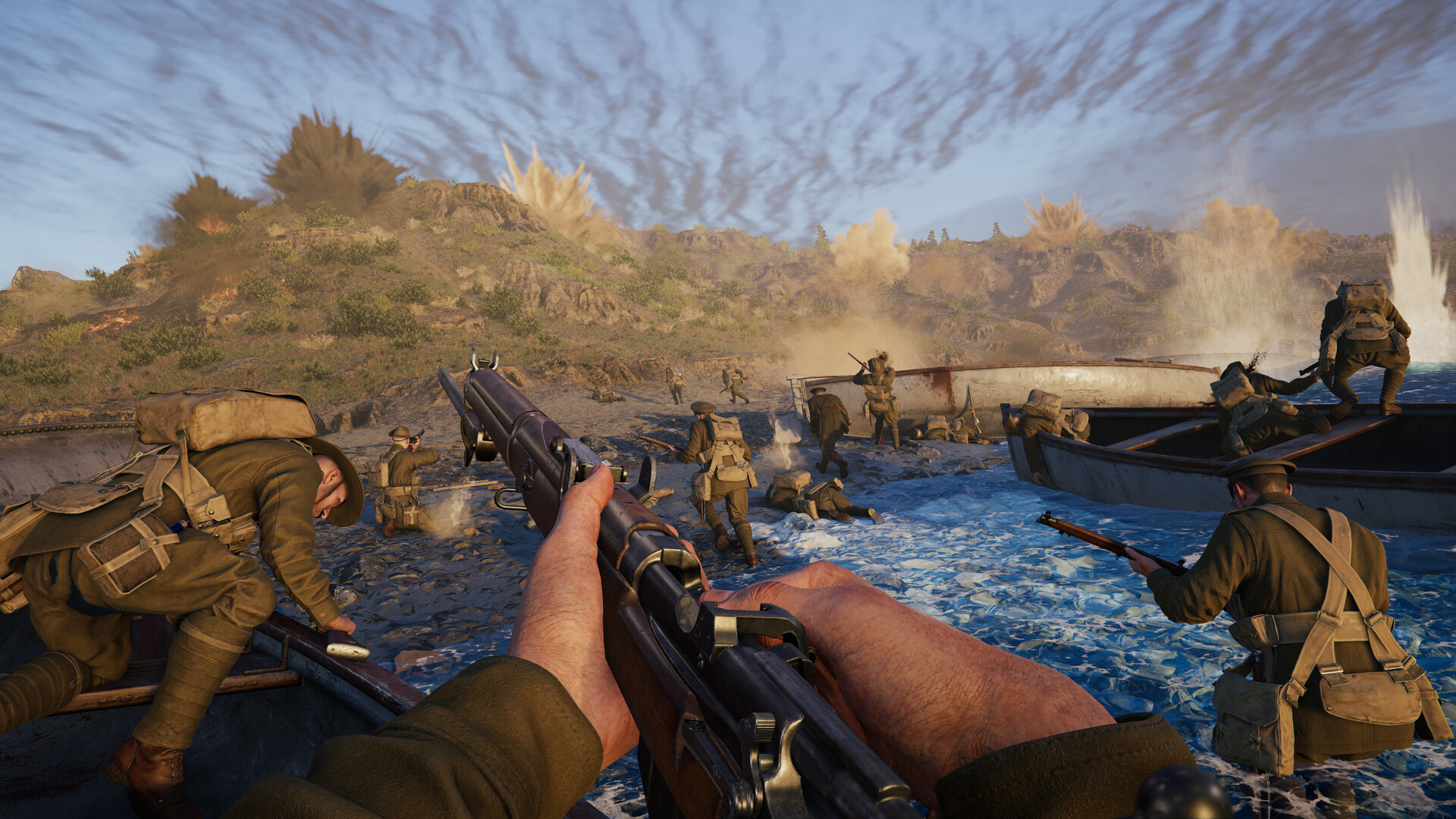
© BlackMill Games. Official media via Steam.
The pitch
OverviewBlackMill Games has spent over a decade building a niche almost entirely to itself: authentic, grim, large-scale World War 1 multiplayer shooters. Verdun arrived in 2013, Tannenberg followed in 2017, and Isonzo in 2022, and together the series has sold more than four million copies by refusing to be another World War 2 game. Gallipoli is the fourth entry, and by most accounts it is the best one yet.
That is the critical consensus, at least. Reviewers have been notably enthusiastic, with several scoring it a 9 out of 10 and calling it the strongest game the studio has made. The pitch is easy to understand: take the proven formula of squad-based, class-driven, historically grounded WW1 combat, sharpen the gunplay, and move it somewhere new. Instead of the well-worn European trenches, Gallipoli takes you to the Ottoman fronts, the beaches of Gallipoli and the deserts of Mesopotamia, giving the series a fresh identity in a genre it already dominates.
Released on August 20, 2026, for PC, PlayStation 5, and Xbox Series X and S with full crossplay and 50-player battles, it is the most accessible and ambitious the series has been. The improved gunplay, the new settings, and the accumulated polish of a fourth iteration make it, on paper and in the hands of critics, the definitive BlackMill experience.
There is one honest caveat that hangs over everything, though, and it is the caveat that hangs over every multiplayer-only game: it is only as good as its player base. The launch reception on Steam has been more divided than the glowing reviews suggest, and for a game that lives entirely online, that matters. This is a review of a genuinely excellent shooter with one real question mark, and that question mark is the crowd.
How it plays
PlayAt its core, Gallipoli is unmistakably a BlackMill game, and that is a compliment. This is authentic, punishing, teamwork-driven WW1 combat, built around large 50-player battles where coordination and positioning matter more than twitch reflexes. The class-based structure returns, pushing you to fill a role within a squad rather than lone-wolf your way to glory, and the result is the tense, methodical, grounded feel the series is known for. Death comes fast and often, and the game asks you to think about cover, suppression, and objectives rather than kill counts.
The biggest mechanical story is that the gunplay has genuinely improved. Critics have singled it out as sharper and more satisfying than in previous entries, and it makes a real difference: the weapons feel weightier and more responsive, which smooths over one of the rougher edges of the older games. Combined with the accumulated lessons of three prior titles, Gallipoli plays like the most refined version of this formula the studio has produced.
The new setting is more than a fresh coat of paint. Moving to the Ottoman fronts, the amphibious assaults and cliffs of Gallipoli, the arid expanses of Mesopotamia, changes the texture of the combat and gives the maps a distinct character. After three games rooted in the mud of Europe, the shift in geography, light, and terrain genuinely reinvigorates the series and sets it apart from the crowded field of European-trench shooters.
And then there is the elephant on the battlefield. Gallipoli is a multiplayer-only experience, and its early Steam reception has been mixed even as critics have raved, following the same pattern as Isonzo, which launched to community hesitation before stabilizing. For a niche online shooter, healthy, populated servers are not a bonus, they are the entire product. If the player base holds and grows, as Isonzo's eventually did, this is a fantastic game. If it does not, even the best gunplay in the series cannot fill an empty lobby. Anyone buying in should check current player numbers first, because the experience depends on them entirely.
Judged on its design and execution, though, this is BlackMill operating at the peak of its craft: a smarter, sharper, better-looking version of a formula it has spent thirteen years perfecting.
Art & atmosphere
CraftGallipoli continues the series' commitment to grim historical authenticity, and the move to the Ottoman fronts gives it a visual identity the previous games could not have. Where Verdun, Tannenberg, and Isonzo lived in the grays and browns of European trench warfare, Gallipoli trades some of that mud for sun-baked beaches, rugged cliffs, and desert expanse. The result is a series that suddenly looks fresh again, with maps that feel distinct from one another and from everything that came before.
The atmosphere remains the studio's calling card. This is not a heroic, bombastic vision of war; it is a bleak, oppressive, deliberately unglamorous one, and the art direction leans into the horror and futility of the conflict rather than glorifying it. That tonal seriousness is a big part of why the series has earned its dedicated following, and Gallipoli honors it while giving the eye somewhere new to look.
As a fourth iteration, it is also the most polished the series has looked, benefiting from years of refinement. It is not a technical showcase in the AAA sense, and it does not try to be, but its authenticity and strong sense of place do more for immersion than raw fidelity would. The presentation understands its assignment: to make you feel like you are in a specific, terrible historical moment, and it succeeds.
BlackMill's most refined WW1 shooter, with sharper gunplay, a fresh and evocative Ottoman setting, and authentic 50-player teamwork combat, earning critic scores up to 9/10 as the series' best. Weighed against a multiplayer-only design whose value depends entirely on player population and a divided early Steam reception. An 8.0 reflects an excellent, distinctive shooter with one real, honest risk: the crowd.
Pros & cons
The ledgerIn its favour
- The most refined entry in a series with over a decade of pedigree
- Noticeably sharper, more satisfying gunplay than previous games
- The fresh Ottoman setting reinvigorates the series and sets it apart
- Authentic, tense, teamwork-driven 50-player WW1 combat
- Crossplay across PC, PS5, and Xbox Series widens the player pool
- Grim, serious atmosphere that respects the horror of its history
Against it
- Multiplayer-only: the experience depends entirely on a healthy player base
- Early Steam reception is divided even as critics rave
- Punishing, methodical style is not for players wanting fast arcade action
- Not a technical showcase; authenticity over fidelity
- Niche appeal that lives or dies on server population
Screens
Official media© BlackMill Games. Official media via Steam.
The player verdict
Real reviews · Steam- Not recommended
“I have to preface this by saying, first and foremost, that I adore this franchise and this developer with all my heart. I was an early tester for Verdun, and I have bought every other game in the series on Day 1 of release since. Another…”
228 found helpfulvia Steam - Recommended
“It might need balance on some maps but the game is totally fire. Don't mind others who say slow movement or something, it's actually fine and fair, this is not Call of Duty. Well, they delivered what Battlefield 1 couldn't. It's a great…”
152 found helpfulvia Steam - Recommended
“It really needs lean left and right mechanics. Movement is a bit slow too, but overall fun so far.”
136 found helpfulvia Steam - Recommended
“This is honestly coming to be my most favorite game in the series! The gunplay is the most refined feature feeling weighted and heavy! The combat system is peak too, down to the suppression mechanics! When your character gets shell…”
105 found helpfulvia Steam
Verdict
The callGallipoli is, by design and execution, the best game BlackMill Games has made. It takes a formula the studio has spent thirteen years honing, sharpens the gunplay, and transplants it to a fresh and evocative setting, and the result earned the strong critical reviews it received, several of them the highest scores in the series. For anyone who loves authentic, grim, teamwork-first historical shooters, this is the genre's high-water mark right now.
The one reservation is unavoidable and it is structural: this is a multiplayer-only game, and its early player reception has been more divided than the critical praise. A niche online shooter is only as good as its lobbies, and while Isonzo proved this community can rally after a shaky start, that is a promise rather than a guarantee. The quality is not in question. The crowd is.
So the recommendation comes with a simple, practical instruction: this is an excellent WW1 shooter and an easy buy if the servers are populated when you read this, so check the player count first. If the community shows up, as it has before, Gallipoli is a superb, distinctive, and criminally underserved kind of game. If you have ever wanted a serious shooter about a war that games usually ignore, it does not get better than this, provided you have people to play it with.
Sources
Original review by Aymen Sakouhi from the licensed facts above. Score: 8.0/10.