Forza Horizon 6 Turns Japan Into the Series' Best Playground Yet
Playground Games swaps Britain for Japan's touge passes and neon cities in the most polished, most cautious Forza Horizon yet — and it's still brilliant.
Aymen Sakouhi·Writer · Games Hobbyist//5 min read
© Xbox Game Studios. Official media via Steam.
The pitch
OverviewPlayground Games has spent a decade dragging the Horizon Festival around the globe — Colorado, southern Europe, Australia, Britain, Mexico — and for its sixth mainline entry it finally lands in Japan. The map spans more than 70 distinct areas: dense Tokyo blocks stacked with neon signage, winding alpine touge passes, volcanic highlands, snowbound backroads, and coastal highways, all built around the series' evergreen promise of dropping you into any of 550-plus real-world cars and letting you drive.
Forza Horizon 6 launched on 18 May 2026 (three days early for Premium Edition buyers) into an unusually loud reception. Critic scores clustered around 90 on Metacritic, making it one of the best-reviewed releases of the year, and the response from players has been just as emphatic — Steam's tens of thousands of user reviews sit at a Very Positive 86% positive rating. That is a lot of goodwill to live up to, and it raises the obvious question any sixth entry in a yearly-ish franchise has to answer honestly: is Japan a genuine reinvention of the Horizon formula, or the same festival wearing a spectacular new coat of paint?
The honest answer, borne out by both the critical consensus and the loudest community complaints, is a bit of both — and that tension is what makes this review worth writing rather than a rubber stamp.
How it plays
PlayThe skeleton is unmistakably Horizon. You arrive at the Festival, start racing, and climb through PR stunts, Showcase events, and curated race series to earn Wristbands — seven of them this time — each unlocking faster car classes and tougher competition. Collect all seven and you're crowned a Horizon Legend, which opens Legend Island, an endgame region built around the Legends Island Circuit and reserved for players who've proven they can handle the game's fastest metal. It's the same skeleton FH5 and FH4 used, just re-skinned and, by most accounts, tuned more tightly than before, with the pacing between story beats and open-world distractions feeling less like padding than in prior entries.
The genuine new idea is Touge Battles, and it's the best thing Playground has added to the formula in years. These are 1v1 duels on real Japanese mountain-pass roads — Hakone, Mount Haruna (an unmistakable nod to Initial D's Akina), Bandai Azuma, the Norikura Skyline, and the Arashiyama Takao Parkway — and they play by different rules than the rest of the game. There's no brute-forcing a touge with a faster car and a fistful of driving assists; narrow roads and unforgiving drop-offs mean you have to actually read the corner, understand how your car loads weight mid-turn, and use drifting as a technique for holding a racing line rather than a stunt for onlookers. It's the closest Horizon has come to rewarding real car control over raw horsepower, and it borrows its structure and stakes directly from Japanese street-racing culture rather than inventing a generic mountain sprint.
Everything around that core is the deepest version of the Horizon toybox to date. The roster leans into Japan's own car culture — kei cars, drift-ready hatchbacks, rally icons, and time-attack specials sit alongside the usual hypercars and off-roaders — and the tuning and livery-sharing systems that have long defined the community carry over intact, with enough depth in the tuning menus to genuinely change how a car behaves on a touge versus a closed circuit. A returning seasons system cycles spring, summer, autumn, and winter through four-week series, quietly reshaping weather, foliage, and the tone of events as it goes, which does real work in making a single map feel like several; snow transforms the mountain passes into a different kind of hazard entirely, and cherry blossom season turns familiar routes into showpieces worth slowing down for.
EventLab, the series' user-generated content suite, comes back significantly expanded: you can now start building from anywhere on the map rather than a fixed canvas, and up to twelve players can build together in real time through a co-op mode called Horizon CO-LAB, complete with sky tracks, prop stamping, and fully custom race, stunt, and drift-zone creation. Paired with cross-save and cross-play, it turns the map into a long-tail content platform that will likely outlive the campaign by years, the way FH5's EventLab scene did, and it gives dedicated players a genuine reason to keep opening the game long after the Wristband grind is finished.
Where the game stumbles is the part that's supposed to hold it together: the story. Reviewers have consistently singled out the campaign missions as the weakest link in the package — low-stakes driving errands wrapped around forgettable Festival characters, with several critics noting that the hosts and DJs still skew heavily British despite the Japanese setting, which undercuts some of the immersion the map itself works hard to build. More broadly, a number of major outlets landed on nearly identical language to describe the whole package: the safest sequel Playground has ever shipped, every system sharpened rather than reinvented, described by one outlet as "less Fast & Furious, more Fast & Mild." That's a fair critique even from people who otherwise loved it. And post-launch, the goodwill has taken a real hit from the game's live-service side — the Series 2 "Horizon Decades" content update drew visible community backlash for weighting new cars toward the paid Car Pass while the free reward track leaned on repeats from Series 1, reviving a familiar complaint about how Horizon's seasonal content economy is balanced once the honeymoon period of launch week ends.
Art & atmosphere
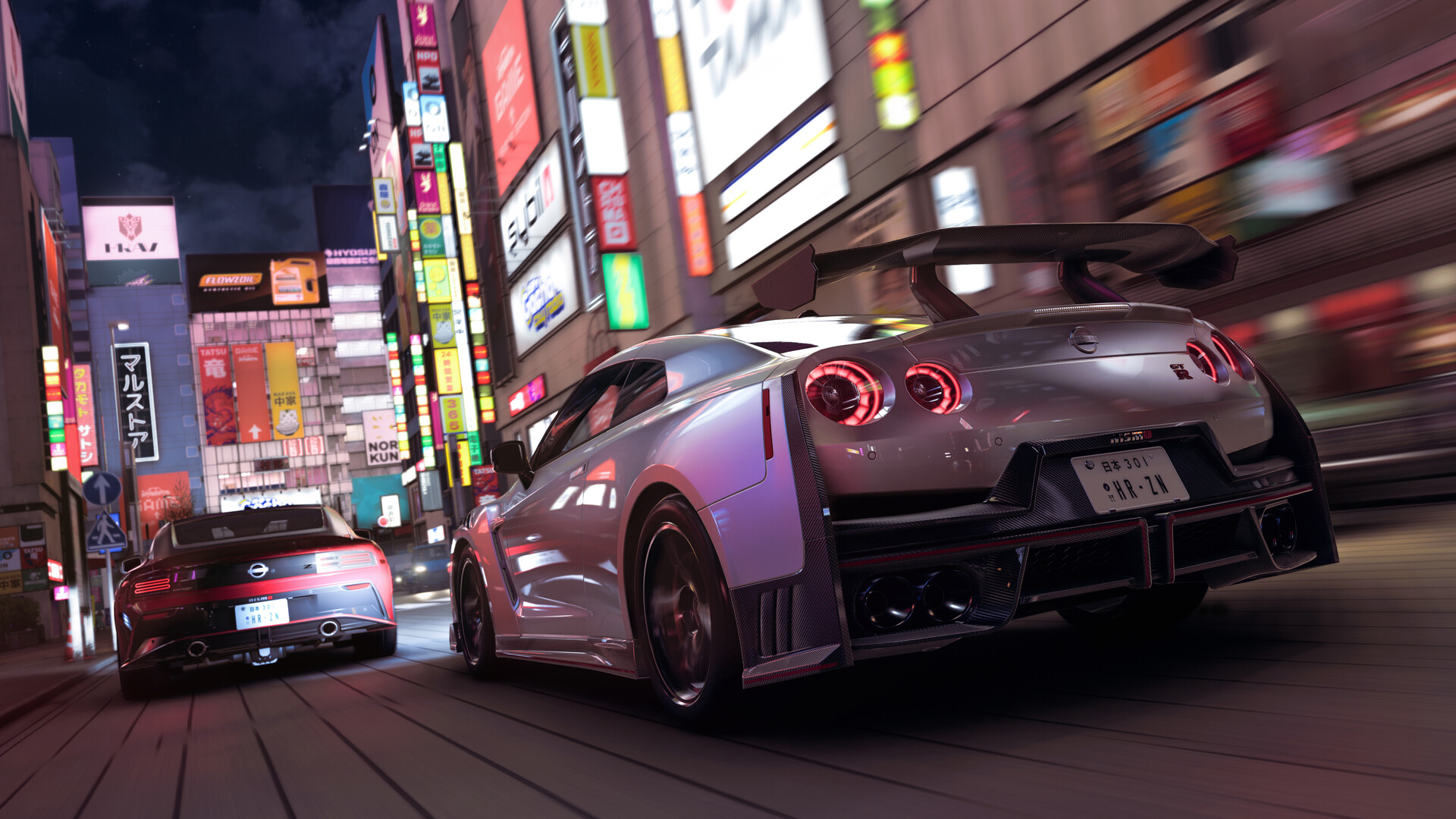
CraftJapan is the best-looking canvas Playground has built. Tokyo's density is rendered with real conviction — stacked signage, cramped backstreets, elevated expressways threading between towers — and it's a sharp contrast against the volcanic highlands, snow-dusted countryside, and the touge roads themselves, which are staged with the kind of elevation change and hairpin drama that makes drifting through them feel genuinely dangerous rather than decorative. The rotating seasons layer mist, cherry blossoms, and snowfall over the same roads without it ever reading as a reused asset with a filter slapped on top, and the studio's decision to chase the country's overall atmosphere rather than a single stereotyped postcard view of it mostly pays off across the map's 70-plus areas.
The soundscape backs that up: a station list built around genres and artists that fit the setting, engine notes distinct enough to matter in Touge Battles where you're listening for wheel slip as much as watching for it, and ambient detail — cicadas in summer, wind through mountain passes, the hum of neon-lit crossings — that does a lot of quiet work in selling Japan as a lived-in place rather than a backdrop.
Performance tells a more complicated story depending on what you're asking of your hardware. Baseline optimization has been widely praised — one Steam reviewer called it "a fantastic example of good optimization" that "runs so absurdly well even on my mid-grade PC," and that tracks with the broader consensus that mainstream rigs run the game comfortably above 60fps. Push toward the top end, though, and the picture gets murkier: independent PC performance analysis found ray tracing barely worth enabling even on an RTX 5090, since Tokyo's dense geometry and stacked light sources are unusually CPU-heavy, and players have separately reported AMD-specific microstutter, shader-compilation stutter in the opening half hour, and, following at least one post-launch update, crashes and disconnects on otherwise capable machines.
A near-90 critic average and a Very Positive Steam verdict reflect a genuinely excellent, if deliberately safe, entry — docked for a thin campaign and post-launch monetization friction that both critics and players have called out.
Pros & cons
The ledgerIn its favour
- Japan is the most atmospherically distinct, best-realized map the series has built, from dense Tokyo streets to volcanic highlands and snowbound touge
- Touge Battles are a genuine mechanical evolution — skill- and car-control-based 1v1 duels on real mountain-pass roads like Mount Haruna and Norikura Skyline
- 550-plus car roster leans into Japanese car culture (kei cars, drift specials, time-attack machines) alongside the usual hypercars, backed by deep tuning and livery tools
- EventLab's expanded, fully multiplayer creation suite (build-from-anywhere, 12-player Horizon CO-LAB) gives the map years of community-made content ahead of it
- Rotating seasons meaningfully reshape weather, tone, and activities on the same map rather than being cosmetic
- Runs comfortably on modest PC hardware according to widespread player reports, well above the usual AAA-launch performance bar
Against it
- Campaign story missions are low-stakes, generic, and the clear weak point compared to the Festival's open-world content
- Critics broadly agree the game plays it safe — the most polished Horizon yet, but the least ambitious in terms of real structural change
- Ray tracing is barely worth enabling even on flagship GPUs, and Tokyo's dense lighting and geometry are unusually CPU-heavy
- Post-launch Car Pass content has outpaced free new-car additions in later updates, drawing legitimate community pushback
- Scattered PC-specific issues persist for some players, including AMD microstutter and post-update crashes or disconnects
Screens
Official media© Xbox Game Studios. Official media via Steam.
The player verdict
Real reviews · Steam- Not recommended
“I'll open with the most positive aspect: this game is a fantastic example of good optimization. It runs so absurdly well even on my mid-grade PC, it's miles ahead of most big releases in this regard. Now, for the issues: The single player…”
108 found helpfulvia Steam - Recommended
“As a Need for Speed fan that almost never played Forza, i'm so happy to be able to play an actual good racing game after so much time... This game is insane, it's probably the best racing game i've ever played in my entire life.”
83 found helpfulvia Steam - Not recommended
“My computer specs are 13900k, RTX 4090, and 32GB RAM. I played it for a month without any problems, but after the game update, I get disconnected after about 2-3 minutes in the game, and then the game crashes immediately. I've tried all…”
62 found helpfulvia Steam - Recommended
“Forza Horizon has easily become the gold standard in racing games for me. Beautiful environments, tons of cars to collect, an excellent tuning system, and amazing community liveries to help make every car feel unique. Need for Speed games…”
43 found helpfulvia Steam
Verdict
The callJudged purely on what's in the box, Forza Horizon 6 earns its reception: Japan is the most striking setting the series has ever built, Touge Battles are a real and welcome evolution of what a Horizon race can demand of you, and EventLab's multiplayer overhaul gives the game a community-content runway that should last years. The near-90 critic average and Steam's Very Positive standing aren't inflated goodwill — they reflect a genuinely well-crafted racing game.
But it's worth being clear-eyed about what it isn't. This is Playground iterating expertly on a formula it has now run six times, not reinventing it — the campaign is thin, the humor and hosting still lean on the same well-worn British Festival-DJ energy regardless of location, and the post-launch Car Pass economy has already given the community a legitimate reason to grumble. None of that undoes what the moment-to-moment driving and the setting accomplish. It just means the ceiling here is excellence within a known shape, not a leap beyond it.
Sources
Original review by Aymen Sakouhi from the licensed facts above. Score: 8.8/10.