Elden Ring Nightreign Trades the Pilgrimage for a Stopwatch
Our Elden Ring Nightreign review: FromSoftware compresses its open world into a three-player, forty-minute roguelite raid, with real trade-offs.
Aymen Sakouhi·Writer · Games Hobbyist//5 min read
© FromSoftware, Inc.. Official media via Steam.
The pitch
OverviewElden Ring built its identity on patience: the slow crawl across a punishing map, the memorization of a boss's every tell, the long walk back to reclaim what you lost. Nightreign takes that same skeleton and shoves it into a stopwatch. FromSoftware's stand-alone follow-up compresses the studio's open-world instincts into roughly forty-minute expeditions, three players dropped onto a shrinking island, racing an encroaching storm toward a boss called a Night Lord before the map itself closes the door on them.
It's a genuinely strange pivot for a studio whose entire brand rests on unhurried dread, and the opening hours spend their time making the case that speed and Souls-style combat aren't natural enemies after all. Eight playable Nightfarers, each with a distinct kit and a specific role in a three-person party, replace the freeform build-your-own-fighter approach of the mainline games with something closer to a hero shooter's cast list.
Released in May 2025 for Windows and published by FromSoftware alongside Bandai Namco, Nightreign arrives with online co-op, a full suite of accessibility options rarely associated with this developer (camera comfort settings, adjustable volume mixing, and a toggle that lets players opt out of tight timed inputs), and a single paid expansion already out for players who burned through the base roster. None of that changes the fundamental wager the game is making: that a genre built on long, singular pilgrimages can survive being cut into repeatable, three-person sprints.
The results are lopsided in a way that's more interesting than a clean success or failure. When a run clicks, when three Nightfarers with complementary kits stumble into the right item synergy and walk into the Night Lord fight over-prepared, Nightreign delivers something none of FromSoftware's other games quite manage: the specific, shared adrenaline of a raid boss going down to a party that built itself in real time. When it doesn't click, it can feel like the studio's combat wearing a costume it didn't ask for.
How it plays
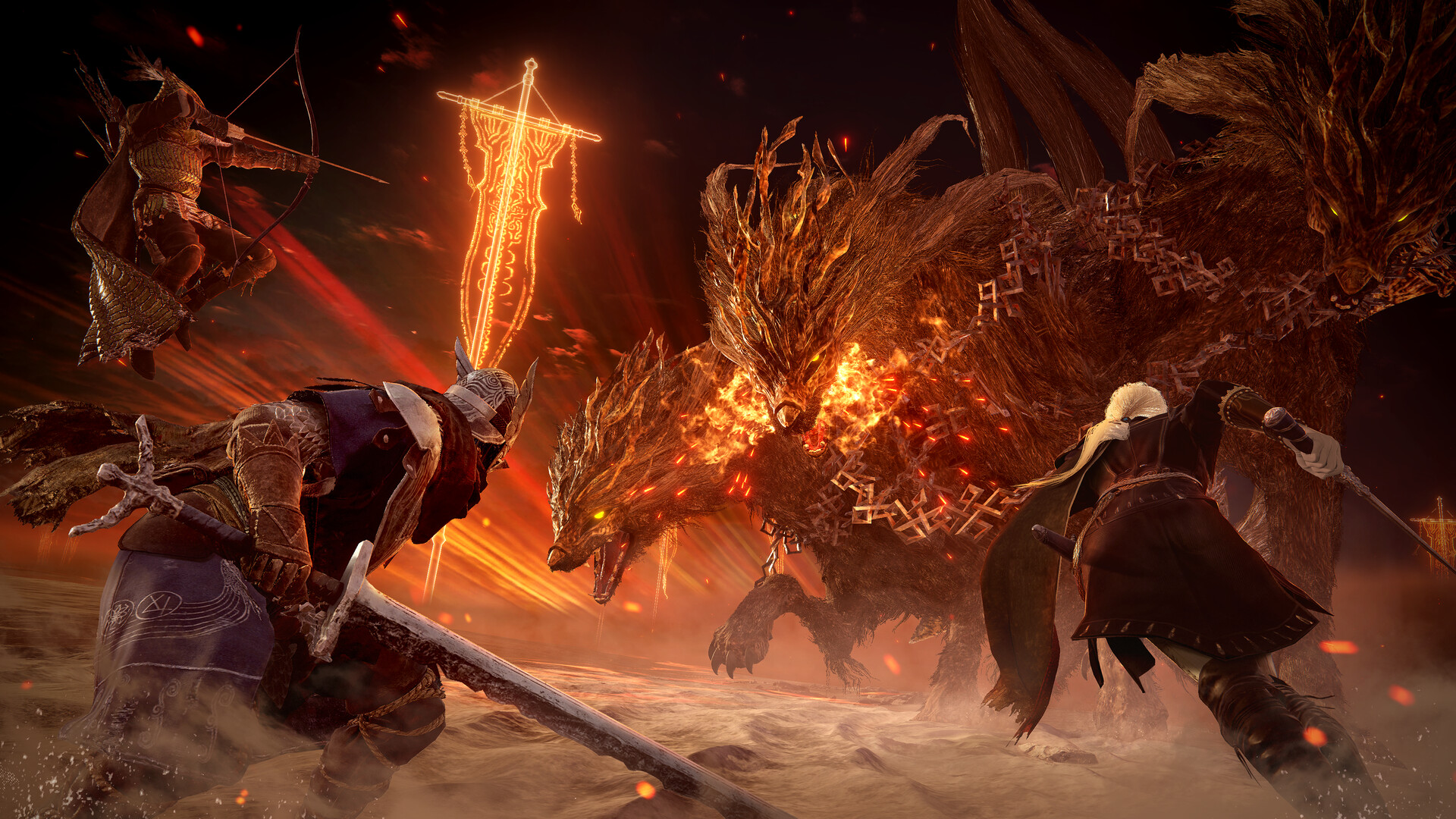
PlayEach run starts the same way: three players, solo queue or premade, pick from eight Nightfarers and drop onto a randomized map assembled from familiar Elden Ring terrain, castles, catacombs, open fields, recombined into something new each time. Three in-game days pass, each one ending in a boss fight, and each one preceded by a storm ring that contracts the playable space and forces the party toward the action rather than letting anyone stall out exploring.
The loop underneath is pure roguelite: kill field bosses, loot runes and relics, spend them on stat boosts and gear at camp between days, and hope the build you've cobbled together survives contact with a Night Lord on day three. What keeps it from feeling like a re-skinned battle royale is that the combat underneath is still recognizably FromSoftware: the same weighty animations, the same punishing openings if you dodge a half-second early, the same telegraphed but lethal boss movesets. Nightreign just refuses to let you slow down and study them the way the mainline game did.
Character choice matters more than build variety usually does in this genre. A run built around a repositioning, burst-damage duelist plays nothing like a run built around a ranged poke-and-retreat kit, and the eight-strong roster is small enough that most players will eventually learn all of them rather than settle into one main. That's a deliberate trade against the mainline game's bottomless character-build sandbox, and it mostly pays off: fights stay legible because your kit is legible, even when three players and a boss are throwing effects across the screen at once.
Progress carries between runs in small, deliberate ways too. Relics and unlocks earned in a failed expedition still nudge future attempts, which softens the sting of a wipe on day three without letting players simply buy their way past the game's difficulty. It's the kind of meta-progression that respects a player's time without pretending every run should be winnable on skill alone.
Co-op is the game's actual center of gravity. A three-person party that communicates, that splits up to clear separate points of interest and revives each other under pressure, turns Nightreign into something closer to a tightly choreographed raid than a traditional Souls game. Solo or duo queuing, by contrast, exposes how much of the design assumes a full party; going in short-handed means eating enemy scaling that was clearly tuned around three bodies, and matchmaking doesn't always fill a party quickly or evenly, which several players have flagged as the loneliest part of an otherwise social game.
The Night Lord fights themselves are the game's best argument for the whole structure. These are large, screen-filling encounters that borrow the series' pattern-reading DNA but ask a coordinated team to solve them together, someone drawing aggro, someone else exploiting an opening, all of it happening on a clock that punishes overly cautious play. They're the moments where the roguelite scaffolding and the Souls combat actually fuse into something new rather than sitting side by side. The randomization stays a familiar double-edged sword, though: a generous map with the right item drops can make a Night Lord fight feel like a formality, while a stingy one can make an unwinnable run feel like the map's fault rather than yours.
Art & atmosphere
CraftVisually, Nightreign leans hard on recognizable Elden Ring iconography, crumbling fortresses, golden tree light, the same oppressive scale, and remixes it into tighter, more legible arenas built for a fast, three-camera chaos the original was never designed to accommodate. The result reads as familiar rather than new, which is clearly the point: this is meant to feel like a spinoff wearing the mainline game's clothes, not a fresh art statement chasing its own identity.
Where the presentation earns its keep is in readability under pressure. Boss silhouettes, telegraph colors, and the storm ring itself are all built to be parsed at a glance by three players simultaneously juggling their own screens, which is a genuinely different design problem than dressing a boss arena for one deliberate, unhurried player. The circle of encroaching fog, glowing as it tightens, communicates urgency more effectively than any countdown timer could.
Sound design stays close to the series' established language: weighty impact audio, ominous ambient drones, choral swells at the big moments. None of it reinvents what the mainline game already built, but the Night Lord themes still land with the same theatrical grandeur FromSoftware has built its reputation on, proof that even inside a compressed forty-minute run, the studio still knows how to make a boss feel like an event worth preparing for.
A confident, well-built roguelite spinoff whose combat and boss design earn the community's near-90 percent approval, held back from higher marks by matchmaking gaps and run-to-run randomness.
Pros & cons
The ledgerIn its favour
- Eight Nightfarers with genuinely distinct kits and roles
- Night Lord boss fights fuse roguelite structure with real Souls combat
- Co-op with a full, communicating party is a genuine high point
- Runs stay short enough to fit a real session, win or lose
- Meaningful accessibility options including a timed-input toggle
- Meta-progression that softens failed runs without trivializing them
Against it
- Solo and duo queuing exposes scaling clearly tuned for three players
- Matchmaking doesn't reliably fill an even party
- Map randomization can make or break a run regardless of skill
- Only eight characters can feel thin across dozens of expeditions
- Chaotic three-player fights occasionally blur readability
- Full price may deter purists expecting a traditional sequel
Screens
Official media© FromSoftware, Inc.. Official media via Steam.
The player verdict
Real reviews · Steam- Recommended
“Still boggles my mind how a game with this much replayability got a SINGULAR dlc. From pls”
72 found helpfulvia Steam - Recommended
“This game is basically Elden Ring roguelite co-op chaos, and honestly the real final boss isn’t the Night Lord it’s always my friends (SHOUTOUT to Pratyush,Meet,Atharv n Nikshay) You pick one of eight characters, drop into a run with two…”
54 found helpfulvia Steam - Recommended
“Every time I hop on the game i either have a great time or am contemplating suicide.. but this help me memorise the attck patterns from my brother belt”
27 found helpfulvia Steam - Recommended
“This game keeps reminding me how lonely I am. Most of the players I got teamed up with is either a couple or two friends playing together. Good game though. Also, Recluse is a baddie.”
25 found helpfulvia Steam
Verdict
The callNightreign works best understood as a genuine experiment rather than a lesser Elden Ring. It takes the studio's core combat, arguably the best in the genre, and asks what happens when you strip out the slow exploration and long-term build tinkering that usually surrounds it. The answer is a game that's tighter, faster, and built for repeat sessions with friends, at the cost of some of the mystery and personal pacing that made the original such a singular experience.
It's a co-op game first and a Souls game second, and players should walk in with that expectation set correctly. Three friends on voice chat, cycling through Nightfarers and learning a Night Lord's patterns together, will get a version of this game that solo or duo queuers simply won't, no matter how sharp the underlying combat feels. That gap between the ideal experience and the average matchmade one is the single biggest asterisk on an otherwise confident piece of design, and the map's randomness can still sour a well-played run.
For FromSoftware loyalists craving another slow pilgrimage, this isn't it, and it was never trying to be. For groups looking for a boss-focused, run-based co-op game with real combat weight behind it, Nightreign delivers on a premise most studios wouldn't have had the nerve to attempt, and the near-90 percent approval from its own community backs that up.
Sources
Original review by Aymen Sakouhi from the licensed facts above. Score: 8.3/10.