DELTARUNE: Toby Fox Turns a Sequel Into a Slow-Motion Ambush
Our DELTARUNE review on Toby Fox's episodic RPG: a warm, funny road trip that keeps quietly rearranging what it is underneath you.
Aymen Sakouhi·Writer · Games Hobbyist//5 min read
© tobyfox. Official media via Steam.
The pitch
OverviewDELTARUNE spends its opening hour pretending to be comfort food. You meet a nervous kid named Kris, get shoved into a fantasy world through a supply closet, pick up a loudmouth and a fluffy prince, and set off to seal a fountain of darkness. The jokes land, the music is instantly hummable, and the whole thing radiates the same handmade warmth that made UNDERTALE a phenomenon. It is only later, once you have stopped bracing for the twist, that you notice the game has been watching you the entire time.
That is the trick Toby Fox has been building toward for years. This is the parallel story to UNDERTALE, sharing faces and font and a certain gallows humor, but it is not a remix. Where the older game handed you a single, agonizing choice about mercy, DELTARUNE keeps insisting your choices do not matter, then structures whole chapters around proving itself a liar. It is a magic trick performed in slow motion, chapter by chapter, and the pleasure is in watching the hand you were told to ignore.
The game arrives in an unusual shape. Chapters 1 and 2 were released free, years apart, as a kind of open-ended promise. The paid release gathered the story into a proper package and has since grown outward, with later chapters added as free updates and more still to come. Playing it now, in one sitting or across a week, is a strange experience: you feel the seams where years of the creator's life were poured in, the tone sharpening and the ambition swelling as it goes.
What holds it together is voice. Almost nobody writes video-game dialogue like this, dumb and tender and suddenly devastating within the same exchange, and almost nobody trusts a joke to carry real emotional weight the way DELTARUNE does. It is very funny, which is the easy part to notice, and quietly serious about loneliness and control, which is the part that sticks.
How it plays
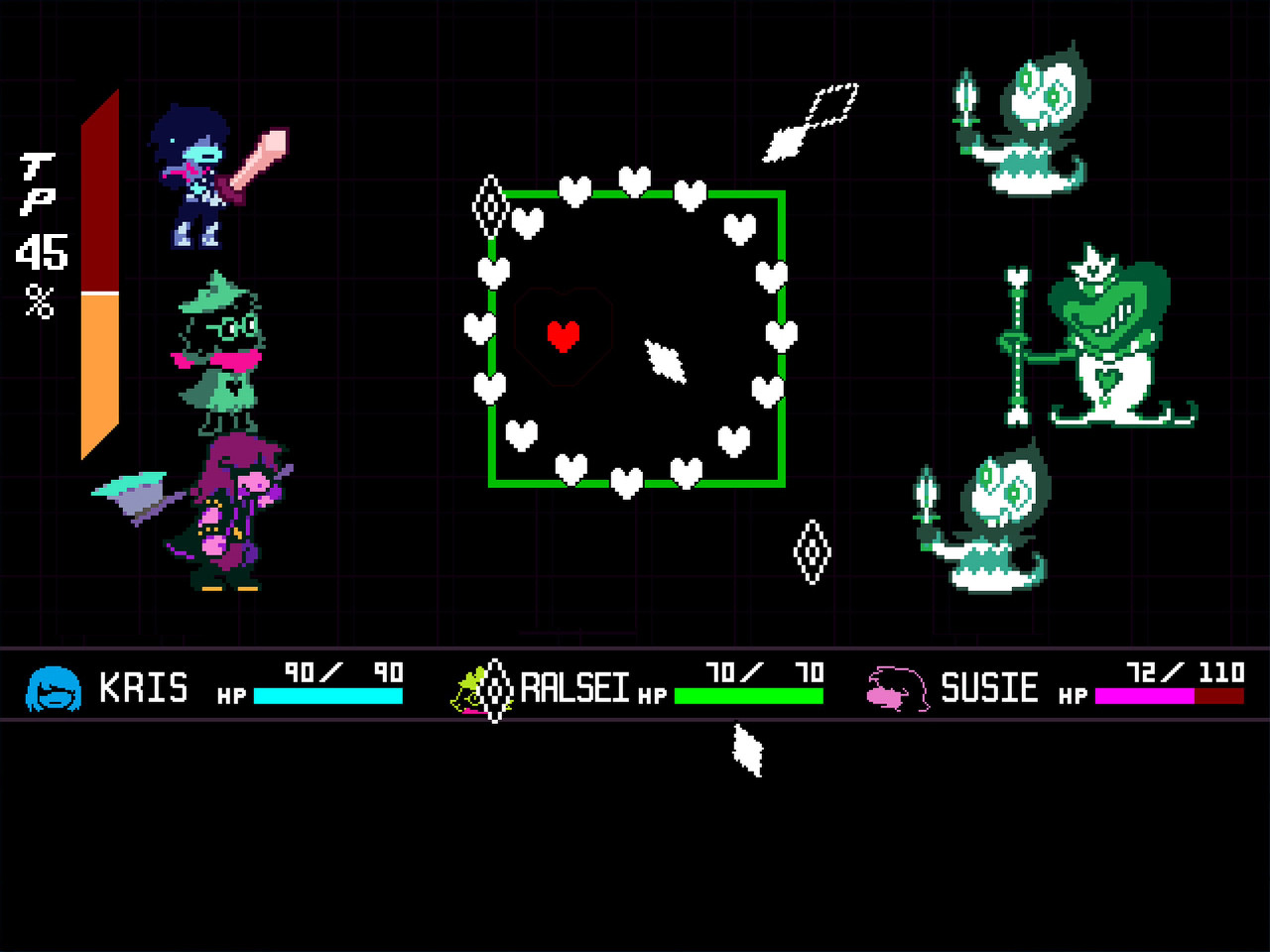
PlayCombat is a hybrid, and a genuinely clever one. On your turn you queue attacks, items, or spells from a menu like any turn-based RPG, but when the enemy strikes back the screen becomes a tiny bullet-hell arena and you steer a heart through the barrage in real time. It means every fight is two games at once: a numbers puzzle on offense and a twitch test on defense, and being good at one does not save you from being bad at the other.
The connective tissue is the mercy system, reimagined from UNDERTALE and smarter for it. Most enemies can be beaten down or talked down, and the ACT options are where the writing does its best work, letting you flirt, reassure, or bewilder a monster into standing aside. A recruited enemy funnels into a hometown that fills up as you spare more of them, so pacifism is not just a moral pose but a slow, tangible reward. TP, the resource that powers spells and defensive graze moves, is earned by threading enemy bullets closely, which quietly nudges you toward engagement over turtling.
Party composition matters more than the low stakes first suggest. Susie hits like a truck and heals for nothing; Ralsei is your medic, buffer, and conscience; a rotating third slot reshuffles the math from chapter to chapter. Boss fights are the real showcases, multi-phase set pieces that fuse spectacle, a killer track, and a mechanical gimmick you have to read on the fly, and the best of them rank with anything the genre has produced. The game is generous with checkpoints, so death is a shrug rather than a punishment.
Outside battle it is a light adventure game: block-pushing and simple environmental puzzles, optional secrets tucked behind curiosity, towns full of characters worth talking to twice. The puzzle design is the weakest strand, rarely more than a speed bump, clearly there to pace the story rather than tax you. It knows this about itself, and mercifully never overstays a mechanic.
Structurally, the episodic shape is both the point and the friction. Each chapter is a self-contained arc with its own world, tone, and final boss, which keeps the pacing brisk and the ideas fresh, but it also means the overarching mysteries advance in patient, sometimes maddening increments. A late chapter in particular leans hard into ambiguity and detour, and the split reaction to it is real: some players read it as the plot circling its most interesting threads instead of pulling them, and that is a fair thing to feel about a story still being built in public.
There is also a darker seam running underneath the whole thing, a second way to play that the game never advertises and this review will not spoil, except to say it recontextualizes the cozy surface in a way that rewards the curious and the slightly ruthless. It is the clearest sign that the low-stakes framing is a costume, not the truth.
Art & atmosphere
CraftVisually, DELTARUNE looks like a children's picture book that occasionally remembers it can bite. The pixel art is deliberately simple, big readable sprites and clean rooms, so that when the game distorts, floods the screen with static, or drops a sudden splash of high-detail horror, the contrast does all the work. Each chapter commits to a strong palette and idea, a candy-colored card kingdom, a hushed cyber-world lit like a late-night arcade, and the restraint of the baseline makes those swings hit hard.
The soundtrack is the reason people cry over this game. Toby Fox writes leitmotifs that mutate and return, so a goofy overworld tune can come back twisted into a boss theme and gut you with a melody you did not know you had memorized. It is chiptune-adjacent but unafraid of a real hook, and the boss tracks in particular are engineered to make a fight feel like the emotional climax of a much larger story. Sound effects, the blips of text and the crunch of a hit, are tuned with the same care.
The overall effect is a mood of deceptive coziness. Everything is soft, funny, and inviting until, for a few seconds at a time, it very much is not, and the game trusts you to sit with the whiplash. That tonal control, the ability to be a warm hangout and a creeping dread in the same breath, is the craft that separates it from its many imitators.
A funny, warm, mechanically inventive RPG with era-defining music that keeps reinventing itself, held just short of the top only by its unfinished, deliberately open-ended shape.
Pros & cons
The ledgerIn its favour
- The turn-based and bullet-hell hybrid makes every fight two engaging games at once
- Writing that swings from genuinely funny to quietly devastating without a seam
- Boss fights fuse spectacle, mechanics, and unforgettable music at a rare level
- A mercy system that turns pacifism into tangible, satisfying progress
- Leitmotif-driven soundtrack that recontextualizes itself across chapters
- Strong per-chapter identity keeps the pacing brisk and the ideas fresh
Against it
- Overworld puzzles are perfunctory, there to pace the story rather than challenge
- The episodic release means the central mysteries advance in patient increments
- A late chapter leans so hard into ambiguity it has genuinely split fans
- Defensive bullet-dodging can spike in difficulty for players there mainly for the story
- As a work still in progress, it necessarily ends on a promise rather than a resolution
Screens
Official media© tobyfox. Official media via Steam.
The player verdict
Real reviews · Steam- Recommended
“After spending literally all day playing chapter 5, I can confidently say that Deltarune is one of the most important pieces of media to come out in this generation. I can't think of any other game that takes such advantage of the fact…”
815 found helpfulvia Steam - Recommended
“Lifechanging to say the least. Toby Fox is one of my idols I look up too, and to see his humor and storytelling put in probably one of the best RPGs of all time. Doesn't matter if Toby TAKES TOO LONG on chapters, I always trust the end…”
217 found helpfulvia Steam - Not recommended
“I know its a unpopular opinion, but coming from someone who is a huge fan of deltarune, ch. 5 was such a let down. I'll probably change my review in the future as the last chapters come but man. This whole chapter felt like it led to…”
212 found helpfulvia Steam - Not recommended
“Man I had a lot of hope for deltarune, now im questioning if theres *any* story to actually experience. Is it going to keep vagueposting and ignoring the actual interesting plot points for goofy nonsense until the very end? Well, I guess…”
135 found helpfulvia Steam
Verdict
The callDELTARUNE is one of those rare games that is easy to love on the surface and hard to stop thinking about underneath. Taken purely as a comedy-RPG road trip it is already excellent: the party is a delight, the combat has real teeth, and the music is among the best in the medium. Taken as the long, deliberate machine it actually is, a story about choice and control that keeps quietly dismantling its own reassurances, it is something closer to essential, even in its unfinished state.
The caveats are honest ones. This is an episodic work you are catching mid-flight, so it asks patience and ends on an open hand rather than a closed fist, and its more experimental late stretch will frustrate players who want the plot to commit. The puzzle design is thin, and the reflex demands of the dodging can wall off a story-first audience during boss phases.
But the price of admission buys an enormous, generous, constantly surprising game from a creator working at the height of his powers, with more still promised for free. If you have any affection for UNDERTALE, or for RPGs that treat you like a co-conspirator rather than a passenger, this is unmissable. Just do not let the friendly opening fool you into thinking you know what it is.
Sources
Original review by Aymen Sakouhi from the licensed facts above. Score: 9.0/10.