Dead Cells Turned Dying Over and Over Into a Joy
Motion Twin's roguelite-metroidvania blends razor-sharp combat with punishing, fair permadeath into something addictive. Our verdict: 8.9/10.
Aymen Sakouhi·Writer · Games Hobbyist//5 min read
© Motion Twin. Official media via Steam.
The pitch
OverviewDead Cells starts every run by killing you eventually, and the miracle is that you keep coming back grinning. Motion Twin's 2018 breakout took two genres that rarely share a room, the roguelite and the metroidvania, and fused them into an action platformer built entirely around the loop of dying, learning, and diving back in. No checkpoints, no mercy, just a sprawling, shifting castle and the promise that you were probably good enough that time, and will definitely be better the next.
The premise is deliberately thin because the game is about motion, not story. You are a blob of sentient cells that reanimates a fresh corpse at the start of each attempt, then fights, rolls, and vaults its way up through a prison island that rearranges itself every time you fall. Reach the end and win, and you can crank the difficulty up another notch. Die, and you keep only the knowledge in your head and a handful of permanent upgrades, then start over from the very bottom.
It was one of the most acclaimed games of its year, taking the Game Award for Best Action Game and holding a Metacritic in the high eighties, and it has aged into a genre landmark. On Steam it still sits at an Overwhelmingly Positive verdict across tens of thousands of reviews, buoyed by years of substantial free updates and paid expansions that kept adding weapons, biomes, and bosses long after launch. Few games have been supported this generously for this long.
What makes it endure is feel. This is a game about the pleasure of moving well and fighting cleanly, and it nails that so precisely that dying stops being a punishment and becomes the price of admission to another run. It is not a gentle game, and its randomness can occasionally frustrate, but as a pure expression of combat momentum it remains close to untouchable.
How it plays
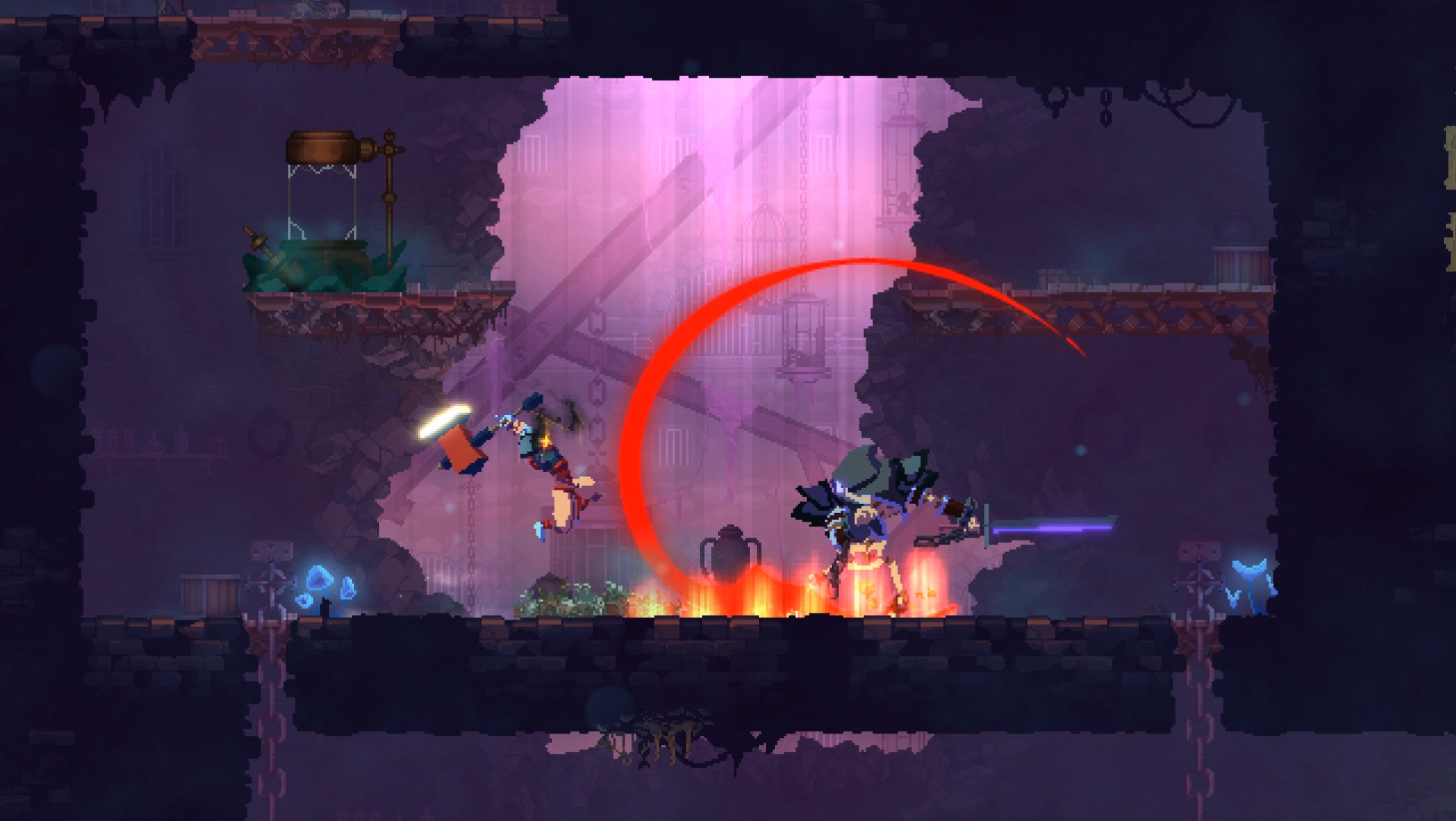
PlayThe combat is the reason to be here, and it is exceptional. Everything hangs off a fast, fluid moveset built around a dodge roll that is generous enough to reward aggression and tight enough to demand timing. You carry two weapons and two skills, drawn from an enormous and eclectic armory, and the joy is in the combinations: a fast blade that bleeds enemies, a shield that parries and counters, traps and turrets and frost grenades that let you set up a room before you ever swing. Each weapon type scales off one of three colored stats, so building a run is a constant negotiation between the gear you want and the gear the random drops actually hand you.
The metroidvania half lives in permanent progression and traversal. Between runs you spend cells, the currency you bank by killing enemies, to permanently unlock new weapons, mutations, and quality-of-life upgrades into the drop pool, so even a failed attempt makes the next one richer. Scattered permanent movement abilities, a wall climb, a teleport rune, open shortcuts and hidden paths through the castle, giving the endlessly reshuffled layout a spine of persistent discovery underneath the chaos. You are never quite starting from zero, and the ambient sense of getting stronger across dozens of deaths is the hook that makes just one more run so dangerous.
Structure is where the roguelite bites. There are branching routes through the biomes, some gated behind those traversal abilities or behind timed doors that reward playing fast and clean, and the game gently pushes you toward mastery rather than caution. Beating the final boss unlocks Boss Stem Cells, a stacking difficulty system that adds enemies, removes healing, and reshapes the run for players hungry for a sterner test. It is a smart, near-bottomless ramp that turns a game you can finish in a weekend into one you can chase for a hundred hours.
The friction is real and worth being honest about. This is a hard game with a steep entry curve, and its roguelite randomness means some runs simply hand you a worse toolkit than others, which can feel arbitrary in a genre built on skill. The procedural assembly of the levels, brilliant for replayability, occasionally produces layouts that feel more stitched-together than designed, and newcomers to either parent genre can bounce off the difficulty before its rhythm clicks. None of it undermines the core, but the game asks for patience and a tolerance for failure that not everyone brings.
The post-launch story deserves its own note, because it is central to the value on offer. Motion Twin, and later the team at Evil Empire, supported Dead Cells for years with a steady stream of free content updates and several paid expansions, folding in new weapons, enemies, biomes, and bosses, including crossover collaborations with other indie darlings. The game you buy today is dramatically larger and more varied than the one that launched, and that longevity is a big part of why it remains such an easy recommendation.
Art & atmosphere
CraftDead Cells looks gorgeous in a way that quietly hides how clever its presentation is. The characters and environments are sculpted as 3D models and then rendered down into crisp pixel art, which gives the animation a fluidity that hand-drawn sprites rarely achieve while keeping the readable, chunky charm of the retro look. In practice that means combat you can parse instantly even at high speed, every attack and enemy tell legible at a glance, which for a game this demanding is as much a design win as an aesthetic one.
The art direction has a grim wit that runs through everything. The prison island is a moody, decaying place of ramparts, sewers, and torchlit dungeons, but it is shot through with a mordant sense of humor, in the flavor text, the item descriptions, and the resigned gallows attitude of your own headless protagonist. It is atmospheric without being oppressive, dark without curdling into misery, and the personality keeps the endless deaths feeling like a shared joke rather than a grind.
Sound and animation lock the whole thing together. Weapons land with a satisfying crunch, the movement has real snap and weight, and the score pulses along with the pace of a good run without ever demanding your attention away from the screen. It is a game whose feel and look are inseparable, a piece of craft where the way it moves and the way it reads are the same achievement.
A near-perfect fusion of roguelite and metroidvania built on sensational combat, held just short of a top score by punishing difficulty and the occasional arbitrariness of its randomness.
Pros & cons
The ledgerIn its favour
- Fast, fluid, razor-sharp combat that feels incredible to control
- A vast, eclectic armory that makes every run play differently
- Permanent unlocks mean even failed runs push you forward
- Boss Stem Cells offer a near-bottomless difficulty ramp
- Gorgeous 3D-to-pixel art that stays instantly readable at speed
- Years of generous free updates and expansions add huge value
Against it
- A steep, punishing difficulty curve that can deter newcomers
- Roguelite randomness sometimes hands you a distinctly worse run
- Procedural layouts can occasionally feel stitched together rather than designed
- The thin premise offers little for players who want story
- Its demand for patience with repeated failure will not suit everyone
Screens
Official media© Motion Twin. Official media via Steam.
The player verdict
Real reviews · Steam- Recommended
“This game is great. It's a sort of 2d side scroller with fast paced combat that has a lot of variety and re-playability. You start off somewhat weak and through every attempt to progress through the maps and every death you slowly gain…”
28 found helpfulvia Steam - Recommended
“English Version (french below) : The game is super cool but it is SO HARD. On the first few difficulties, it's hard but it's still manageable, after the 3rd boss cell however, it just becomes total madness. The gameplay is nice, but it…”
7 found helpfulvia Steam - Recommended
“You control a reanimated corpse trying to escape an island prison. It's a side-scrolling platformer. Multiple different enemies which you can attack using melee (swords, kicks and punches), you also have longer range attacks (bows,…”
6 found helpfulvia Steam - Recommended
“You can tell the developers put a lot of love into this game, theres so much personality oozing out of this game. For me the combat didn't really click, but theres a lot of content in here, that if you do like it you'll get a LOT out of…”
4 found helpfulvia Steam
Verdict
The callDead Cells remains one of the definitive action roguelites, and time has only made that clearer. By marrying the addictive, run-based structure of the roguelite to the persistent progression and traversal of the metroidvania, and building all of it on a combat system that feels sensational to play, Motion Twin created something that is far more than the sum of its borrowed parts. The loop of dying, learning, and coming back sharper is engineered so precisely that failure becomes fuel.
It is not for the impatient. The difficulty is steep, the randomness can occasionally feel unfair, and the procedural castle sometimes assembles itself in ways that betray the seams. If you need a strong narrative or a gentle on-ramp, this will test you before it wins you over.
But for anyone drawn to the feel of pure, momentum-driven combat, and to the deep satisfaction of watching your own skill climb across a hundred attempts, it is essential and remarkably good value, especially given how much has been added since launch. Years on, Dead Cells still hits harder and moves better than most of the games it inspired. It is a modern classic of its genre, and dying to it is still one of the best times you can have on Steam.
Sources
Original review by Aymen Sakouhi from the licensed facts above. Score: 8.9/10.