Dark Souls III Review: FromSoftware's Greatest Hits, Played With Frightening Precision
FromSoftware's fastest, most refined Souls game: demanding, gorgeous, and playing it just a little safe. Our full Dark Souls III review.
Aymen Sakouhi·Writer · Games Hobbyist//6 min read
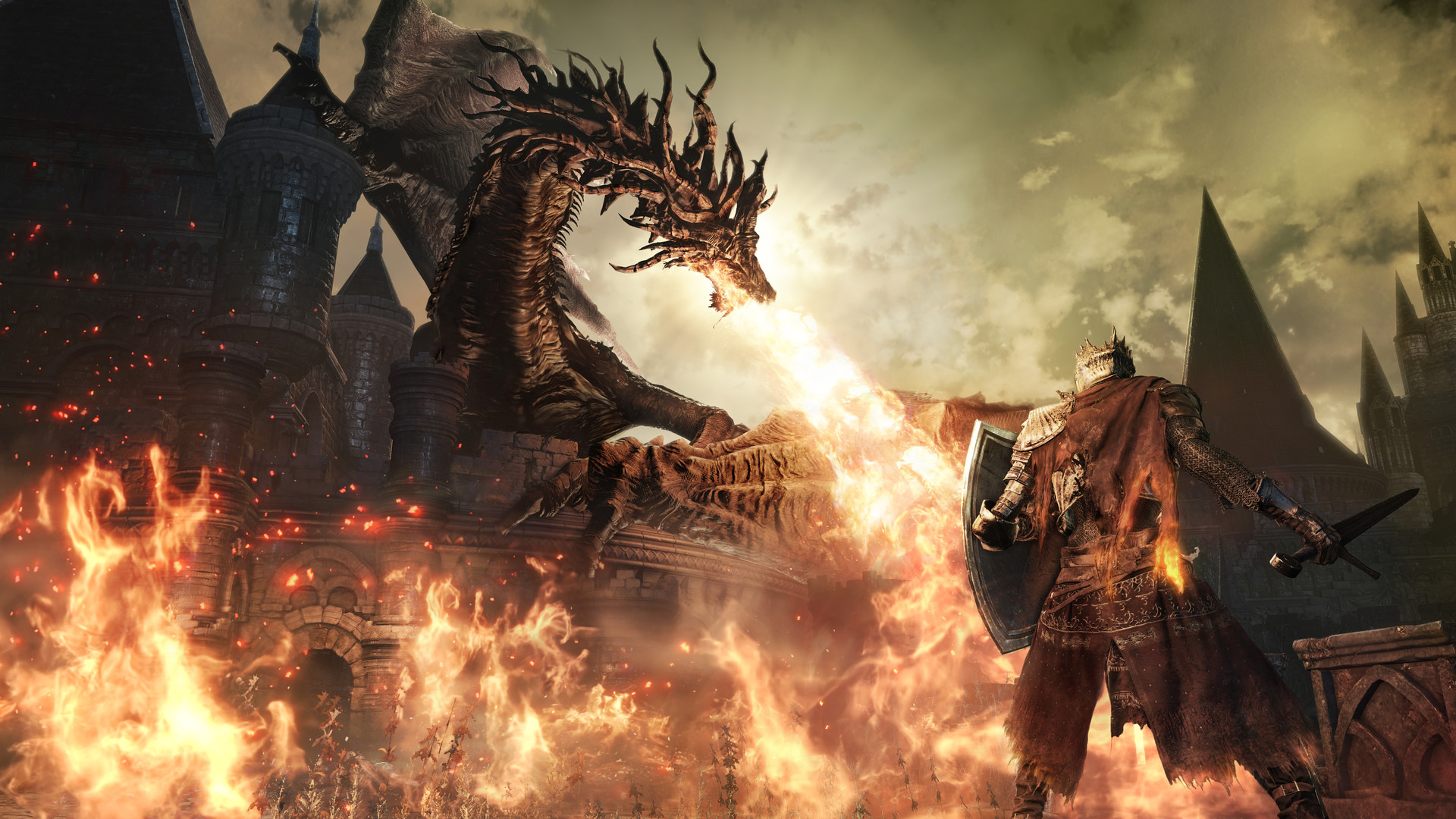
© FromSoftware, Inc.. Official media via Steam.
The pitch
OverviewThere is a specific species of dread that only FromSoftware has ever learned to bottle, and it has nothing to do with jump scares. It is the hesitation before a fog gate you cannot see past. It is the grim arithmetic of walking back through a level carrying more souls in your pocket than you can stand to lose. Dark Souls III understands that dread is a resource, and it spends that resource with the assurance of a studio doing this for the third time in the same cursed universe.
This is the final mainline chapter of the trilogy that reorganized modern action games around patience, punishment, and the strange dignity of a fair death. Hidetaka Miyazaki returned to the director's chair after handing off the second game, and his fingerprints are everywhere: the kindling of bonfires, the pilgrimage through a kingdom in the middle of collapsing, the bosses who function less like obstacles than like brutal final exams. You are the Ashen One, roused to a duty the world would rather you leave undone, and the loop of die, learn, and advance remains as legible as it was when the first game arrived.
What sets this entry apart is its metabolism. FromSoftware folded the predatory tempo of Bloodborne into the heavier, stamina-bound rhythm of Souls, producing something quicker on its feet than any Dark Souls before it without abandoning the weight that gives the series its gravity. It is less an experiment than a summation, a greatest-hits set performed by the band that wrote every one of the songs.
That is both the pitch and the catch. Newcomers are handed the most approachable version of a famously unapproachable idea; veterans are handed a lavish victory lap that only rarely startles them. Where you land on Dark Souls III depends almost entirely on how many of its ancestors you have already buried.
How it plays
PlayCombat is the altar everything else is built around, and it has never felt more exact. Every swing costs stamina, every blow trades against poise, and the heft of your chosen weapon dictates how greedy you can afford to be. The core conversation is unchanged and still unmatched: read the wind-up, roll through it, and answer in the narrow window before your enemy recovers. Get impatient and the game will teach you humility inside a single combo.
The headline addition is Weapon Arts, a dedicated special move bound to each armament and paid for out of a new Focus meter. A straight sword gains a lunging thrust, a greataxe a staggering overhead, a curved blade a spinning follow-up. Spells and Weapon Arts now draw from the same Focus pool, refilled by a second flask you have to budget against your healing Estus, which quietly turns every rest at a bonfire into a small logistics decision. None of it rewrites the fundamentals, but it hands you a wider vocabulary and rewards the curiosity to actually speak it.
Structurally, this is a pilgrimage rather than a puzzle box. Bonfires anchor a chain of set pieces that loop back on themselves through satisfying shortcuts, yet the world is more corridor than clockwork; it never assembles into the single interlocking structure that made the original feel like one continuous building you learned to navigate blind. Lothric is a sequence of gorgeous rooms rather than a house. The trade is pace for elegance, and for a first-timer the clearer throughline is arguably a mercy.
The bosses are the reason to endure everything between them, and this is among the strongest rosters the studio has ever assembled. The twin princes Lorian and Lothric, the balletic Dancer of the Boreal Valley, the desperate late duel that longtime fans will recognize the instant the music swells: each is a wall you fail against until your hands learn its rhythm, and the game trusts you to study rather than softening the blow on your behalf. When a fight finally breaks in your favor, the release is earned in a way vanishingly few games bother to demand.
The difficulty is punishing but scrupulously honest, and there is more give in it than the reputation suggests. Strength bruisers, dexterity duelists, pyromancers, and faith casters all remain viable paths, and a generous respec system lets you pivot when a build stalls out. Summoning a phantom or two can defang a boss that has hardened into a brick wall, and the reciprocal thrill of being invaded keeps the tension permanently live. Online play threads a strange, wordless community through an otherwise solitary march: bloodstains that replay how other players died, messages scrawled to warn of an ambush or simply to lie for sport, brief alliances forged against a shared tormentor.
There is a full campaign's worth of content here before you even account for replay. A first run comfortably clears thirty hours if you explore, and the game is built to be climbed again: New Game Plus stiffens the whole roster, covenants tie optional online roles to long-tail goals, and two substantial expansions, Ashes of Ariandel and The Ringed City, extend the march with some of the most vicious encounters FromSoftware has ever shipped. The friction that remains is mostly technical and mostly minor. The interface is functional but archaic, upgrade materials and their vendors are needlessly cryptic, and at launch the PC version arrived with frame-pacing hitches that could stutter during the busiest fights.
Art & atmosphere
CraftLothric is a kingdom dressed for its own wake. FromSoftware paints almost entirely in ash-grey, corroded iron, and the occasional bruise of ember-orange, stacking cathedrals, gallows, and archives into vertical ruins that feel eroded rather than authored. Very little here was ever new; everything reads as the beautiful afterthought of something that already fell down centuries ago. The enemy and boss silhouettes carry that same funereal grandeur, all tattered heraldry and armor fused to the shapes suffering inside it.
Light does much of the emotional labor. A grey shaft falling through a shattered vault, the sickly glow of a bonfire, the flat cold blue of a snowbound arena outside the painted world of Ariandel: the game keeps finding new ways to make sheer exhaustion look majestic. The prevailing mood is melancholy pushed to its outer limit, a place so weary of dying that it can no longer quite manage to stop.
The sound design seals the whole thing. Yuka Kitamura's orchestral boss themes rise on mournful strings and a Latin choir at precisely the instant the spectacle calls for them, then withdraw entirely, leaving you with the rattle of your own armor, the hiss of embers, and the animal noise of whatever wants you dead. That restraint is the point: the near-silence of exploration makes the choral eruptions land like grief rather than bombast. Even the loading screens, with their patient tips and their long stares into the dark, eventually start to read like small elegies.
A near-flawless distillation of a landmark formula, kept a single step from perfection only by how carefully it declines to risk anything genuinely new.
Pros & cons
The ledgerIn its favour
- The tightest, most responsive combat in the entire trilogy
- Weapon Arts broaden your options without breaking the core rhythm
- One of FromSoftware's strongest and most memorable boss rosters
- Mournful, meticulously realized art direction from start to finish
- Punishing difficulty that stays scrupulously, teachably fair
- Deep build variety plus two excellent, brutal DLC chapters
Against it
- Leans heavily on Bloodborne and recycled Souls ideas
- A more linear world than the original's interlocking map
- Frame-pacing hitches on some PC configurations at launch
- Precious few genuine surprises for series veterans
- Archaic menus and obscure upgrade systems show their age
Screens
Official media© FromSoftware, Inc.. Official media via Steam.
The player verdict
Real reviews · Steam- Recommended
“"Dark Souls 3: From Ashes to Memories" As someone whose favorite game of all time is Elden Ring, I always wondered what it would be like to go back and experience one of the games that inspired it. Among all of FromSoftware's titles, Dark…”
34 found helpfulvia Steam - Recommended
“This game is actually designed to make you face yourself. Every time a boss kills you, it asks a simple question: will you give up and quit, or will you stand up again and test your own patience? The graphics look great imo, and the…”
13 found helpfulvia Steam - Recommended
“Dark Souls III is one of the best action RPGs ever made. It offers challenging yet rewarding gameplay, incredible boss fights, stunning visuals, and an unforgettable atmosphere. Every victory feels earned, making it an amazing experience…”
7 found helpfulvia Steam - Recommended
“the camera angles in this game against the nameless king 1st phase is so ♥♥♥♥♥♥♥ ♥♥♥♥, the boss is not even hard, u are fighting against the camera angles. other than that, peak game”
5 found helpfulvia Steam
Verdict
The callDark Souls III is the most consistent game in its series and the least surprising, and the two facts turn out to be the same fact wearing different clothes. It refines nearly everything FromSoftware had learned by the time it shipped into a single confident statement, and it almost never fumbles. What it declines to do is gamble. There is no idea here as strange as Bloodborne's blood-vial aggression or the first game's interlocking geography; there is instead a master craftsman coloring, immaculately, inside lines he drew years earlier.
For a newcomer, that makes it the finest possible door into this world: legible, merciless, gorgeous, and fair in the exact way that converts frustration into resolve. For a veteran, it is a farewell that would rather be great than risky, and it clears that slightly lower bar with room to spare. If you have never bled out on a Souls boss, start here and find out what all the noise was about. If you have, come for the craftsmanship and the unmistakable sense of a curtain being drawn, and forgive the game a little for admiring its own reflection.
Either way, it earns its standing. This is a landmark series choosing to end on control rather than reinvention, and control, executed this cleanly, is its own kind of triumph.
Sources
Original review by Aymen Sakouhi from the licensed facts above. Score: 9.0/10.