D-topia Builds a Beautiful Machine for Human Happiness, Then Forgets to Interrogate It
Our D-topia review: Annapurna's gentle puzzle adventure about an AI-run utopia asks sharp questions but settles for soft answers. Charming, if slight.
Aymen Sakouhi·Writer · Games Hobbyist//5 min read
© Annapurna Interactive. Official media via Steam.
The pitch
OverviewD-topia opens on a premise that is timely to the point of being slightly uncomfortable. You arrive as the newest Facilitator in a self-contained city where an artificial intelligence has been handed a single directive: maximize the happiness of every resident, by any means the system can calculate. Your job is to keep the machinery of that engineered contentment running smoothly, one small logic puzzle at a time.
Marumittu Games, working under Annapurna Interactive, wraps this idea in the softest possible packaging. This is a cozy, unhurried puzzle adventure with a muted pastel palette and a gentle pace, the kind of game that asks you to sink into an armchair rather than sit forward in your seat. The contrast is deliberate and effective: a warm, low-stakes surface stretched over a premise about surrendering human autonomy to an optimizer, and for a while that tension is genuinely compelling.
What you actually do is solve puzzles to fix the facility's systems and, more interestingly, listen to the residents whose lives that facility manages. Each one has a story, a small crisis, a wish or a worry, and D-topia repeatedly asks you to decide how much to intervene. It is a game that clearly wants to be about something, that reaches for questions about optimization, consent, and the price of frictionless comfort.
The trouble is the reach exceeds the grasp. D-topia raises genuinely sharp questions and then, more often than not, answers them with a shrug and a platitude. It is a pleasant, thoughtful, occasionally moving few hours that keeps promising a depth it never quite delivers, and how much that bothers you will decide whether you find it quietly lovely or quietly frustrating.
How it plays
PlayMechanically, D-topia sits at the intersection of the walking-sim and the light logic puzzler. You move through the facility's clean, modular spaces, talk to residents, and periodically sit down to solve a self-contained puzzle representing some system that needs balancing or repairing. The puzzles are the closest thing the game has to a spine, and they are pleasant, legible, and gently escalating, each introducing a small new wrinkle before you have fully tired of the last.
The problem is that they almost never bite. For most of the main path, the puzzles resolve within seconds of you looking at them, more a matter of confirming the obvious solution than working toward a hidden one. A handful of optional puzzles reach for something trickier, but even those rarely cost more than a couple of minutes of thought. If you come to D-topia hoping for the satisfying resistance of a real puzzle game, you will find the challenge curve almost entirely flat, and the puzzles start to feel less like problems to crack than like a rhythm the game wants you to keep.
The more interesting layer is the residents and the choices they present. Helping people is optional and open-ended: you can throw yourself into every small drama and try to smooth every wrinkle in the community, or you can ignore them and simply keep the lights on. These moments are where D-topia's themes are supposed to land, where an AI optimizing for happiness runs into the messy, contradictory reality of what people actually want. On paper it is a strong design, and the writing has real warmth, sketching a cast of oddballs with recognizable modern anxieties.
In practice, though, the moral texture is thinner than the setup implies. The dilemmas tend to arrive with an obvious humane answer already glowing, so the act of choosing rarely feels like a choice with weight. The game gestures at hard tradeoffs, at the possibility that maximizing happiness might mean overriding what people say they want, but it seldom forces you to actually sit in that discomfort. You are usually just doing the nice thing, and being told you did the nice thing.
Structurally, this is a short experience, running somewhere between six and nine hours depending on how thoroughly you chase the optional content and lore. That length is about right for the amount of mechanical idea on offer, but the back half tests it. The environments, initially soothing in their clean uniformity, start to blur together, and the loop of wander, talk, solve an easy puzzle, repeat begins to feel less like a deliberate meditative rhythm and more like the game running low on new things to show you. The pacing, always gentle, occasionally tips over into simply slow.
There is a real game here for a specific player: someone who wants a calm, story-forward experience they can drift through, who values atmosphere and gentle reflection over friction and challenge. But anyone drawn in primarily by the AI-utopia premise, expecting it to be genuinely wrestled with rather than gestured at, should temper that expectation. The systems support the mood beautifully; they support the ideas much less.
Art & atmosphere
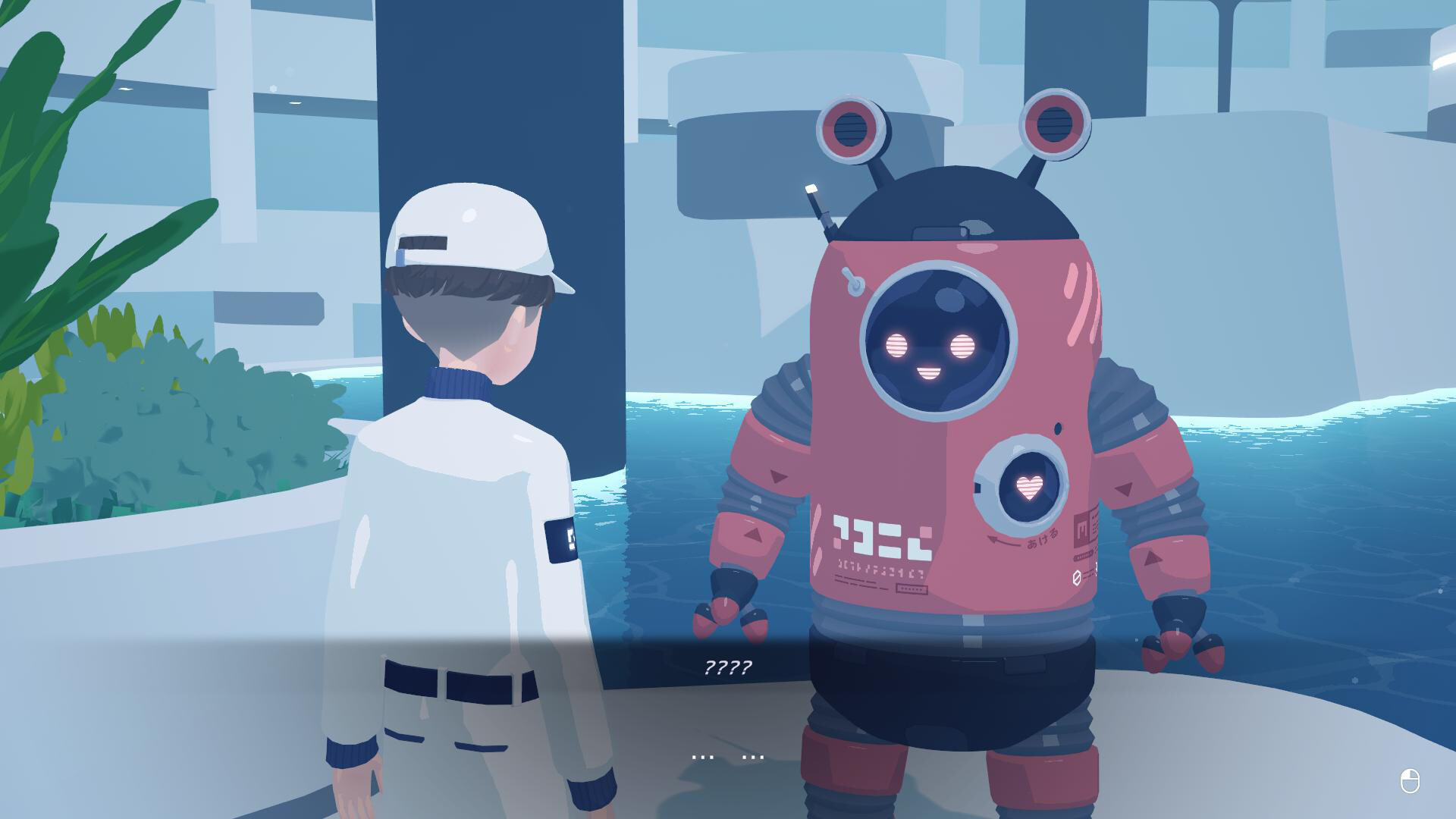
CraftD-topia's aesthetic is its most confident quality, a study in deliberate blandness that is far more considered than it first appears. The facility is rendered in soft, desaturated pastels and clean geometric spaces, all rounded corners and calm negative space, the visual language of a wellness app given three dimensions. It is soothing on contact, and it is also, pointedly, a little sterile, which is exactly the right note for a world where comfort has been engineered and optimized to within an inch of its life.
That restraint is a genuine risk, and it mostly pays off. The muted palette and minimalist staging give the whole game a hushed, contemplative quality that suits its ambitions, and the character designs, simple and warm against all that cool architecture, stand out as the small human notes in an inhuman system. The danger, and the game does occasionally stumble into it, is that a world built on purposeful blandness can slide from calm into merely dull, and in its slower stretches D-topia flirts with that line.
The sound design holds up the atmosphere with quiet competence. A gentle ambient score hums along underneath, unobtrusive and mood-setting, and the audio never raises its voice, which is entirely in keeping with a game this committed to serenity. It is a cohesive, tasteful aesthetic package, well matched to the experience it wraps, even when that experience runs thinner than its striking premise deserves.
A charming, atmospheric puzzle adventure with a premise sharper than its follow-through, worth the trip for the mood but short on the depth and challenge it keeps hinting at.
Pros & cons
The ledgerIn its favour
- A timely, genuinely intriguing premise about an AI optimizing human happiness
- Warm, characterful writing for a cast of oddball residents
- Confident, cohesive minimalist art direction that suits the themes
- Calm, legible puzzles that escalate at a gentle, welcoming pace
- A soothing, atmospheric few hours for the right unhurried mood
Against it
- Puzzles are rarely challenging and often solve in seconds
- The moral choices telegraph their humane answer and lack real weight
- It raises sharp questions but settles for soft, obvious conclusions
- Environments and the core loop blur together in the back half
- The gentle pace occasionally crosses over into simply dull
Screens
Official media© Annapurna Interactive. Official media via Steam.
The player verdict
Real reviews · Steam- Not recommended
“This isn't a bad game, it's just not a game for me, or adults. I would call this a narrative/walking sim with some extremely simple puzzle elements, rather than a puzzle game. Easily more than half of the time you are playing is dedicated…”
30 found helpfulvia Steam - Recommended
“I LOVE fixing things i can't WAIT to begin my day at the fixing things factory. :edit i'm very responsible and committed to caring for this feline.”
22 found helpfulvia Steam - Recommended
“Got the "happy ending" achievement on my first run-through. I liked the game; the setting is interesting, and the characters are likeable. Some of the decision-making sequences are a bit confusing because there is no back button, but at…”
16 found helpfulvia Steam - Not recommended
“The puzzles feel similar to The Witness, except there aren't nearly as many, some of them don't *quite* make sense (later on) and you're forced to talk to a lot of boring people, slowly, all of whom are totally obsessed with themselves.…”
14 found helpfulvia Steam
Verdict
The callD-topia is easy to admire and easy to feel slightly let down by, sometimes within the same hour. It has a premise sharp enough to carry a much bigger game, a warm cast, and an art direction that understands exactly what it is doing. As a calm, story-forward way to spend an evening or two, drifting through a beautifully sterile little world and helping its residents sort out their lives, it is a lovely, low-stakes thing to sink into.
The disappointment is one of ambition unmet rather than competence lacking. This is a game that keeps raising a hand as if to ask a hard question about happiness, autonomy, and what we would trade for a life without friction, and then, again and again, lowers it and offers a reassuring pat instead. The puzzles do not push, the choices do not bite, and the big ideas end up decorating the experience rather than driving it.
Take it for what it actually is and there is real pleasure here: a gentle, thoughtful, handsomely made curio best suited to players who prize atmosphere over challenge and are happy to bring their own harder questions to a game content to only pose the easy ones. Go in expecting a cozy reflection rather than a provocation, and D-topia rewards you. Go in expecting the sharp, uncomfortable game its premise promises, and you will keep waiting for a punch that never lands.
Sources
Original review by Aymen Sakouhi from the licensed facts above. Score: 7.3/10.