Moss: The Forgotten Relic Brings a VR Fairytale to Flat Screens, and Most of the Magic Survives
Our Moss: The Forgotten Relic review: Polyarc's storybook adventure leaves VR for a normal screen. Quill is still lovely, but the fixed camera is the catch.
Aymen Sakouhi·Writer · Games Hobbyist//6 min read
© Polyarc. Official media via Steam.
The pitch
OverviewFor eight years, Moss was one of the games VR skeptics got quietly nagged about. You strapped on a headset, leaned into a diorama the size of a coffee table, and watched a small mouse named Quill look up and wave at you, and something about that direct little gesture tended to disarm people who had walked in ready to be unimpressed. The catch was always the price of entry: you needed the headset, and most people simply do not own one.
Moss: The Forgotten Relic is Polyarc's answer to that problem. It gathers the original Moss, its larger sequel Moss: Book II, and the Twilight Garden expansion into a single package and rebuilds the whole thing to run on an ordinary screen with an ordinary controller. It is, in effect, the complete Moss story finally made available to the roughly everybody who was never going to buy a VR rig to play it.
The question hanging over a translation like this is whether a game built so specifically around your physical presence still works once that presence is gone. Moss was never just a platformer you happened to play in VR; the headset was part of the design, casting you as a giant, benevolent spirit peering into a tiny world. Strip that away and you are asking a fairytale to stand on its writing, its craft, and its puzzle design alone.
The good news, and it is genuinely good news, is that most of what made Moss special was never really about the hardware. What survives the move to a flat screen is a warm, confidently told storybook adventure with one of the most likeable protagonists in recent memory. What it loses is harder to shrug off, and it lives almost entirely in a single word: camera.
How it plays
PlayMoss is a third-person action-adventure built on a dual role that has always been its cleverest idea. You directly control Quill, a sword-swinging mouse who runs, jumps, climbs, and fights her way through a series of handcrafted dioramas. At the same time you are the Reader, an unseen presence in the world who can grab certain objects, slide platforms into place, possess enemies, and reach in to heal Quill when she takes a hit. Nearly every puzzle and every fight asks you to be both characters at once, guiding Quill with one set of inputs while manipulating her surroundings with another.
On a controller, Quill takes the left stick and face buttons while the Reader lives on the right stick and triggers: you move a cursor to a grabbable object, hold a trigger, and drag it. It works, and for long stretches it works well, letting you choreograph the two roles into a single flowing motion, boosting Quill across a gap on a platform you are sliding beneath her feet in real time. The dioramas themselves are a joy to solve, compact three-dimensional boxes you rotate around to hunt for levers, hidden collectibles, and the exact order of operations that unpicks each one.
Combat is light but satisfying, a matter of dodging, chipping away at scuttling mechanical enemies with Quill's blade, and using the Reader to freeze or reposition a foe at the right moment. It never reaches for real difficulty, and it is not trying to; the fights are punctuation between puzzles rather than the main event. Across the collected games the scope widens noticeably, with Book II in particular introducing new tools and larger, more elaborate environments that give the back half of the package real momentum. Taken together, the three pieces run in the region of eight to ten hours and genuinely feel like one continuous story rather than a stitched-together bundle.
And then there is the camera, which is the single biggest thing separating this version from the one people fell in love with. In VR you simply moved your head to change your view of the diorama; here Polyarc has built what it calls a Smart Follow Camera, a scripted system that automatically repositions to keep Quill in frame as you move. When it works, you barely notice it. When it does not, you feel it keenly, because you are given essentially no manual control to fix it: you cannot freely pan or rotate the view to peek around a pillar or line up a jump the camera is hiding from you.
That limitation is the review's whole fault line, and it is worth being blunt about. These levels were designed for a player who could lean and crane at will, and a fixed automatic camera occasionally leaves you squinting at a platform whose distance is hard to judge or fighting to see a lever tucked behind the geometry. It rarely breaks the game, but it does introduce a low, recurring friction that the VR original never had, and how much it bothers you will depend a lot on your patience for a camera that decides, firmly, where you get to look.
There is a smaller cost too, in the Reader interactions. Sweeping a cursor around with the right stick and clamping the trigger to grab things is perfectly functional, but it lacks the tactile, reach-out-and-touch directness of doing the same motion with a tracked VR controller, and in busier moments, wrangling the cursor while also steering Quill can feel like more plate-spinning than the elegant duet it clearly wants to be.
Art & atmosphere
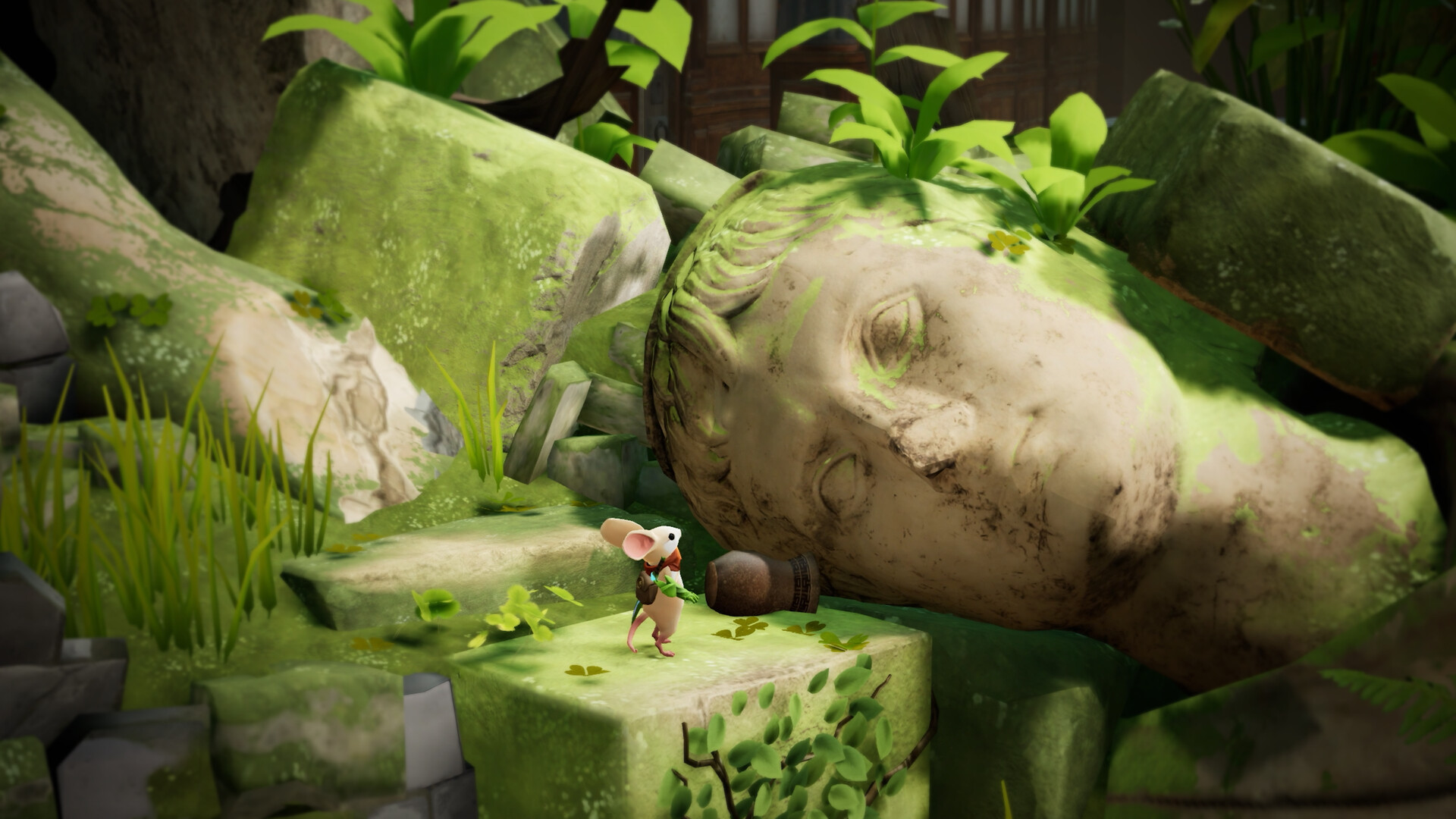
CraftWhatever the camera takes away, the presentation gives a great deal back. Moss looks like a pop-up book brought to life, its worlds staged as intricate little sets of moss-slicked stone, trickling water, and warm lantern light, each one framed as a page you lean into. The rebuild sharpens all of this for flat displays, and on a good screen the dioramas have a tabletop-model tactility that suits the storybook framing beautifully, every ruin and forest clearing reading like something you could pick up and turn over in your hands.
Quill remains the reason all of it lands. Polyarc's animators give her an astonishing amount of personality with almost no dialogue: she high-fives the Reader, she claps with delight when a puzzle clicks, she looks up at you with unmistakable trust or worry. It is a genuinely rare feat of character work, and it survives the transition to a screen completely intact. The fourth-wall relationship between this tiny hero and the giant unseen presence guiding her, once the headline VR trick, turns out to be just as affecting when it is a cursor and a controller doing the reaching.
The audio matches the touch. A gentle orchestral score threads the whole journey, a narrator frames the tale in the hushed cadence of a bedtime story, and the sound design keeps everything small and intimate, all skittering feet and soft magical chimes. It is a game with impeccable manners, unhurried and sincere, and it earns its sentiment honestly rather than reaching for it.
A lovely, sincere storybook adventure and a smart way to rescue a VR-locked gem, held just short of the top tier by a fixed camera that its levels were never designed around.
Pros & cons
The ledgerIn its favour
- Three acclaimed games and an expansion in one complete, well-paced package
- Quill is a superb, expressive protagonist with almost no dialogue
- The dual Quill-and-Reader design makes puzzles and fights feel distinctive
- Gorgeous storybook dioramas that translate cleanly to a flat screen
- Warm, sincere storytelling with a lovely score and narration
- Finally opens a VR-locked favorite to players without a headset
Against it
- The fixed automatic camera offers no manual control and occasionally hides platforms
- Some jumps and levers are hard to judge from the angle the game chooses
- Cursor-and-trigger Reader controls lack the directness of VR motion
- Combat stays very light and never poses much of a challenge
- Juggling Quill and the Reader can feel fiddly in busier moments
Screens
Official media© Polyarc. Official media via Steam.
The player verdict
Real reviews · Steam- Recommended
“I fell in love with both of the VR versions, and I'm happy that folks have a platform to play this cute adventure on without a VR Headset. Quill is a huge comfort character of mine :) Help make Moss Book III happen! In terms of controls,…”
47 found helpfulvia Steam - Recommended
“The mousiest mouse, that ever moused! :3 10/10-IGN Okay for real. Overall a decent game. Not great, but 7, or maybe an 8/10. For the price, it's worth it. It looks good in its own style and runs well. The story leaves some bits to be…”
21 found helpfulvia Steam - Recommended
“not to be dramatic or anyting, but i'd die for Quill. she's so small, she only need one popcorn.”
16 found helpfulvia Steam - Recommended
“been following this game for a while and it does not disappoint, the puzzles are challenging but not too difficult which is perfect for someone like me who gets frustrated easily hehe. so happy to finally experience this world with Quill…”
12 found helpfulvia Steam
Verdict
The callMoss: The Forgotten Relic sets out to solve a real problem, that one of the most charming adventures of the last decade was trapped behind hardware most people will never own, and it very nearly solves it cleanly. The story, the craft, and above all Quill herself come through the move to a flat screen with their charm fully intact, and as a way to finally experience the complete Moss saga on the screen you already have, it is easy to recommend.
The honest asterisk is the camera. This is a game whose levels were built around a player who could physically look wherever they wanted, and the automatic stand-in it offers is competent rather than invisible. If you can make peace with occasionally being shown the wrong angle at the wrong moment, there is a genuinely special ten hours here. If a camera you cannot control is the kind of thing that sours a game for you, adjust your expectations by a point or so.
Either way, this is the version that lets the rest of the world meet Quill at last, and that alone makes it worth celebrating. Come for the novelty of a famous VR game gone flat, stay for a small mouse with more heart than protagonists ten times her size.
Sources
Original review by Aymen Sakouhi from the licensed facts above. Score: 8.0/10.