Coffee Talk Tokyo Review: A Warm Cup With a Weaker Blend
Coffee Talk Tokyo review: gorgeous pixel art and a strong cast of regulars can't quite hide a thinner, tidier story than the series' best.
Aymen Sakouhi·Writer · Games Hobbyist//6 min read
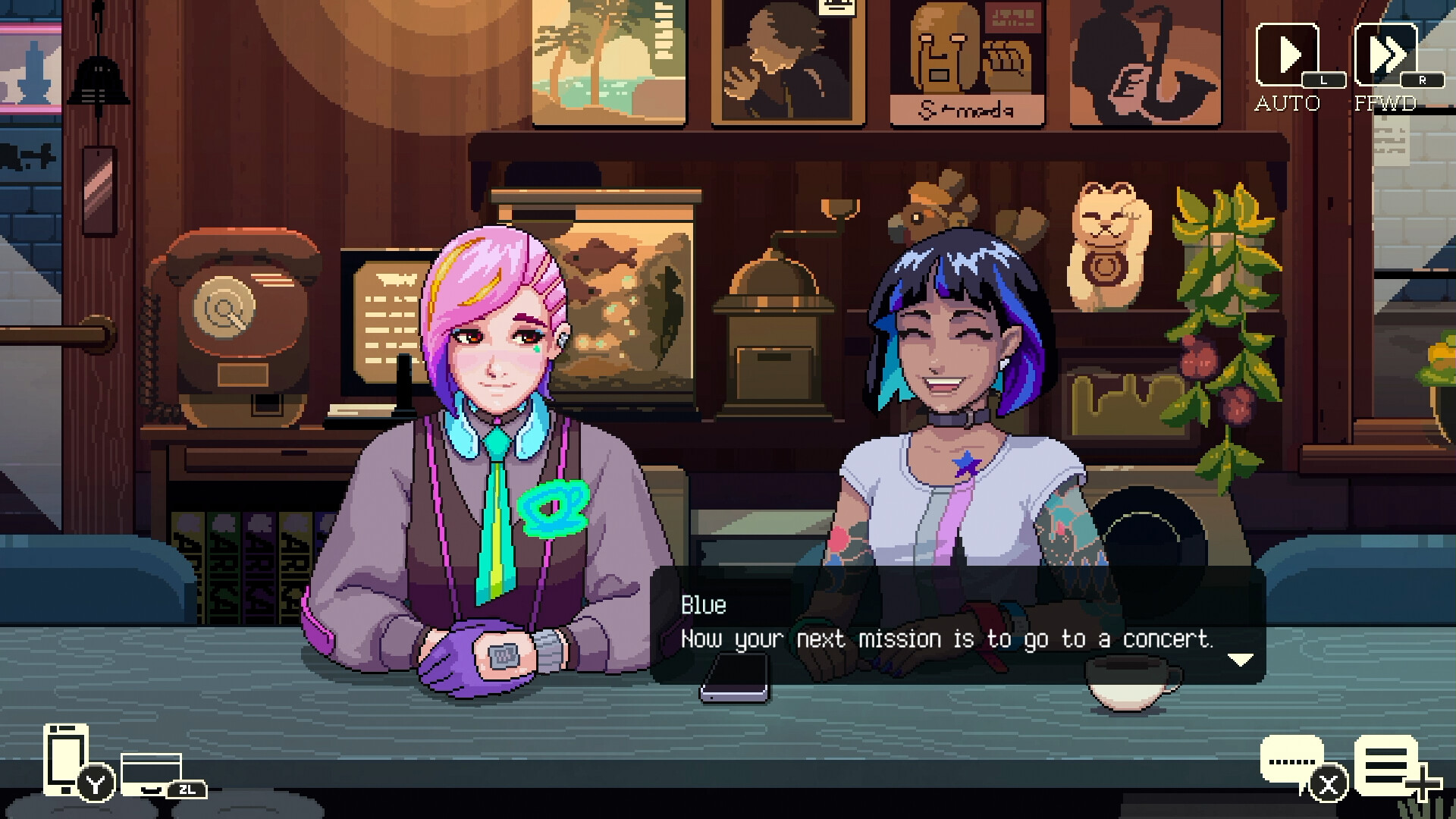
© Chorus Worldwide Games. Official media via Steam.
The pitch
OverviewCoffee Talk built its reputation on a simple premise: you're a barista, you make drinks, and mostly you listen. Two games and one spin-off into the series, Chorus Worldwide and series co-creator Toge Productions have moved the counter from a rain-soaked Seattle to a neon-lit late-night café in Tokyo, and swapped the original's dwarves and orcs for a cast that mixes ordinary humans with yōkai. It's a change of scenery rather than a change of formula, and for a series this comfortable in its own skin, that's mostly fine.
The pitch is unchanged: pull up a stool behind the espresso machine, brew drinks to order, and let customers talk. Some are venting about work. Some are working through grief, identity, or a chronic illness that's reshaped their whole life. A few aren't entirely human, and the game treats that with the same shrug it gives everything else — just another regular, just another order, just another story that needs somewhere quiet to land. Released on May 21, 2026 at a modest €14.99, Tokyo has settled into Very Positive territory on Steam and an 81 on Metacritic, respectable numbers that undersell just how divisive the shift in setting has been among longtime fans.
Because that's the tension running through Tokyo: the parts that made Coffee Talk special are still here, and mostly still work, but the game around them feels like it's coasting on a formula it isn't willing to push much further. The customers are as good as ever. The yōkai hook that's supposed to justify the whole relocation barely gets used. That gap is the whole review.
How it plays
PlayMechanically, Coffee Talk Tokyo asks very little of you, and that's by design. Most of your time is spent clicking through dialogue — reading a customer's problem, watching it unspool over several visits, occasionally choosing a line that nudges the conversation rather than steering it outright. There's no failure state to speak of, no combat, no exploration beyond the four walls of the café. If you've played either previous game, or 2021's spin-off, you know exactly what you're getting into within the first ten minutes.
The drink-making is the one system with any real texture. You pick a temperature first, then a base — coffee, tea, milk, alcohol — then layer in a primary and secondary ingredient, and the order you choose them in actually changes the outcome, since the primary ingredient carries more weight than the secondary. A green tea punched in three times makes a straightforward matcha; swap in soy milk and mango and you get something else entirely. It's a small, satisfying puzzle dressed up as a menu, and returning players will recognize the rhythm immediately, though Tokyo doesn't meaningfully expand it. New this time is stencil-based latte art on select drinks — mostly cosmetic, except for one specific order from a character named Ayame that outright requires you to nail the etching, which is as close as the game gets to a genuine mechanical stakes.
What's conspicuously absent is anything resembling the promise of the setting. You never leave the café, never wander Tokyo's streets, never get to poke at the yōkai lore beyond what a character volunteers mid-conversation. Reviewers have flagged this repeatedly: the supernatural cast reads as a costume change rather than a storytelling choice, since terminology goes largely unexplained and the fantasy elements rarely bear on the plot in any way that matters. A game that relocated its entire premise to trade on yōkai folklore, and then declined to actually use it, is a strange kind of restraint.
The writing carries the rest of the weight, and mostly it's up to the task. The regulars are a strong ensemble — nobody feels like filler, and at least one storyline involving a character living with a chronic illness lands with a specificity that plainly comes from somewhere real. But the larger structure is looser than the earlier games. Where Coffee Talk and Hibiscus & Butterfly threaded their smaller character arcs into something resembling a season-long story, Tokyo's vignettes feel more isolated from each other, and several resolve themselves through disarmingly tidy, articulate conversations that read more like group therapy than the messier way people actually process things. It's a visual novel that knows how to write a good scene; it's less confident stringing them into something larger.
Session length and pacing are unchanged from the series' template — expect somewhere around six to eight hours for a full playthrough, with multiple endings gated behind which orders and conversations you prioritize across the game's fifteen in-fiction days. Achievement hunters and completionists will find a reason to run it back, though the game gives you little new to do on a second pass beyond chasing the branches you missed.
The fan reaction since launch has split roughly along these same lines. Some longtime players call this the best of the three, arguing the Tokyo cast's problems land harder and more specifically than anything the earlier games attempted. Others, including some who say they've finished every prior entry, describe a rockier fit: characters who state what's bothering them almost immediately, with little of the slow-unspooling reticence that made earlier confessions feel earned. Both camps are responding to the same design choice — a script that trades subtext for directness — and which side you land on will likely depend on how much patience you have for characters who tell you exactly how they feel, rather than making you work to notice it.
Art & atmosphere
CraftIf the writing is a slight step down, the presentation is not. Tokyo's pixel art is gorgeous — rain-slicked streets glimpsed through café windows, warm interior lighting against a cool neon exterior, character portraits that convey more with a raised eyebrow than most fully-voiced games manage with a full performance. The Tokyo backdrop gives the artists a genuinely different palette to work with than Seattle's muted grays, and they clearly relished the excuse: paper lanterns, convenience-store glow, the specific blue-black of a city well past midnight. The latte art stencils double as a small showcase for that same attention to detail, turning a five-second animation into a genuinely pretty payoff for an order well made.
The soundtrack is the other constant the series has never once fumbled, and it doesn't here either — a lo-fi, jazz-inflected score that's engineered to be played in the background as much as listened to, the kind of soundtrack that's already made its way onto playlists independent of the game itself. Ambient café noise — the hiss of the espresso machine, distant traffic, the low murmur of a full room — does a lot of quiet work keeping the space feeling lived-in even when no one at the counter is talking. Between the visuals and the music, Coffee Talk Tokyo nails the one thing it absolutely could not afford to get wrong: it feels like somewhere you'd actually want to sit for a while.
Excellent character writing and presentation are undercut by an underused supernatural premise and a looser, tidier narrative than the series has delivered before.
Pros & cons
The ledgerIn its favour
- A strong ensemble of customers, written with genuine specificity and empathy
- The order-dependent drink-making loop is still a small, satisfying puzzle
- Best-looking entry in the series, with a Tokyo backdrop the pixel art clearly relishes
- The lo-fi jazz score is as good as anything the franchise has produced
- Multiple endings and fifteen in-fiction days give completionists a reason to replay
- Approachable, low-stakes pacing at a modest price point
Against it
- The yōkai and supernatural setting is underused, more aesthetic than story-relevant
- Individual arcs feel looser and less interwoven than in earlier Coffee Talk games
- Several conflicts resolve through unrealistically tidy, over-articulate conversations
- Minor characters are noticeably thinner than the main cast
- The core gameplay loop hasn't meaningfully evolved across three entries
Screens
Official media© Chorus Worldwide Games. Official media via Steam.
The player verdict
Real reviews · Steam- Recommended
“Coffee Talk Tokyo is a very good visual novel where you play as a barista who's listenning some customers life stories while you're preparing their favorite drinks. The ambient is very cozy, the pixels graphics are nice and the music is…”
15 found helpfulvia Steam - Recommended
“I've played all three Coffee Talk games and I must say, this one is by far my fav. one. I've read some of the negative reviews for this game, how they find the writing/story/characters design weaker than the previous two. But I highly…”
9 found helpfulvia Steam - Not recommended
“I am a massive fan of the previous games, so I had to play this one, sadly already on day 1 on 2 something felt wrong. The more I played, the more I disliked the game. The characters instantly say what is bothering them, I ended this game…”
9 found helpfulvia Steam - Not recommended
“I really liked the first two Coffee Talk, so much that I had this one in my wishlist the second it was announced. But ... I wouldn't say the game is "bad", because it isn't : the art and the music are perfect as always, and there are some…”
7 found helpfulvia Steam
Verdict
The callCoffee Talk Tokyo is a well-made, frequently affecting visual novel that changes its scenery far more than it changes its ambitions. The character writing is still the series' strongest asset, the drink-making loop remains a small, satisfying pleasure, and the presentation might be the best the franchise has looked or sounded. What's missing is the connective tissue — a supernatural setting introduced with confidence and then barely explored, and a narrative structure that resolves its conflicts a little too neatly to match the messier, more layered storytelling of its predecessors.
None of that makes it a bad café to sit in. It makes it a slightly less interesting one than the last two, which is a narrower complaint than it might sound — Coffee Talk's floor has always been comfortably high, and Tokyo never comes close to falling through it. The 81 on Metacritic and the Very Positive standing on Steam both track with what's actually here: a game that mostly delivers on what it promises, with a few ideas — the relocation, the yōkai, a script that leans on directness over subtext — that don't quite pay off the way the setup implies they will.
For fans of the series, or anyone who wants a low-stakes, low-commitment story to unwind with over a handful of evenings, it's still an easy recommendation at its price. Just don't come in expecting it to clear the bar the earlier games set — this is a comfortable, well-brewed sequel rather than a bolder one.
Sources
Original review by Aymen Sakouhi from the licensed facts above. Score: 7.7/10.