Big Walk Is the Best Reason to Get Your Friends Back Online
The Untitled Goose Game studio turns proximity voice chat and shared exploration into a joyful co-op adventure. Our verdict: 8.8/10.
Aymen Sakouhi·Writer · Games Hobbyist//5 min read
© Panic. Official media via Steam.
The pitch
OverviewBig Walk is a game about the specific, slightly awkward, deeply human business of hanging out. It comes from House House, the small Melbourne studio that turned a honking goose into a global phenomenon, and it trades that mischief for something warmer: a cooperative online adventure built entirely around exploring a big, open world with a friend or two and talking to each other while you do it. Panic publishes it, and it arrived on 4 August 2026 to the kind of reception most studios only dream about.
The pitch is disarmingly simple. You and your companions are dropped into a sprawling, sun-warmed landscape with no minimap arrow barking orders and no urgent threat at your back. You walk, you talk, you poke at things, and you slowly work out how to get from here to there together. The signature mechanic is proximity voice chat: your friends' voices get louder as they get closer and fade as they wander off, so the game is constantly nudging you to regroup, split up, call out, and reconvene. It turns the act of simply being near each other into a mechanic.
The critical response has been extraordinary. On Steam it sits at a Very Positive rating across more than twelve thousand reviews, with roughly 94 percent of them positive, and its Metacritic average landed in the low nineties, among the highest-scored games of the year so far. The recurring note in both critic and player reactions is not about systems or spectacle. It is about feeling, again, the particular joy of messing around in a world with people you like.
That framing matters, because Big Walk is unapologetically a game with friends rather than a game you conquer alone. Judged as the thing it wants to be, a generous, funny, low-pressure space to share with a couple of other people, it is close to perfect. Judged as a solo experience or a systems-driven adventure, it would be a different and much smaller game. Almost everyone who has fallen for it fell for it in company.
How it plays
PlayThe loop is exploration and cooperative puzzle-solving, stripped of the usual scaffolding. There is a world to cross and obstacles between you and where you want to go, and the game trusts you to figure out the how by talking it through rather than following a waypoint. Puzzles are built for more than one brain and more than one pair of hands: someone holds this, someone reaches that, someone stands over here and describes what they can see while the others act on it. The satisfaction is less about the elegance of any single puzzle and more about the small negotiation of solving it together.
Proximity voice chat is the design's masterstroke, and it does more work than it first appears. Because your friends' voices swell and fade with distance, the game is always quietly shaping how you move. Split up to cover ground and you lose the easy chatter, so you shout across the gap or hurry back to compare notes. Cluster together and the world shrinks to a cozy huddle. It manufactures the exact texture of a real hangout, the drifting apart and drifting back, and it does it without a single line of forced dialogue. It is also, inevitably, the source of the game's biggest dependency: it lives and dies on the people you bring.
The world itself is generous and unhurried. There is no fail state hanging over you, no timer, no punishing death loop, so the tone stays relaxed even when a puzzle has you stumped. That openness is the point, but it is also where the game asks something of the player. Big Walk rewards curiosity and conversation and gives comparatively little to anyone hoping to be pulled along by momentum or challenge. If your group wants a tight, goal-driven co-op experience with clear objectives and escalating stakes, this is deliberately not that.
It is worth being honest about the shape of the content, too. This is a bounded adventure rather than an endlessly replayable systems toybox, and its magic is strongest on a first run through its surprises with the right company. There were some rough edges at launch, most visibly the lack of separate volume sliders for game audio and voice chat, a complaint that topped the early reviews and that the developers have since patched. The accessibility options are a genuine strength, with full controller support, adjustable difficulty, and comfort settings that make it easy to get a mixed group playing together.
Cross-platform play ties it all together, letting friends on different systems share the same walk. That reach is not a footnote; the entire game is an argument for playing with the specific people you want to play with, and letting them join regardless of hardware is central to that promise being kept.
Art & atmosphere
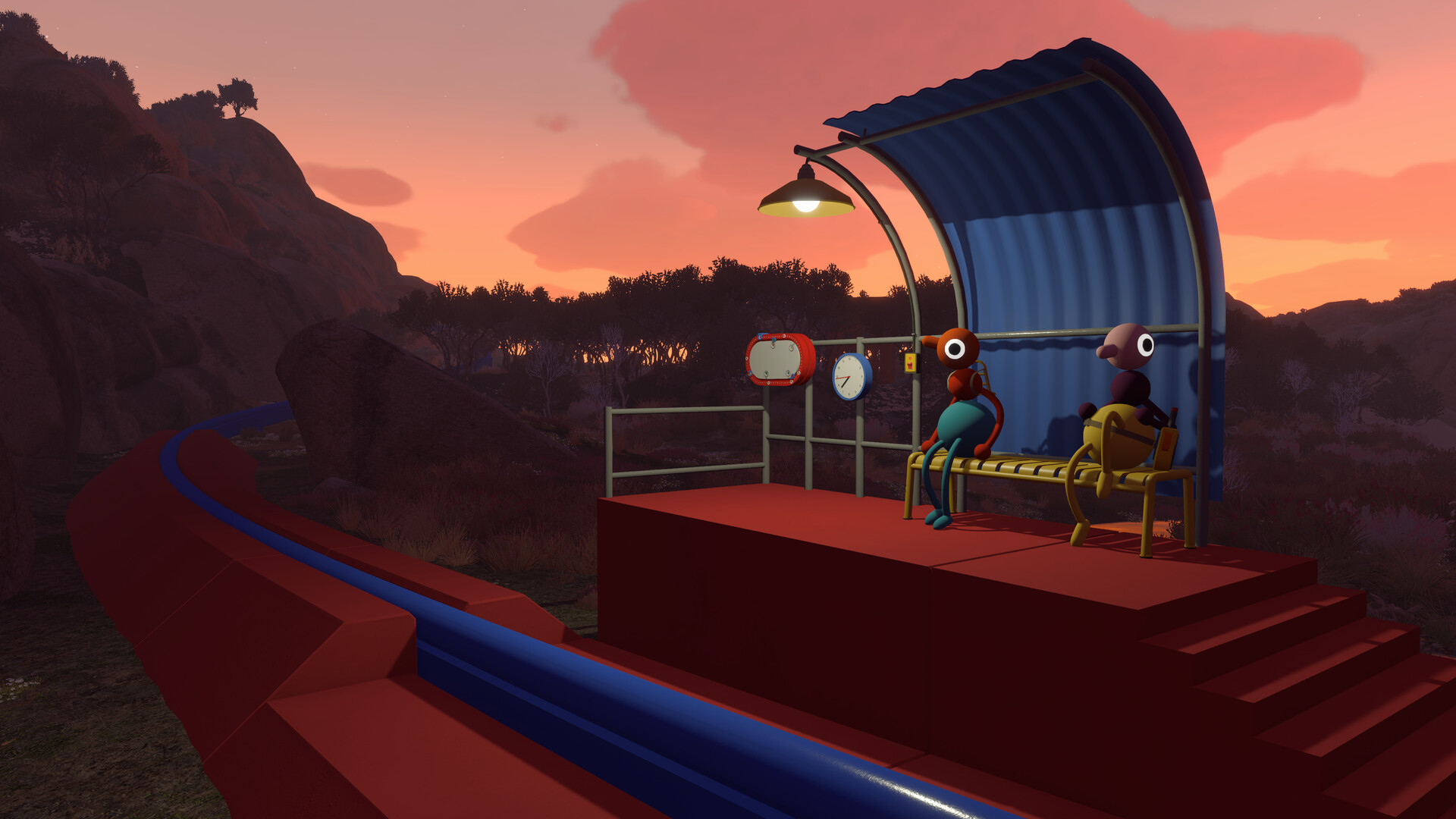
CraftBig Walk has the clean, characterful look House House established with Untitled Goose Game, scaled up to a whole landscape. The world is soft and inviting, built from simple, readable shapes and warm light, the kind of place that feels good to wander even when you are not entirely sure where you are going. It is not chasing photorealism or spectacle; it is chasing atmosphere, and the atmosphere it lands on is unmistakably pleasant.
The restraint is the craft here. By keeping the visual noise low and the palette calm, the game leaves room for the actual content, which is your friends' voices and your shared reactions, to become the star. Nothing on screen competes with the conversation. The result is a space that acts almost like a stage set for hanging out, present enough to spark curiosity and quiet enough to disappear behind the people you are playing with.
Sound is where the design really sings, and not through a bombastic score. The star is the human audio: the proximity chat that ebbs and flows, the laughter and the half-finished sentences and the sudden shouts of discovery. House House understood that in a game about being together, the most important sound is the other players, and everything else is tuned to get out of its way.
A beautifully judged co-op adventure whose proximity-chat hangout is close to perfect with the right friends, held just short of the top by how little it offers solo and how bounded the experience is.
Pros & cons
The ledgerIn its favour
- Proximity voice chat turns simply being near your friends into a genuine mechanic
- A warm, low-pressure world with no fail states, built for relaxed hangouts
- Cooperative puzzles designed around real conversation and teamwork
- Cross-platform play lets friends join regardless of hardware
- Strong accessibility: full controller support, adjustable difficulty, comfort options
- One of the best-reviewed games of the year, and it earns the reputation with friends
Against it
- It is a game with friends first; solo or with the wrong group, much of the magic evaporates
- Light on challenge and momentum for players who want clear goals and stakes
- A bounded adventure whose spell is strongest on a first playthrough, not an endless toybox
- Some launch rough edges (notably missing separate audio sliders, since patched)
Screens
Official media© Panic. Official media via Steam.
The player verdict
Real reviews · Steam- Recommended
“Great so far, but DEAR GOD PLEASE ADD DIFFERNT VOLUME SLIDERS FOR GAME AUDIO AND MIC AUDIO Edit: Its been fixed there has been a change to the volume settings!”
3,854 found helpfulvia Steam - Recommended
“I live abroad and am playing this game with my brother. We both became parents in the last year. At some point we encountered a puzzle with a couch and chair in a closed room with a view over a valley and big 5 minute countdown timer on…”
1,397 found helpfulvia Steam - Recommended
“This was a love letter to playing games with friends and being able to enjoy your time with them, even if there is no clear goal for why you're together. Big Walk has a Big Heart.”
904 found helpfulvia Steam - Recommended
“I'm sorry if you don't have the buds for this one. But this is it. Our crew was intentionally getting separated just to engage with the amount of mechanics that the game has to either get back together, or just play with your newfound lost…”
816 found helpfulvia Steam
Verdict
The callBig Walk is a small miracle of a co-op game, and one of the most quietly joyful things released this year. House House took the simple idea of walking and talking through a world with friends and built something around it that most bigger, louder games never manage: a genuine feeling of being together. The proximity voice chat is the kind of mechanic that seems obvious in hindsight and is clearly the product of enormous care, shaping how you move and talk without ever telling you to.
The caveat is the same as its strength. This is a game you play with people, and its brilliance is proportional to the company you keep. Bring a friend or two you actually enjoy talking to and it is close to essential, a warm and funny few hours you will remember for the conversations as much as the puzzles. Come to it alone, or hoping for challenge and escalating systems, and you will see a lovely but slight adventure instead.
Given what it sets out to do, it succeeds almost completely, and the near-universal acclaim is deserved. It is not the biggest or the most demanding game of the year, but it might be the most generous. If you have a friend you have been meaning to catch up with, this is the best excuse to log on that games have offered in a long time.
Sources
Original review by Aymen Sakouhi from the licensed facts above. Score: 8.8/10.