Anno 117: Pax Romana Is the Series at Its Most Beautiful, and Its Most Demanding
Our Anno 117: Pax Romana review: Ubisoft Mainz's Roman city-builder is deep, gorgeous and hard to put down, if you weather its rough launch.
Aymen Sakouhi·Writer · Games Hobbyist//3 min read
© Ubisoft. Official media via Steam.
The pitch
OverviewAnno has always been a series for people who look at a working supply chain the way others look at a sunset, and Anno 117: Pax Romana is the most seductive expression of that fixation yet. Ubisoft Mainz has taken the franchise's fiendishly deep production-chain city-building and dressed it in the togas of the Roman Empire at its height, and the result is a strategy builder that is genuinely hard to stop playing, provided you can get past a launch that arrived rougher than the game underneath it deserved.
You play a Roman governor tasked with turning provinces into thriving, sprawling civilisation. The headline structural idea is two very different regions to develop: Latium, the sun-baked Italian heartland of marble and Mediterranean trade, and Albion, a colder, wilder Britannia of bogs and Celtic culture. They are not reskins of one another; they demand different goods, different building strategies and different approaches, and juggling both is where the game's considerable depth really opens up.
What has always separated Anno from other city-builders is that its cities are engines, not dioramas. Every citizen tier wants a lengthening list of goods, each good needs a production chain, each chain needs raw materials, labour and logistics, and the satisfaction is in watching a sprawling clockwork economy you designed tick over in perfect, humming balance. Pax Romana takes that loop and pours a Roman-history obsession over it.
How it plays
PlayThe core is classic, deepened Anno. You settle, you build the production chains that satisfy your population's escalating needs, grain to bread, grapes to wine, ore to tools, and on into luxuries, and you connect it all with trade routes across land and sea. As your citizens climb tiers, their demands multiply, and the puzzle of laying out a city that can actually supply them without choking on its own logistics is as addictive as ever. The two-province structure doubles the challenge: goods you can make cheaply in Latium may need shipping to Albion, and vice versa, turning inter-provincial trade into a genuine strategic layer.
The fresh systems are the standout. A new religion mechanic lets you build temples to Roman gods and gain civic bonuses, tangling faith into your economy. A culture system asks whether you Romanise a conquered province or embrace its local traditions, each path carrying real trade-offs. And the political and diplomatic layer, alongside optional naval military campaigns, gives you room to pursue dominance through commerce, statecraft or force. Combat remains the weakest strand, it is functional rather than deep, and most players will treat it as a means to an end, but its presence gives the sandbox more ways to win.
The honest caveat is the launch. Pax Romana shipped with performance hitches, some bugs, and connectivity and interface friction that soured a chunk of early players, a big reason its Steam user reviews landed more mixed than its strong critical scores. The systems underneath are excellent and the game is being patched, but if you value a smooth day-one experience, this is one where a little patience pays off. It is also, by any measure, a demanding game: the interface is a wall of information and the mechanics do not hold your hand, which is exactly what its fans want and exactly what will bounce newcomers.
Art & atmosphere
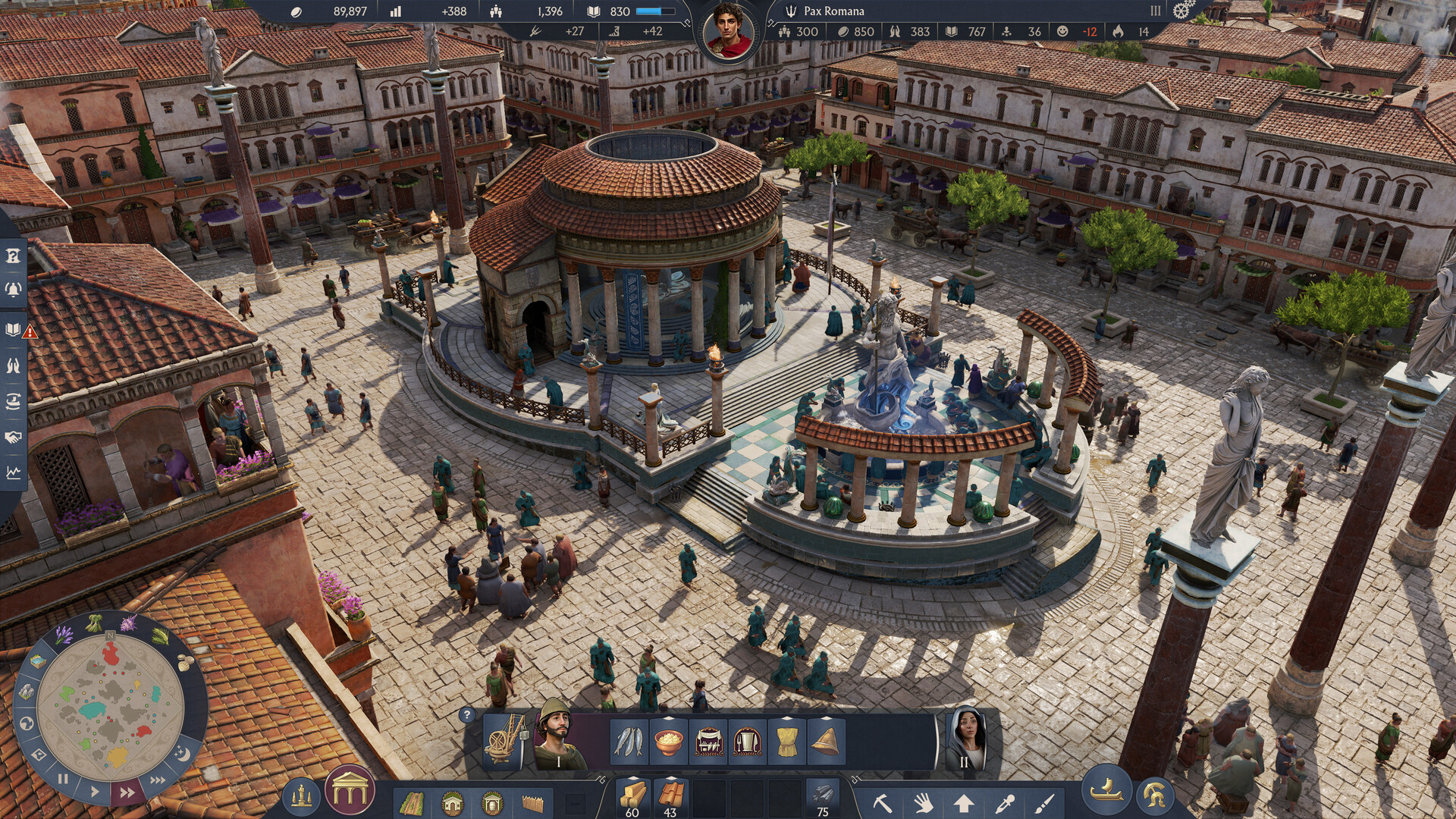
CraftPax Romana is comfortably the best-looking Anno yet, and for a series about zooming out over vast industrial sprawl, the detail when you zoom in is remarkable. A fully realised Roman city teems with life, carts trundling goods along roads, workers in the fields, ships crowding a harbour, smoke rising from a hundred workshops, and the two provinces are visually distinct in a way that makes moving between sun-drenched Latium and misty, green Albion feel like travelling across an empire.
The architecture is lovingly researched, from humble insulae to grand marble temples and bath complexes, and watching a modest settlement grow into a sprawling metropolis over dozens of hours is the series' oldest pleasure rendered more beautifully than ever. The lighting and water in particular do a lot to sell the fantasy of Mediterranean trade under a golden sun.
The orchestral score is suitably grand and Roman without tipping into cliché, swelling as your empire grows and settling into pleasant ambience during the long, absorbing stretches of optimisation. It is a presentation that rewards the obsessive zoom-and-admire habit every Anno player knows well.
A deep, gorgeous, series-best Roman city-builder that's hard to put down, docked for a rough launch and a complexity wall that will turn away newcomers.
Pros & cons
The ledgerIn its favour
- Series-best depth from the two-province Latium/Albion structure
- New religion and culture systems add real strategic novelty
- The most beautiful Anno yet, with superb city detail
- Endlessly absorbing production-chain optimisation
- Multiple paths to dominance: commerce, diplomacy or war
Against it
- A rough launch with performance, bugs and connectivity friction
- Weak, functional military combat
- Steep complexity and a dense interface unfriendly to newcomers
Screens
Official media© Ubisoft. Official media via Steam.
The player verdict
Real reviews · Steam- Not recommended
“I didn't mind the game, it's Anno, and I have generally enjoyed the Anno games I have played. But I feel ripped off. I paid a lot of money for the gold edition because I assumed that that meant I would have access to all the DLC. But no.…”
127 found helpfulvia Steam - Recommended
“I think they are really on to something with this installment of Anno. I will also say I believe this game will in the end be a better game than Anno 1800. 1800 is fantastic of course, but this game has some fresh ideas that set it apart.…”
49 found helpfulvia Steam - Not recommended
“- Anno 1800 was a rollercoaster compared to this: If you thought watching paint dry was thrilling, wait until you launch Anno 117. It manages to make the entire Pax Romana look like a corporate meeting about municipal tax codes. - The…”
44 found helpfulvia Steam - Not recommended
“I am physically unable to play because hackers got access to my ubisoft account, they then changed the email where authentication email goes from mine to theirs. They were able to successfully take over my account and prevent me from…”
43 found helpfulvia Steam
Verdict
The callAnno 117: Pax Romana is a superb city-builder and one of the deepest, most beautiful strategy games of its year, a near-perfect marriage of the series' clockwork economic obsession and a Roman setting that flatters it completely. The two-province structure and the new religion and culture systems give it genuine strategic novelty on top of a loop that was already among the best in the genre, and once it sinks its hooks in, hours vanish.
The asterisk is the launch, which was rougher than a game this good deserved, and its steep, unapologetic complexity, which will turn away anyone hoping for a gentle builder. But those are caveats, not disqualifiers. For strategy fans willing to meet it on its demanding terms, and to give the patches a little time, this is Anno at its most ambitious and its most gorgeous, and comfortably one of the best builders in years.
Sources
Original review by Aymen Sakouhi from the licensed facts above. Score: 8.2/10.