Vampire Survivors Made Doing Almost Nothing Weirdly Irresistible
Our Vampire Survivors review: poncle's auto-firing horde hit, its weapon evolutions, its addictive loop, and where the spell wears off.
Aymen Sakouhi·Writer · Games Hobbyist//5 min read
© poncle. Official media via Steam.
The pitch
OverviewVampire Survivors has no business being as good as it is, and it seems to know it. You slide a single character around a flat arena with the movement stick, your weapons fire entirely on their own, and enemies pour in from every edge by the hundred. That is the whole input scheme. No aiming, no dodge button, no attack command, nothing to press in the heat of the moment. And yet poncle's tiny, pocket-money oddity became one of the defining games of its year and quietly spawned an entire genre in its wake.
What it is really about is the slow, chemical satisfaction of watching a build assemble itself. It takes the last-stand horde idea and boils it down to an almost embarrassingly moreish core: outlast a fixed run, hoover up weapons and passive items along the way, and pray the level-up screen keeps handing you the pieces that turn your character from harried prey into a walking, screen-erasing engine of destruction.
The heritage is worn openly on its sleeve, a knowing pastiche of Castlevania whips and holy water and cross-throwing crusaders, filtered through the sensibility of a mobile idle game. But the ambition under the joke is real: to find the exact tuning at which a game that mostly plays itself becomes a game you genuinely cannot put down. More often than not, it finds it.
It launched into Early Access as a curiosity priced somewhere around a cup of coffee and climbed, on word of mouth alone, to the top of the charts, and virtually every horde-survivor clone released since owes it a royalty it will never collect. That influence is the clearest measure of what poncle actually built here: not merely a hit, but a template.
How it plays
PlayEvery run drops you in with one weapon and a countdown, usually thirty minutes long. Killing things scatters glowing gems; gems fill an experience bar; each level-up pauses the carnage and offers a small hand of new weapons or upgrades to draft. That is the entire skeleton, and for a genre this frantic it is almost startlingly calm, a steady drip of tiny decisions punctuating an ever-thickening storm of enemies. Chests dropped by the tougher foes fan open into a slot-machine flourish that can hand you several level-ups at once, and an occasional glimmering pickup on the floor might reveal the whole map, sweep the screen clean, or spill a small fortune in gold to bank for later.
The genius is in the evolutions. Marry the right weapon to the right passive item, push it to max level, and it transforms into a dramatically nastier version of itself, and learning those pairings is most of the game's long tail. The King Bible spiraling out into the Unholy Vespers, the humble whip becoming a bloody arc that scythes across the whole screen, these are the small revelations the entire design exists to deliver, and the first time you stumble onto one by accident it lands as a genuine jolt.
Because you never aim and never attack on command, the skill lives entirely in two places: movement and drafting. Positioning your character so the swarm funnels into your weapons rather than into your face is a constant, low-key spatial puzzle, and every level-up is a real decision, whether to complete an evolution, shore up survivability, or greedily chase more damage. It is quiet, nearly meditative in the moment, but the choices stacking up underneath are anything but arbitrary.
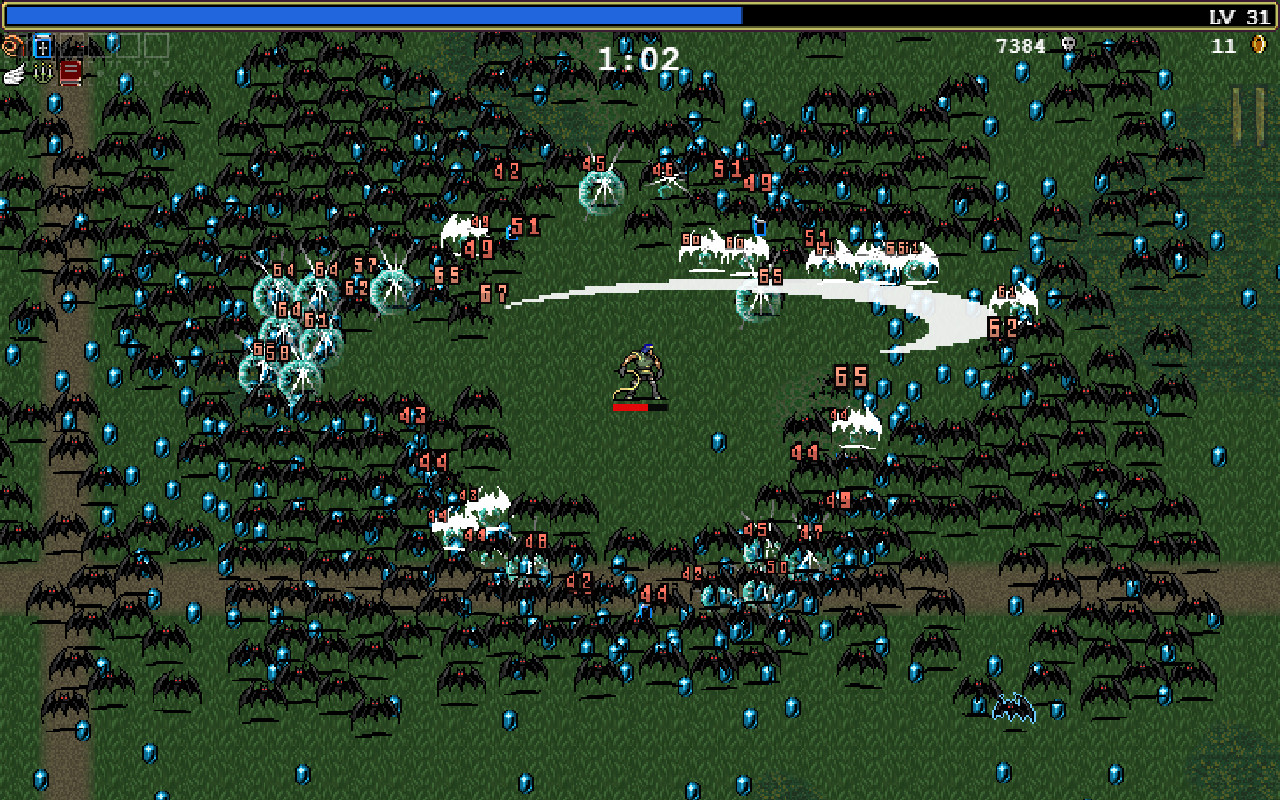
By the back half of a strong run, the screen dissolves into a fireworks display of overlapping projectiles, floating damage numbers, and strobing light, and the game leans all the way into that spectacle without apology. Enemies that terrified you at minute two now evaporate in waves before they can reach you, and the fantasy flips cleanly from survival to slaughter. There is a specific, faintly guilty pleasure in watching a build you assembled reduce a horde to confetti. And when the clock finally runs down, the game plays its best joke: a scythe-swinging reaper materializes to erase even the most unkillable build, a pointed reminder that the run was always a countdown and you were only ever borrowing the time.
For the price, the sheer quantity is faintly ridiculous. There is a deep bench of unlockable characters, a set of stages hiding secrets and Easter eggs, a bestiary's worth of weapons and evolutions to uncover, and a steady rollout of substantial free updates and paid expansions that have kept the thing growing for years. A meta-progression shop lets you spend earned gold on permanent stat boosts between runs, which smooths the early grind and gives even a doomed run something to show for itself. Later additions deepen the drafting considerably: the Arcana system lets you slot a handful of tarot cards before a run, each one bending its rules in ways that can turn a mediocre build into an unstoppable one, and a small army of secret characters waits behind hidden conditions and old-fashioned typed passwords, a knowing wink at the arcade era the whole thing is affectionately cosplaying.
The catch, and it is a real one, is that Vampire Survivors is front-loaded with discovery and noticeably thinner once you have seen the tricks. The first dozen hours of prying open characters, stages, and evolutions are compulsive; after that, runs can start to blur together, and a fully realized build meets so little genuine resistance that later sessions coast rather than test you. The permanent-upgrade shop, for all its convenience, is part of the problem, softening the roguelike tension by handing you power you never had to earn inside the run itself. None of that stops the first playthrough from being a small revelation; it just means the well runs shallower than the sheer number of hours you will happily pour into it might suggest.
Art & atmosphere
CraftVampire Survivors looks, entirely on purpose, like something you would have dug off a dodgy shovelware shelf around 2004: garish bitmap sprites, menus laid out with all the visual grace of a tax return, an aesthetic that seems almost to dare you to take it seriously. Then it hypnotizes you anyway. The trick is escalation, a run that opens on a few pixelated bats and closes as a screen-devouring squall of light and motion, chaos that somehow stays legible right up to the edge of whiting out the entire display.
That legibility is the genuinely underrated craft here. However dense the swarm gets, and it gets absurd, you can almost always pick out your own character, track the gems worth grabbing, and feel the shape of the danger closing in. The game is forever threatening sensory overload and almost never actually tipping into it, which is a far harder needle to thread than the cheerfully ugly presentation lets on.
The real ambush is the soundtrack. It is a chiptune-and-orchestra hybrid far better than a game this cheap has any right to, driving the massacre along like a boss theme that forgot to stop, and it does an outsized share of the work in making a plain arena feel like an event. Vampire Survivors is proof that production values and aesthetic effect are not the same thing, and that ugliness, tuned with enough care, can be completely irresistible.
A brilliantly tuned one-idea game that fully earns its praise but runs thin once the discovery phase is behind you.
Pros & cons
The ledgerIn its favour
- An addictive, instantly legible horde-survival loop
- Weapon evolutions make build discovery genuinely thrilling
- An almost absurd amount of content for the asking price
- Escalating spectacle that stays readable even at peak chaos
- A chiptune-and-orchestra soundtrack well above its budget
- Years of substantial free updates and paid expansions
Against it
- Loses much of its grip once the evolutions are known
- Auto-attacking caps the moment-to-moment skill ceiling
- The permanent-upgrade shop blunts the roguelike tension
- Late runs tend to coast rather than genuinely challenge
- Deliberately garish presentation will not win everyone over
Screens
Official media© poncle. Official media via Steam.
The player verdict
Real reviews · Steam- Recommended
“Still the best surivaton, survivors-like, bullet-heaven game out there. Tons to do, cheap and collecting those sweet, sweet xp gems feels so good. I have started this game over and played a ton three times because of how good it feels and…”
11 found helpfulvia Steam - Recommended
“I'm a number go up gamer these days, what can I say. I have to be conscious of when I keep this game installed on my computer/when I keep my Deck around so I don't just disappear into it.”
8 found helpfulvia Steam - Recommended
“This game is the game that inspired hundreds of 2D roguelikes. Start playing and you'll understand why : the amount of possible combination you can get without even counting the DLC's is just crazy. The game can be easily bought on…”
8 found helpfulvia Steam - Not recommended
“Fun to kill some time. Unfortunately I do not find the progression fun or meaningful. Probably a skill issue, but I go for long periods of time without unlocking anything new and basically still have the same ~20 items I've had since the…”
6 found helpfulvia Steam
Verdict
The callFor the price of a sandwich, Vampire Survivors hands you dozens of hours and a genuinely novel-feeling rhythm, and it deserves real credit for inventing, more or less single-handedly, an entire subgenre that others are still busily mining. It is a masterclass in taking one deceptively simple idea and tuning it until it hums.
Judge it honestly, though, and it is a brilliant time-sink rather than a deep well, a game you will binge hard for a fortnight, set down thoroughly satisfied, and return to in occasional bursts when the itch comes back. That it accomplishes so much with so little input is the entire point, and very nearly the entire joy. Just do not expect it to keep surprising you forever.
Sources
Original review by Aymen Sakouhi from the licensed facts above. Score: 8.2/10.