The Carcass Has a Brilliant Idea and a Trust Problem
A typing-driven Lovecraftian colony sim with a wild premise, undone by AI-flavored writing and a Negative launch. Our verdict: 4.5/10.
Aymen Sakouhi·Writer · Games Hobbyist//5 min read
© PiqFocus Interactive. Official media via Steam.
The pitch
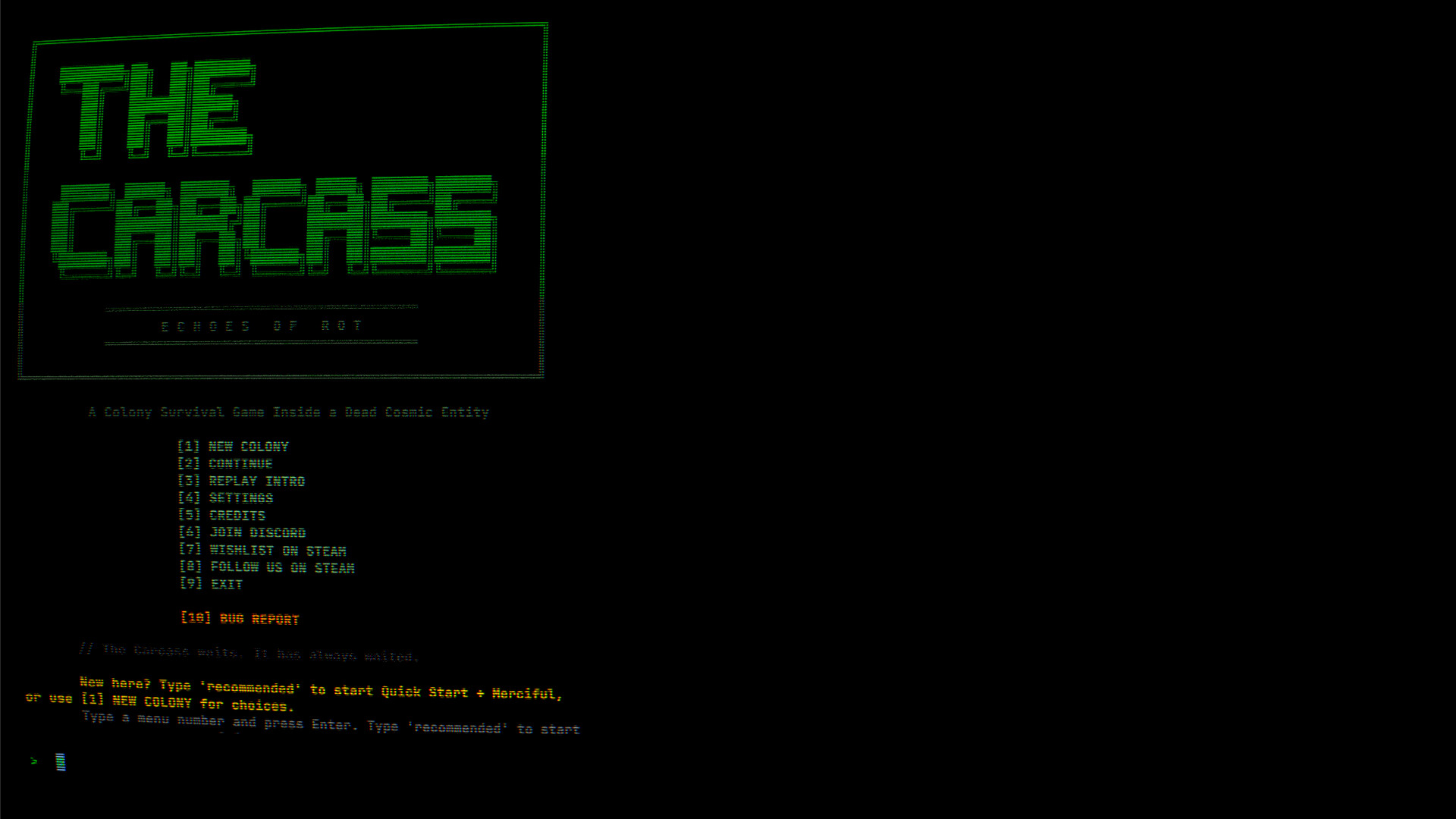
OverviewThe Carcass opens with one of the most arresting premises on Steam this year. You wake inside the corpse of a dead god, adrift in the cold of space, and you carve a colony out of its procedurally generated anatomy. It is a typing-driven Lovecraftian colony sim, a roguelike where you negotiate with rival alien factions, evolve occult mutations, and hunt for one of several endings while the dead thing around you slowly remembers you are there. On paper it is exactly the kind of strange, specific idea that a small studio can build a following on.
PiqFocus Interactive released it on 11 August 2026 for PC at a modest 7.49 euros, and the concept alone was enough to earn a demo audience and a community request to have it reviewed. The setup promises something between a text adventure and a survival management game: read, decide, type, and live or die by the consequences. For a certain kind of player, the pitch of managing a settlement grown from a divine cadaver is irresistible.
The launch, though, has been rough, and it is only honest to lead with that. On Steam the game sits at a Negative user rating, with well under a quarter of its first fifty or so reviews recommending it. The single loudest complaint, repeated across the most-upvoted reviews and the store discussion boards, is that the writing feels machine-generated, which is a serious charge for a game whose entire loop is built on reading text. A store page that described its events as hand-written, followed by an AI-use disclosure that players say appeared after they had already bought in, turned a reception problem into a trust problem.
This review is grounded in the game's confirmed design, its official store details, and the early critic and player response rather than a claim of a finished playthrough, because at this stage that public record is the clearest signal there is. The idea at the center of The Carcass is genuinely good. The execution around it, on the evidence available so far, does not yet earn the confidence its premise asks for.
How it plays
PlayMechanically, The Carcass is a text-forward colony sim you drive almost entirely from the keyboard. Resources, rival factions, and exploration all shape your decisions as you expand into the body around you, and the studio leans on that keyboard-only design as a deliberate identity rather than an oversight, with no controller support at launch. Around the management layer sit the roguelike hooks: occult mutations that change how a run plays, an Ironman mode with permanent death that gives each decision real weight, adjustable difficulty, and a spread of endings, advertised as five main conclusions and four hidden ones, to chase across multiple attempts.
Those are strong bones for a management roguelike, and the parts list is not the problem. The problem is that in a game where you spend nearly all of your time reading, the text has to carry everything, and this is exactly where the reception has been harshest. The most helpful reviews on Steam describe writing that feels thin and templated, with an introduction that info-dumps a great deal of lore and terminology while explaining too little of it, then leans on a glossary to catch you up. In a genre where atmosphere and clarity are the whole experience, that combination frustrates on both ends at once.
Depth is the other open question. An independent critic who spent time with it at launch found the concept distinctive but could not yet vouch for how deep the systems run, how long a typical run lasts, or how stable the game is over time, and pointed to the small and unfavorable early review sample as a reason to wait. That is a fair read. There is clearly a real management game in here, with faction negotiation and mutation builds that could reward mastery, but nothing in the current public record confirms that the loop sustains itself past its striking first impression.
For now the honest summary is that the skeleton is interesting and the connective tissue is weak. A typing-driven colony sim lives or dies on the quality of its prose and the clarity of its onboarding, and early players are telling a consistent story about both. Until the writing and the tutorialization are reworked, the systems underneath are hard to reach and harder to trust.
Art & atmosphere
CraftThe Carcass reaches for a grim, Lovecraftian mood, and the imagery of building a home inside a god's remains is evocative on its own terms. The header art and marketing lean into that cold cosmic body-horror tone, and for a budget indie the surface presentation sells the fantasy well enough to draw you in.
The complication is that a meaningful share of the negative response extends past the writing to the presentation itself. Players have pointed at the artwork and the audio as feeling generated rather than crafted, part of a broader sense that too much of the package was assembled with AI assistance and not fully finished by hand. The developer's own disclosure acknowledges generative AI in the workflow, including for store capsule and header art, marketing images, and localization, while stating that the team directed, reviewed, and finalized that work. Whether that reads as reasonable transparency or as a gap between the store's earlier hand-written framing and the reality is the exact fault line the community has split along.
What is not in dispute is a set of genuinely thoughtful accessibility options: narrated menus, adjustable text size, adjustable difficulty, custom volume controls, and a playable-at-your-own-pace design. Those choices deserve credit and suit a slow, text-driven game. They are a real point of care in a launch that has otherwise struggled to convince players the rest of the craft got the same attention.
A striking, original premise undercut at launch by writing players call AI-generated in a text-first game, a trust-damaging disclosure, and depth that remains unproven.
Pros & cons
The ledgerIn its favour
- A genuinely distinctive premise: a typing-driven colony sim set inside the corpse of a dead god
- Real roguelike ambition with mutations, faction negotiation, Ironman permadeath, and multiple endings
- Thoughtful accessibility: narrated menus, adjustable text and difficulty, play-at-your-own-pace design
- An approachable price for a small, experimental indie
Against it
- Negative Steam reception, with well under a quarter of early reviews recommending it
- Writing that many players call machine-generated, which is fatal for a text-first game
- A store page that read as hand-written followed by an AI disclosure players say arrived after purchase
- A heavy opening info-dump with weak tutorialization
- Keyboard-only with no controller support at launch
- Depth, run length, and stability still unproven this early
Screens
Official media© PiqFocus Interactive. Official media via Steam.
The player verdict
Real reviews · Steam- Not recommended
“The AI disclosure was added after I had already purchased, but you can feel it immediately. There's a tangible lack of soul to the writing and you can sense the gaps in the introduction where an AI was asked to fill in for the writer's…”
133 found helpfulvia Steam - Not recommended
“edited review: gameplay was fine although it info dumps you massively with very little explanation. information is accessible via a glossary, but, still, an infodump nonetheless. story is somewhat interesting but not really fleshed out…”
126 found helpfulvia Steam - Not recommended
“"It wasn't just not handwritten, it was blatantly AI-written. Not only was it unaltered LLM slop, but it REMEMBERED being unaltered LLM slop." Allow me to quote the store page directly: "Story-rich, **hand-written** Lovecraftian events…”
97 found helpfulvia Steam - Not recommended
“Aggressively AI-produced game. Every- or everyother sentence is clearly copied from an llm-induced reply to a prompt. In a game that relies on text, that's a hard no.”
75 found helpfulvia Steam
Verdict
The callThe Carcass is the frustrating case of a great idea that has not yet been given the execution or the honesty it needs. The core fantasy, growing a roguelike colony out of a dead god's anatomy and typing your way through a Lovecraftian collapse, is the sort of concept that deserves to find an audience, and the underlying systems, mutations, faction play, permadeath, and a web of endings, suggest a real game trying to emerge.
But a typing-driven colony sim is only ever as good as its words, and at launch that is precisely where players say it fails, with writing that feels generated and an onboarding that buries you before it teaches you. The disclosure controversy compounds the damage: when a store page reads as hand-written and an AI notice appears after people have paid, the issue stops being taste and becomes trust, which is hard currency for a small studio to lose.
There is a path forward here. Reworked writing, a gentler and clearer introduction, and straightforward transparency could turn this into the cult curiosity its premise deserves, and the accessibility work shows the team can care about the details. For now, though, the safe advice matches the critics and the early buyers: wishlist it, watch how it updates, and wait for the words to catch up to the idea before you commit.
Sources
Original review by Aymen Sakouhi from the licensed facts above. Score: 4.5/10.