Persona 5 Royal Review: A Heist RPG That Turns Style Into Substance
Persona 5 Royal review: ATLUS's stylish Tokyo heist RPG returns with a new confidant and a third semester that earns its 100-hour runtime.
Aymen Sakouhi·Writer · Games Hobbyist//6 min read
© SEGA. Official media via Steam.
The pitch
OverviewNot many games would dare to make opening a menu feel like a runway walk, yet Persona 5 Royal manages it before you have even settled on a difficulty. Every submenu knifes onto the screen, every confirmation prompt seems to pose, and the whole production carries itself like it knows exactly how good it looks. Spend an hour inside it, though, and the swagger turns out to have a point. This is a game about teenagers who have been failed by every adult with power over them, and who decide, quietly at first and then very loudly, to take that power back.
Mechanically it is a Japanese role-playing game running two clocks at once. By day you are a transfer student on probation in Tokyo, juggling exams, part-time shifts, and friendships you never asked for; by night you and a growing crew of outcasts slip into the warped mental worlds of predatory adults and steal the desires that made them monstrous. ATLUS has spent decades refining this template of dungeon plus daily life, but Royal is the most elaborate and confident expression of it the studio has shipped.
This is the enhanced re-cut of 2019's Persona 5, and it makes no secret of wanting to render the original obsolete. It introduces a new confidant and party member in the gymnast Kasumi Yoshizawa, threads fresh scenes and systems through the existing calendar, and, most consequentially, bolts on an entire third semester that the base game simply did not have. The cost of all that generosity is measured in hours: a first playthrough can comfortably run past a hundred of them.
Within its genre it occupies an odd, ambitious intersection. It is part dungeon-crawler, part dating sim, part study of social anxiety, and it commits to all three with equal seriousness rather than treating any as a minigame. Where Persona 4 was about a foggy small town and the confusion of adolescence, Royal is about a metropolis and the specific fury of realizing the system is rigged against you. It wears that anger like a tailored coat.
How it plays
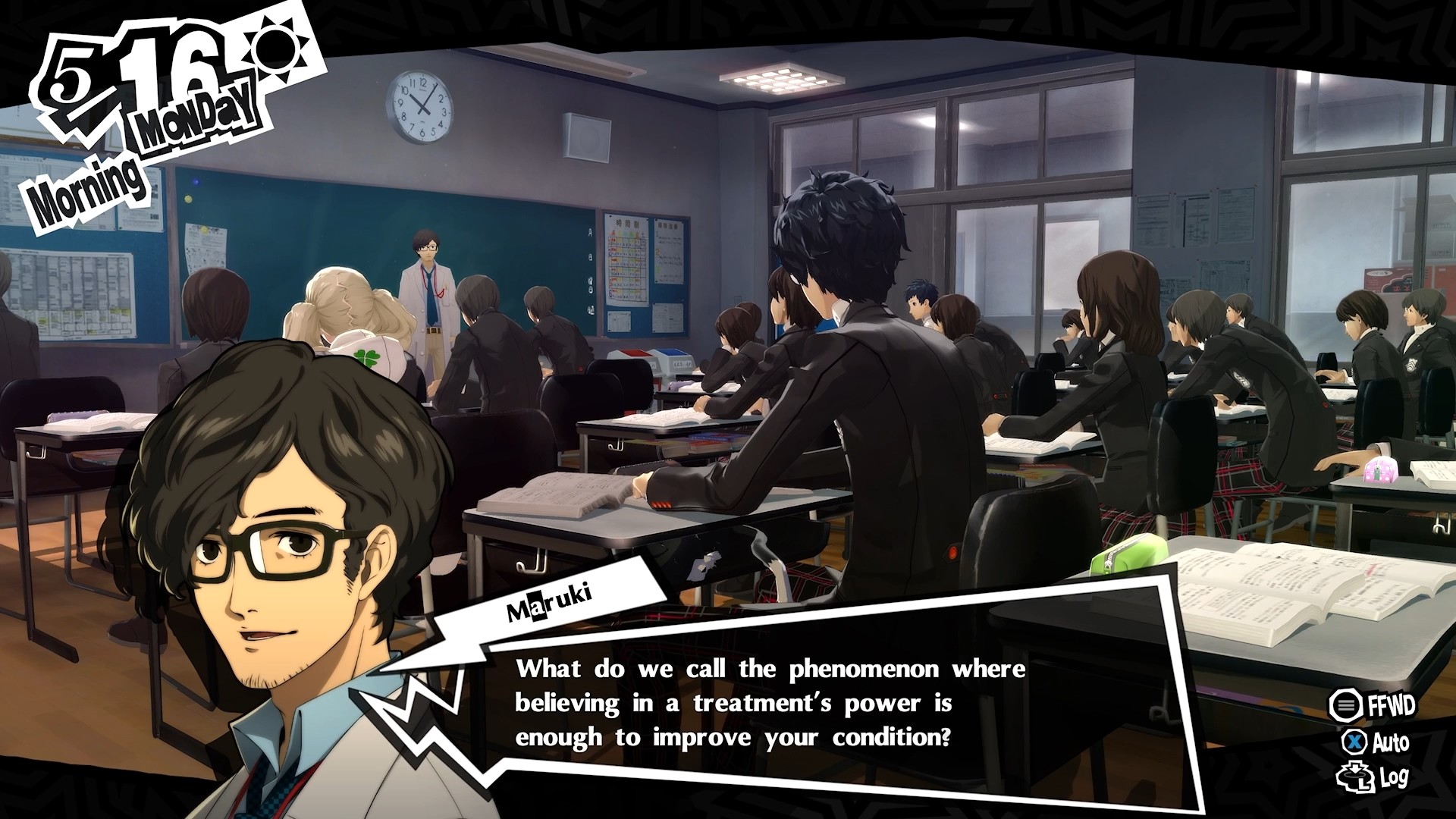
PlayEverything orbits a calendar, and the calendar is merciless about time. Each day hands you a small number of slots and a long menu of things worth spending them on: study for an exam, take a shift at the flower shop or the convenience store, watch a film to raise a personality stat, brew coffee, or descend into a Palace with the team. Because the school year is finite and relationships deepen only over real in-game weeks, you are perpetually weighing the dungeon against the day job, and the game is honest enough to let you make choices you cannot take back.
The social layer is not decoration draped over the combat. Every person you grow close to becomes a Confidant, and each rank in a Confidant unlocks something concrete: an ally who will throw themselves in front of a killing blow, cheaper equipment, the ability to fuse Personas above your own level, bonus damage on an ambush. This is the design masterstroke. Befriending a burned-out doctor or a cynical politician is not a break from building your character; it is building your character. The simulation and the RPG are wired so tightly into one another that neglecting one starves the other.
Combat itself is turn-based and built on one elegant instinct: find the weakness. Strike an enemy's elemental soft spot and you knock it down and immediately earn a second action, which you can either use yourself or hand to a teammate through Baton Pass, stacking damage bonuses as the turn ricochets around the party. Floor every enemy at once and you can trigger an All-Out Attack, a stylish group finisher with its own splash-panel send-off. Royal adds Showtime attacks, lavish duo cut-ins that fire off at semi-random in tougher fights, plus a grappling hook that opens new routes and hidden treasure inside each Palace.
Underneath sits the series' collectible engine. The protagonist alone carries a whole stable of Personas, mythological figures swapped mid-fight to cover every element, and the Velvet Room lets you fuse them into stronger forms while hand-picking the skills they inherit. Chasing a specific build, a Persona with exactly the resistances and passives you want, becomes a satisfying puzzle in itself, and the game hands absurd power spikes to anyone who leans into it. Progression is layered enough that two players can finish the same story with wildly different toolkits.
Royal is also markedly kinder than the original in the ways that matter. Difficulty can be nudged on the fly outside the hardest setting, an assist-heavy option softens the resource juggling, and generous fast-travel, a proper autosave, and clearer objective markers trim the busywork that used to pad the days. Mementos, the sprawling procedural dungeon that once felt like filler, now hides collectible seeds and a mysterious new tenant who give you real reasons to keep diving. There is simply an enormous amount to do here, dozens of side stories, a battle arena, a jazz club, a darts game that doubles as a way to buff the party.
The friction deserves naming, though. The opening is a long, heavily narrated tutorial that keeps explaining systems well after you have obviously grasped them, and it can be a couple of hours before the game trusts you to steer without a hand on the wheel. A midgame Palace or two overstays its welcome. And the sheer length, luxurious when you have the time, can curdle into homework the moment you start trying to max every Confidant in a single run. This is a game that asks for a season of your life and never once pretends otherwise.
Art & atmosphere
CraftPersona 5 Royal treats its user interface as a lead performer rather than a set of buttons to press. The palette is ruthless, arterial red against black and white, loosened only slightly by the rose accent Royal introduces, and every screen transition is choreographed down to the individual frame. Character art favors sharp angles and confident linework, the Phantom Thief costumes reading like a heist film handed its wardrobe department an unlimited budget and a taste for theater. Even the load screens strike a pose, and somehow it never tips into self-parody.
Then there is the sound, which is where the game quietly becomes untouchable. Shoji Meguro's soundtrack fuses acid jazz, funk, and J-pop into songs that have no business being this catchy, with Lyn's vocals sliding over the battle theme 'Last Surprise,' the rainy melancholy of 'Beneath the Mask,' and the surge of 'Life Will Change' as a heist crests. Royal contributes its own numbers, including a new combat track, and they hold their own against a score already regarded as one of the medium's finest. It is the rare game where you will leave a fight running just to hear the loop resolve.
Tokyo itself is rendered with affectionate specificity. The cramped warmth of Cafe Leblanc, the churn of Shibuya's scramble crossing, the hum of a late subway carriage, all of it grounds the fantasy in a real, tired city where teenagers actually have trains to catch home. The result is a game whose style is not a coat of paint but an argument, that presentation, taken seriously enough, hardens into character.
A landmark JRPG whose new content and quality-of-life polish make Royal the definitive cut, held a step short of perfect by a slow start and indulgent length.
Pros & cons
The ledgerIn its favour
- The added third semester deepens and genuinely improves an already excellent story
- Weakness-driven, Baton Pass combat stays sharp across a hundred-hour campaign
- The Confidant system makes your social life and your build one and the same
- Presentation and Shoji Meguro's soundtrack sit in a class of their own
- A new confidant, difficulty options, and quality-of-life fixes flesh out the original
- Tokyo is specific, lived-in, and genuinely atmospheric rather than a backdrop
Against it
- A long, over-explained opening keeps repeating tutorials you have already mastered
- One or two midgame Palaces sag noticeably under their own length
- A full completionist run demands a serious commitment of real-world time
- Its themes are delivered with far more volume than nuance
- Mementos, though much improved, is still the least interesting place to fight
Screens
Official media© SEGA. Official media via Steam.
The player verdict
Real reviews · Steam- Recommended
“this game is sensational, it integrates life and lesson perfectly; i loved when john persona said 'its persona time' and persona'd all over the place.”
43 found helpfulvia Steam - Not recommended
“It took over 100 hours until I solidified my recommendation for this game. Despite the scenario problems I was going to recommend this game until I got to November in-game. In November the story unfolds a lot more quickly; it immediately…”
19 found helpfulvia Steam - Recommended
“This is my first JRPG game i have ever played and i have a great time playing through it, it has some flaws but the daily calendar system is what hooks me to this game and the franchise, espicially the gameplay and combat for this one, it…”
15 found helpfulvia Steam - Recommended
“Persona 5 Royal was my second game of the persona series, and I absolutely love everything about it. Makes me want to discover more of what this series is known for. I absolutely adore the character design, music direction, environment…”
11 found helpfulvia Steam
Verdict
The callThe third semester is the whole reason to come back, and it is far more than a victory lap. It takes a character the base game underserved, hands them the emotional core of the finale, and reframes the entire story in a way that lands harder than the original ending ever did. For a piece of add-on content, it is startlingly essential, the uncommon expansion that changes how you feel about everything preceding it rather than merely appending to it.
Persona 5 Royal is not subtle and it is not brief, and now and then it mistakes length for depth. But it is among the most self-assured role-playing games of its generation, a marathon that is stylish, mechanically rich, and emotionally sincere in equal measure, and it very nearly justifies every one of its many hours.
If you have the time to give it, few games repay the commitment this completely; if you do not, its demands are real and worth respecting before you start. For newcomers this is unambiguously the only version to play, and for anyone who rolled credits on the original back in 2019, the Royal additions are strong enough to make a second hundred hours feel less like indulgence than unfinished business.
Sources
Original review by Aymen Sakouhi from the licensed facts above. Score: 9.3/10.