Palworld 1.0 Review: The Survival Sandbox That Refused to Stay a Punchline
Palworld 1.0 review: Pocketpair's creature-survival sandbox finally leaves early access, bigger and still addictive, with the same grind and jank.
Aymen Sakouhi·Writer · Games Hobbyist//6 min read
© Pocketpair. Official media via Steam.
The pitch
OverviewWhen Palworld first appeared in early access, most of the conversation was about everything except the game: the guns strapped to pocket-monster stand-ins, the memes, the lawsuits, the sheer speed at which it sold. Two and a half years later, Pocketpair has shipped the 1.0 version, and the more interesting story is the quiet one underneath all that noise. The joke game turned out to have a real spine, and the full release is where that finally becomes hard to argue with.
Palworld is an open-world survival and crafting game built on a single, slightly deranged idea: the creatures you catch are also your labor force. You explore, you fight, you capture Pals with thrown spheres, and then you march them back to a base where they mine ore, tend crops, run the generator, and hammer out gear at your workbenches while you head back out for more. It sits at the crossroads of Ark, Pokemon, and a factory builder, and the reason it works is that none of those three pillars is decorative. Each one feeds the other two.
The 1.0 update is not a victory lap so much as a genuine expansion of scope. Pocketpair added two new regions, the floating sky islands of Sunreach and a World Tree that now serves as the game's proper endgame, and used them to finally close out the central story that early access left dangling. The reported Pal count climbs to 287, with dozens of fresh designs and variants, the level cap rises from 65 to 80, and new systems like Awakening and Mutation give long-term players something to chase past the point where most survival games run out of rope.
The reception has been warm and wide, a Very Positive standing on Steam across more than four hundred thousand reviews and a spread of critic scores that mostly lands in the 8-to-10 range. That enthusiasm is real, and so are the caveats underneath it. This is still a game that grinds hard, still a game whose Pals occasionally forget how walls work, and it earns its place through momentum rather than polish.
How it plays
PlayThe core loop is the whole pitch, and it is dangerously good at eating an evening. You start with nothing, punch a tree, catch your first Pal, and within an hour you have a small camp where two or three creatures are chopping wood and mining stone without you. From there the game becomes a constant, satisfying negotiation between what you want to build next and which Pals you need to make it happen, because every Pal carries work suitabilities: one is a lumberjack, one waters crops, one is a walking furnace whose body heat smelts your ore. Assembling a base crew that covers every task is its own progression system layered on top of the survival one.
Combat is where the guns-and-monsters premise stops being a gag. You fight alongside your active Pal, swapping it out mid-battle, riding some of them into the fray, and leaning on captured creatures the way another game would lean on a loadout. Capture itself is a risk calculation lifted from the monster-catching genre and given weight: weaken a target, read the odds, decide whether to spend a good sphere now or come back stronger later. Boss encounters against Alpha Pals and the game's tower battles give the mid-game clear spikes to train toward, and the 1.0 additions push that curve out to level 80 with new bosses waiting at the top.
Base building is the engine room, and it is both the most rewarding and the most frustrating part of the game. Automating a self-running settlement, ranch, farm, smelter, assembly line, power source, is genuinely absorbing, and breeding lets you chase Pals with better traits and work skills in a way that can quietly consume hours. The 1.0 Mutation system extends that hobby with rare breeding outcomes worth hunting, and Awakening lets you push your most developed Pals past their old ceilings. The catch is that the toolkit around all this stays thin. Compared with dedicated builders, Palworld hands you a smaller set of structural and decorative pieces, many of them gated behind high levels, so most bases end up boxy and utilitarian no matter how much love you pour in.
The friction that early access players remember has not fully gone away, and pretending otherwise would be dishonest. The grind is real: Pal levels creep upward slowly, tech trees get daunting fast, and the endgame in particular asks for a tolerance that not everyone will have. Pal artificial intelligence remains the game's most persistent weak spot. In combat it can swing between sharp and strangely binary, and in base logistics it goes plain dim, with workers wandering off tasks, jamming up on pathing, and occasionally clipping straight through a fortress wall in the middle of a raid you were counting on them to defend.
Multiplayer is where a lot of Palworld's real lifespan lives. Co-op and dedicated servers let a group split the labor and the exploration, and cross-platform play widens the pool of people you can build with. Working a base alongside friends smooths over some of the AI's failures, because a human handling logistics is simply more reliable than a Pal, and the game is at its funniest and its best when four people are trying to manage one overloaded settlement at once. Full controller support and a broad options set make it easy to drop into on whatever you own.
Performance is the last honest asterisk. Palworld runs fine most of the time, but the moment a large base fills up with fifteen Pals and several active workstations, the seams show, animations get scrappy and the frame rate remembers this is an ambitious game from a studio that was tiny not long ago. The camera can also turn genuinely awkward in tight fights against the biggest creatures. None of it is a dealbreaker, but all of it is the kind of rough edge that a game with this much reach probably should have sanded down by 1.0.
Art & atmosphere
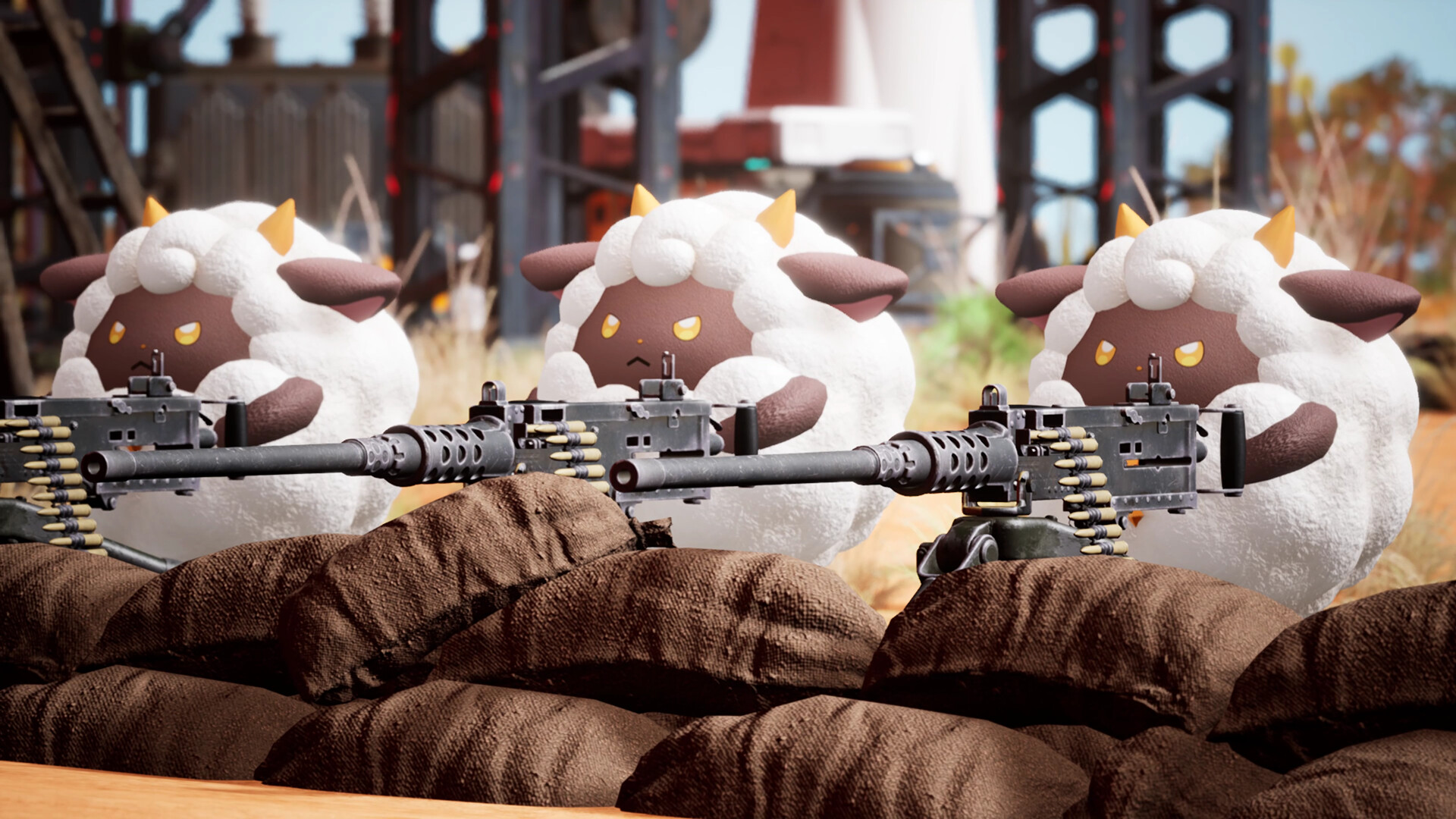
CraftPalworld's visual identity is easy to mock and harder to dismiss once you are inside it. The Pals themselves are the flashpoint, cute, round, occasionally a little too familiar in silhouette, but the roster is enormous and varied, and the best designs land somewhere genuinely charming, a fluffy creature with a flamethrower or a sheep-thing that doubles as a mattress. The 1.0 additions lean into that range, and whatever you think of the lineage, the sheer breadth keeps the world feeling populated rather than repetitive.
The environments do a lot of quiet work. The base game already covered a wide spread of biomes, and the new regions give the world its most distinct spaces yet: Sunreach's floating islands trade the grounded survival mood for something lighter and more vertical, while the World Tree gives the endgame a landmark with actual presence, a place that feels like a destination instead of just a higher-level zone. It is not a photorealistic game and never tries to be, but the color and scale are used with more intent than the early memes ever gave it credit for.
Sound and music are functional more than memorable, a pleasant, unobtrusive backdrop to the real business of building and capturing, and the game's tone sits in a strange, effective middle ground between wholesome creature-collector and something with a darker sense of humor lurking at the edges. That tension, adorable companions in a world where you can also strap them into a factory or a firing line, is the whole aesthetic, and 1.0 commits to it without blinking.
A relentlessly compelling survival loop and a genuinely expanded 1.0 (new regions, finished story, deep late-game) held just short of the top tier by heavy grind, shaky Pal AI, and lingering performance rough edges.
Pros & cons
The ledgerIn its favour
- The catch-build-automate loop is genuinely addictive and rarely stops giving you a next goal
- Pals as a labor force ties survival, creature-collecting, and base automation into one system
- 1.0 adds real scope: Sunreach, the World Tree endgame, a finished central story, and a level 80 cap
- Breeding, Mutation, and Awakening give long-term players a deep late-game to chase
- Co-op and cross-platform multiplayer are where the game is at its funniest and most durable
- Enormous, varied Pal roster keeps the world feeling full rather than recycled
Against it
- The grind is heavy, with slow Pal leveling and a demanding, time-hungry endgame
- Pal AI still falters in base logistics and combat, including clipping through walls mid-raid
- Base-building toolkit is thin, leaving most settlements boxy and utilitarian
- Performance dips noticeably once a large base fills with active Pals and workstations
- The camera can turn awkward in tight fights against the largest creatures
Screens
Official media© Pocketpair. Official media via Steam.
The player verdict
Real reviews · Steam- Recommended
“I don't play games often. My grandkids got me into this game. The last game I put this much time into was Breath of the Wild which this game has a few similarities to. I hope the tree is going to be a bridge to other realms as large as…”
3,079 found helpfulvia Steam - Recommended
“When I first played Legends: Arceus, I thought it was the best Pokemon game ever. It had most of the "this is what a perfect Pokemon game" features: big, open worlds, riding Pokemon, reasons to explore and discovering brand new things. But…”
1,305 found helpfulvia Steam - Recommended
“Throw Ball. Catch Chicken. Breed Chicken. Make The Chicken The most powerful In the world and slaughter everything and everyone. Good Game”
464 found helpfulvia Steam
Verdict
The callPalworld 1.0 is the version that makes the early hype look less like a fluke and more like an undervalued idea finally seen through. The catch-fight-build-automate loop is as compulsive as ever, the new regions and finished story give the whole thing a shape it lacked in early access, and the late-game systems reward the exact kind of player this game was always secretly built for. It is a survival sandbox that earns its enormous audience through sheer, relentless momentum.
It also has not outrun its roots. The grind will test anyone who is not already sold, the Pal AI is still the thing most likely to make you sigh, and the performance and building limits are reminders that ambition outpaced polish here more than once. If you bounced off the loop in early access, 1.0 will not convert you, and that is fair.
But for anyone who felt the pull of that first self-running base, this is the game at its fullest and most confident. Palworld set out to be the survival game where your creatures do the work, and after two and a half years it has become exactly that, bigger, sillier, and far more complete than its punchline reputation ever suggested. It is worth the descent back in, jank and all.
Sources
Original review by Aymen Sakouhi from the licensed facts above. Score: 8.3/10.