Die in the Dungeon Throws Out the Cards, and the Dice It Deals Instead Are Better
Verdict: 8.4/10. Die in the Dungeon swaps the deckbuilder's cards for dice you place and reshape, and the tactile roguelike it builds is a small gem.
Aymen Sakouhi·Writer · Games Hobbyist//5 min read
© HypeTrain Digital. Official media via Steam.
The pitch
OverviewThe roguelike deckbuilder has hardened into a formula in the years since Slay the Spire showed everyone how it was done. Draw a hand, spend energy, thin your deck, fight up a branching map, die, learn, repeat. It is a great formula, which is exactly why so many games run it back with only the theme changed. Die in the Dungeon does something braver: it keeps the shape of the genre and throws out the cards entirely. Your deck here is a fistful of dice.
That one substitution changes more than it sounds like it should. This is still a turn-based roguelike where you climb a dungeon, upgrade between fights, and chase a run to its end, but instead of playing cards you roll dice and place them onto a small board, combining their values, chaining their effects, and boosting them with relics you collect along the way. Some encounters even ask you to gamble, to risk a bad result on the hope of a good roll. The lineage is unmistakable, yet the moment-to-moment feel is its own thing, more tactile and more physical than shuffling a hand.
Die in the Dungeon did not arrive fully formed. It began life as a 2021 game-jam entry from the small Spanish studio ATICO, grew into a free prologue that a lot of people fell for, spent a long stretch in Early Access, and only reached its full 1.0 on May 1, 2026, published by HypeTrain Digital on PC and macOS for around fifteen dollars. That history matters, because it is a game that has been played, broken, and rebuilt in public for years. Its Very Positive standing across more than two thousand reviews is not launch-week enthusiasm; it is the accumulated goodwill of a project that kept sharpening the same good idea.
How it plays
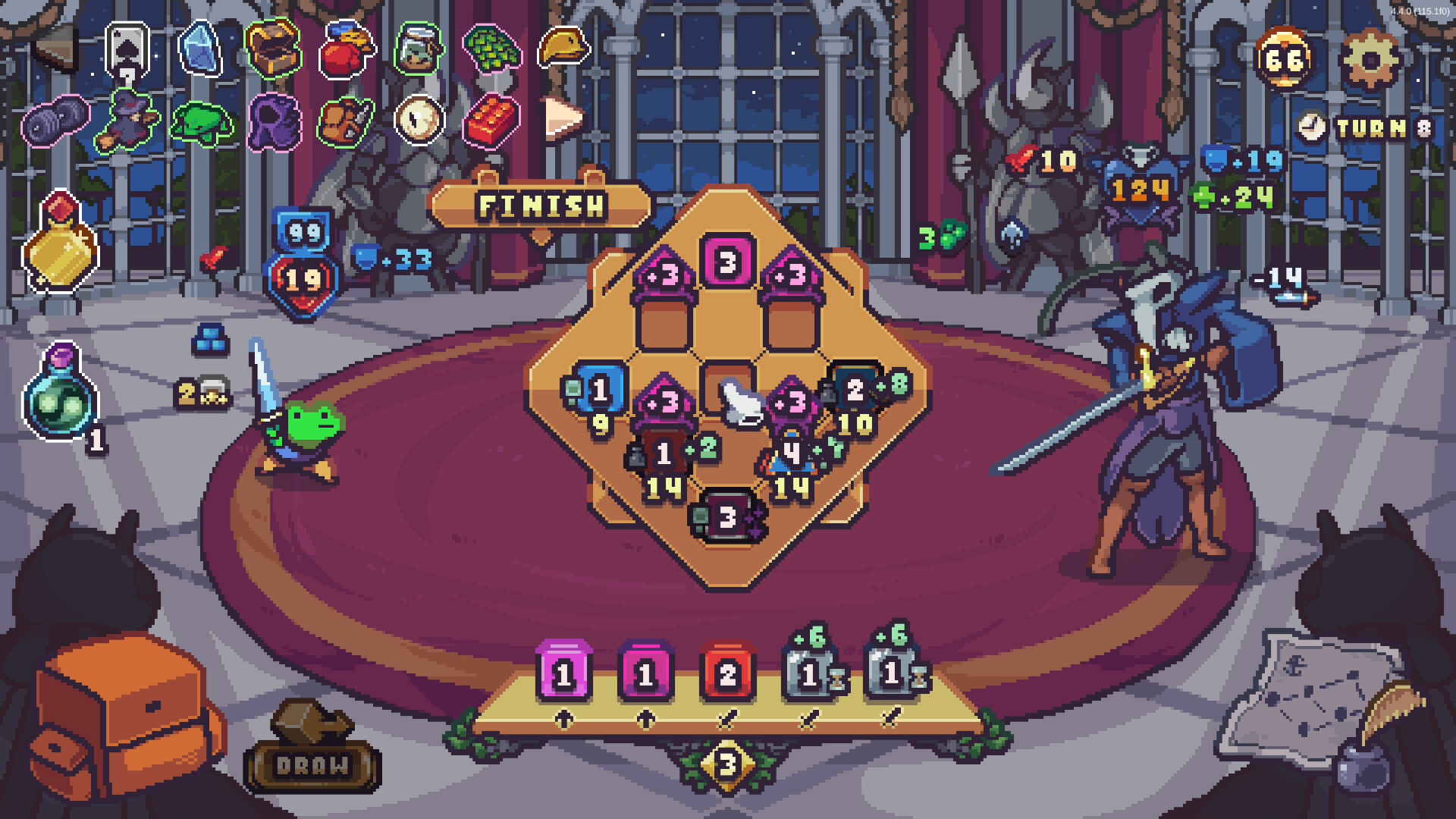
PlayThe core loop is the deckbuilder's, rewired around a die tray. Each turn you draw and roll a small set of dice, then place them onto a compact grid to attack the enemy across from you, raise a shield, or feed a combo that pays off a placement or two later. Enemies telegraph what they are about to do, so a turn is a little spatial puzzle: which die goes where, in what order, to blunt the incoming hit and still push damage. Because the dice sit on a board rather than resolving from a hand, position and adjacency matter, and the good turns feel less like drawing the right card and more like solving the board in front of you.
The smartest thing the game does is refuse to let dice be pure luck. Between fights you can raise the pips on your dice and redistribute their faces, so a die is not a random number generator you pray to but a tool you sculpt toward the roll you actually want. Load a die with high faces and it becomes reliable muscle; skew another toward a single value and it becomes the key to a specific combo. Layer on the relics, which grant passive effects that bend the rules of your board, and a run stops being about rolling well and starts being about building a small machine that rolls well by design. That tension, between the chaos of the roll and the order you impose on it, is where the depth lives.
The risk encounters lean into the fantasy the title promises. Now and then the game offers you a gamble, a chance to bet on an unexpected roll for an outsized reward, and taking or declining those bets becomes its own read on how strong your build is and how much rope you can afford. Around all of it sits the familiar roguelike scaffolding: ascend the dungeon, take upgrades between battles, and when you fall, carry what you learned into the next attempt. Runs are short enough to invite one more try and layered enough that the next one plays differently.
As a package it is lean and considerate. It is single-player only, with full controller support, Steam achievements, and cloud saves, and the planning-over-reflexes design means you set your own pace within each turn. The one recurring friction, and players name it often, is clarity: the tooltip and information layer is not always as forthcoming as a systems-heavy game like this needs, and early on you can misfire simply because the interface did not spell out an interaction. It is the kind of rough edge that experience sands down, but it is real, and it is the first thing a newcomer bumps into.
The honest ceiling is content. The dice-and-relic sandbox rewards experimentation, and chasing a new synergy is the reason to keep playing, but the roster of characters and distinct build paths is on the smaller side, and some of the most invested players finish wanting more of them. What is here is deep; there just is not a vast amount of it, which is the familiar trade of a small team turning one excellent idea over and over rather than sprawling outward.
Art & atmosphere
CraftDie in the Dungeon presents itself as a board game come to life, and its art leans all the way into that fiction. The fight plays out on a diamond-shaped tray staged in the middle of an ornate gothic hall, all stained-glass windows, deep red velvet carpet, and candlelit stone, with your hooded frog-knight planted on one side and an oversized armored beast looming on the other. The pixel art is chunky, warm, and heavily saturated, closer to a lovingly painted tabletop diorama than to a grim dungeon crawl, and the whole thing reads like a game you would set up on a table and hunch over with friends.
That staging is not just decoration; it does real work for legibility. Dice show their pips in bold color, relics line the top of the screen as clear little icons, and the board keeps your placements readable even when a turn gets busy with buffs and numbers flying off in every direction. The screen carries a lot of information at once, and while that ties back to the tooltip friction, the visual language itself is confident enough that you learn to parse it. Small character touches, the sword-toting frog, the horned imps framing the table like spectators, the dungeon map unfurled in the corner, give the presentation a personality that players single out as one of the game's real draws.
The result is a look that punches above the game's budget. It is the confident, cohesive work of a small studio that knew its aesthetic and committed to it, and it makes a numbers-and-dice systems game feel inviting rather than austere. You are always aware you are playing a game about probability and placement, and yet it never stops feeling cozy, which is a harder trick to pull off than it appears.
A years-in-the-making roguelike that reinvents the deckbuilder around dice you place and reshape, with genuine tactical depth and standout art, held back only by unintuitive tooltips and a modest amount of content.
Pros & cons
The ledgerIn its favour
- The dice-as-deck concept genuinely reshapes the deckbuilder loop rather than reskinning it
- Raising and redistributing pips turns luck into a system you sculpt
- Tight board placement rewards spatial planning with real combo depth
- Years of Early Access iteration show in the balance and polish
- Characterful, saturated pixel art that reads like a living board game
- Fair price with full controller support and cloud saves
Against it
- The tooltip and information layer can be unintuitive, especially early on
- The roster of characters and distinct build paths is on the smaller side
- Inevitable Slay the Spire comparisons underline its narrower scope
- Bad-luck rolls can still sting despite the mitigation systems
- Single-player only, with a modest amount of content to exhaust
Screens
Official media© HypeTrain Digital. Official media via Steam.
The player verdict
Real reviews · Steam- Recommended
“I have been following this game since 2021 when it was a gamejam submission. I remember beating all there was to offer back then, and now I have too gotten 100%. This game is really spectacular and such a fun rogue like. When I first was…”
19 found helpfulvia Steam - Recommended
“Great game. Loved the dice mechanics. I wish there were more characters and builds, but for the price, this game was great!”
4 found helpfulvia Steam - Recommended
“Been playing since origins and I'm so delighted to see how much farther this project has come! Not without its shortcomings but overall a super fun play. Definitely worth a shot!”
2 found helpfulvia Steam - Recommended
“I love this game, but fear I'm too dumb to fully appreciate it. It is unique and fun, and sweet at its core.”
2 found helpfulvia Steam
Verdict
The callDie in the Dungeon had every excuse to be a novelty. Swap cards for dice, ship the gimmick, move on. Instead the swap turns out to be the whole point: placing dice on a board and, crucially, reshaping their faces between fights produces a tactical texture that a hand of cards simply cannot, one that balances the thrill of the roll against the satisfaction of engineering your own luck. It is a genuinely fresh angle on a genre that badly needed one, and it is executed with the assurance of a team that has been refining it since 2021.
The caveats are the honest ones of a small, focused game. The information layer needs to be clearer, the pool of characters and builds is not enormous, and if you come to it demanding the sprawling content of the genre's biggest names you will hit the ceiling sooner than you would like. None of that undoes what works, but it does mark this as a sharp, contained gem rather than an endless one.
At 8.4, Die in the Dungeon is an easy recommendation to anyone who loves a roguelike deckbuilder and has quietly grown tired of the card. It takes the genre's best ideas, finds a new object to hang them on, and comes away feeling like more than the sum of its inspirations. For fifteen dollars, it is one of the more inventive small strategy games you can buy right now.
Sources
Original review by Aymen Sakouhi from the licensed facts above. Score: 8.4/10.