Avatar Legends Turns a Beloved Cartoon Into a Genuinely Sharp Fighter
Our Avatar Legends: The Fighting Game review: a gorgeous hand-drawn fighter with real depth, a big story mode, and a roster that runs a little thin.
Aymen Sakouhi·Writer · Games Hobbyist//6 min read
© PM Studios, Inc.. Official media via Steam.
The pitch
OverviewLicensed fighting games spend most of their lives apologizing for existing. They arrive as merchandise first and mechanics second, banking on nostalgia to paper over the fact that nobody wanted to labbing them. Avatar Legends: The Fighting Game is the rare exception that flips the priority, a game that clearly wants to be a real competitive fighter first and an Avatar tribute second, and somehow ends up better at both.
Developed by Gameplay Group International and published by PM Studios, it is a 1v1 fighter built around the two animated series, The Last Airbender and The Legend of Korra. The pitch is simple on paper: take the bending, the four elements bent by martial artists into fire, water, earth, and air, and translate that into a genre where spacing and timing already do the talking. What is not simple is making the source material read as a fighting system rather than a costume, and that is where this one earns its keep.
It launches at a budget-friendly thirty dollars with hand-drawn 2D animation, rollback netcode, and full cross-play, a feature set that would have been unthinkable for a cartoon tie-in a console generation ago. Critically it has landed as the highest-rated fighting game of the year so far and the best-reviewed Avatar game ever made, even as the Steam player base has been more divided. That gap between the pros and the crowd is the most interesting thing about it, and it is worth unpacking rather than smoothing over.
What you are really getting is a small, confident fighting game wearing a very expensive coat of paint, made by people who understood the assignment and then quietly overdelivered on the parts that matter to players who stick around past the first weekend.
How it plays
PlayThe core is a four-button fighter that leans technical without being hostile. Each character bends one or more of the elements into a distinct kit, and the show's choreography is doing real mechanical work rather than sitting on top as decoration. Aang plays like the air he bends, fast and evasive and built around repositioning. Korra is the heavy-handed brawler who mixes elements mid-string and rewards aggression. Toph, the blind earthbending prodigy, is the character everyone will point at, a dominant pick whose tools are strong enough that she skews the early meta all by herself. The bones here are good, and the moment-to-moment combat is fast, readable, and satisfyingly precise.
The signature wrinkle is the Flow system. You spend a dedicated meter to automatically dodge and block incoming attacks for a stretch, which turns a heated exchange into something closer to the rhythmic, redirect-and-counter dance the shows are known for. It is a smart, series-appropriate mechanic that gives defense an active texture instead of the usual crouch-block passivity, and learning when to burn Flow versus when to save it becomes its own small metagame. It also raises the skill ceiling in a way that is easy to underestimate on day one and harder to ignore once opponents start reading your patterns.
Where the game genuinely surprises is the single-player. The story mode runs twenty-seven chapters and, rather than stapling cutscenes to an arcade ladder, it tells an original riftbending tale written by series co-creator Michael Dante DiMartino alongside Tim Hedrick. The conceit lets characters from both shows collide across converging timelines, complete with personality-flipped versions of familiar faces, which is exactly the kind of self-aware fan service a fighting game can get away with. It is meatier than the genre norm and treats its license with obvious affection, and it doubles as a decent on-ramp for players who came for the cartoon rather than the frame data.
Under the hood the netcode is the quiet hero. Rollback plus full cross-play means matches feel responsive across platforms, which is the single most important box a modern fighter has to tick and the one licensed games have historically fumbled. When the fundamentals of getting online and playing a clean match are handled this well, everything above them gets a fair shot at landing.
The friction shows up around the edges of the package rather than in the fighting itself. The launch roster is twelve characters, and two of those are close variants that share most of their toolkit, so the effective count is closer to ten. For a series with this deep a bench of iconic benders, that reads thin, and it means the matchup variety runs dry faster than you would like once you have a main. More DLC fighters are planned, including fan-voted picks, but a roster is judged on what ships, and this one ships light.
The other gap is the training and balance side, which is where the more competitive crowd has registered its complaints. There is no online training mode, a real omission for a game with this much combo freedom and this steep a learning curve, since it makes practicing with a distant friend far clumsier than it should be. Balance is a work in progress too, with Toph in particular sitting well above the curve at launch, and single-player options outside the story and a standard arcade run are sparse. None of this breaks the game, but it explains why the enthusiast reception has outrun the everyday player sentiment: the fighting is excellent, and the scaffolding around it is still filling in.
Art & atmosphere
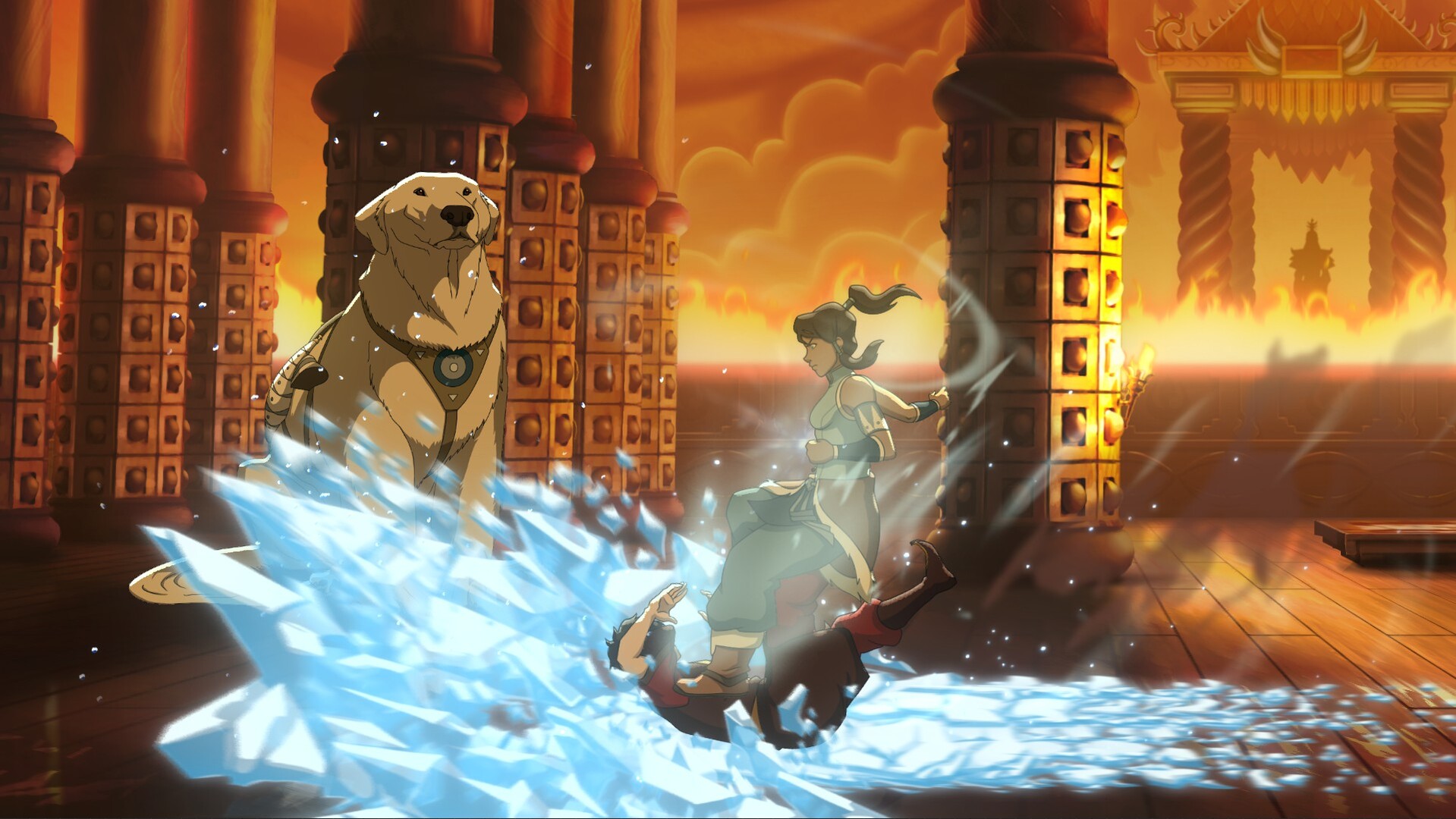
CraftThis is the part nobody will argue with. The team recreated the shows' 2D, hand-drawn look and pushed it into a fighting game with a fidelity that borders on absurd, reportedly animating well over nine hundred frames per character. The result is that a match does not look like a fighting game doing an Avatar impression; it looks like an episode you happen to be controlling. Every bending arc, every stance shift, every follow-through carries the weight and squash-and-stretch of the source animation, and the illusion holds even when the action is moving fast.
The elemental effects are where the craft pays off in play as well as spectacle. Fire reads as heat and pressure, water and ice have a liquid follow-through, earth lands with mass, and air blurs and displaces. Because those effects are legible, you can actually parse a chaotic screen, which is the hidden discipline behind fighting-game art: it has to be beautiful and readable at the same time. The backgrounds pull from recognizable locations across both series, and the whole presentation is soaked in the warm, storybook palette fans will know on sight.
Sound and music do their part without showing off. The voice work and the elemental audio sell every impact, and the score leans into the series' pan-Asian instrumentation rather than defaulting to generic fight-game bombast. It is a presentation that treats the license as something to honor rather than exploit, and it is the single most persuasive argument the game makes for itself.
A beautiful, mechanically sharp fighter that honors its source and nails the netcode, held just short of greatness by a thin roster and some rough launch scaffolding.
Pros & cons
The ledgerIn its favour
- Hand-drawn animation faithfully recreates the shows and looks stunning in motion
- The Flow system gives defense an active, series-appropriate rhythm
- Rollback netcode with full cross-play makes online matches feel clean
- A surprisingly substantial 27-chapter story mode written by a series co-creator
- Technical, readable combat with a higher skill ceiling than it first shows
- A genuinely fair thirty-dollar price for the amount of craft on display
Against it
- Twelve-character roster, with two near-clones, runs thin on variety
- No online training mode, a real pain point for a combo-heavy fighter
- Launch balance skews hard toward a few dominant picks, Toph especially
- Single-player content outside the story and arcade modes is sparse
- Deep matchup variety dries up quickly once you settle on a main
Screens
Official media© PM Studios, Inc.. Official media via Steam.
The player verdict
Real reviews · SteamVerdict
The callAvatar Legends: The Fighting Game is the tie-in that actually did the homework. It plays like a real fighter, not a licensed novelty, with a clever defensive system, gorgeous hand-drawn animation, and the online plumbing to keep a scene alive. That it comes wrapped in a genuinely substantial story mode, at a price that undercuts most of its genre, only sweetens the deal.
The caveats are real and worth weighing honestly. A thin roster, a missing online training mode, and some pronounced launch balance are exactly the sort of gaps that separate a very good fighting game from a great one, and they are the reason the everyday player reception has been cooler than the rave critical scores. Whether they bother you depends on how deep you plan to go: casual fans will be delighted, and the hardcore will bump into the ceiling of what shipped.
If you love the shows, this is comfortably the best game they have ever produced and an easy recommendation. If you love fighting games, it is a smart, good-looking entry that needs a few patches and a bigger roster to reach its full potential. Either way, it clears the low bar for licensed fighters so completely that the comparison stops being useful, which is the highest compliment a game like this can earn.
Sources
Original review by Aymen Sakouhi from the licensed facts above. Score: 8.0/10.